5 citations
,
April 1992 in “Pediatrics in review” This review discusses diagnostic methods for superficial cutaneous fungus infections in children and reports no new clinical results; the authors emphasize affordable, simple testing for confirmation.
 4 citations
,
March 2006 in “Journal of dermatology”
4 citations
,
March 2006 in “Journal of dermatology” This report describes a rare case of Trichophyton violaceum infection with conidia formation in a young boy, likely contracted in Dalian, China, and documents a method for visualizing conidia formation.
3 citations
,
June 2021 in “Case Reports in Infectious Diseases” This case study reports that a 9-year-old Nepalese boy with tinea capitis successfully recovered with systemic antifungal therapy, though experienced focal alopecia without recurrence at a two-year follow-up.
 3 citations
,
September 2020 in “Case reports in dermatological medicine”
3 citations
,
September 2020 in “Case reports in dermatological medicine” This case report described a misdiagnosed kerion in a 10-year-old child initially treated as a bacterial abscess, leading to unnecessary surgery and residual scarring alopecia.
2 citations
,
January 2022 in “Actas Dermo-Sifiliográficas” In this study, researchers found that dermoscopy revealed specific features in Malassezia folliculitis, such as folliculocentricity and perilesional erythema, which can aid in its identification and potentially distinguish it from acne vulgaris.
 2 citations
,
October 2019 in “Current sports medicine reports”
2 citations
,
October 2019 in “Current sports medicine reports” This case report describes a high school wrestler whose forearm rash was initially misdiagnosed as eczema, later identified as Majocchi's granuloma, and successfully treated with oral antifungal therapy after a biopsy.
 2 citations
,
April 2015 in “Dermatology practical & conceptual”
2 citations
,
April 2015 in “Dermatology practical & conceptual” This case report suggests that regular use of antifungal shampoo might obscure clinical indicators of Trichophyton tonsurans tinea capitis in healthy adults, necessitating detailed diagnostic approaches like histopathology and dermoscopy.
 2 citations
,
May 2002 in “Clinics in Dermatology”
2 citations
,
May 2002 in “Clinics in Dermatology” This study found that androgenic alopecia is present in 22% of women with polycystic ovary syndrome and is associated with other clinical signs of hyperandrogenism, but not with increased biochemical hyperandrogenemia or metabolic dysfunction.
2 citations
,
January 2002 in “PubMed” This article discusses dermatophytosis, focusing on the identification and clinical importance of various dermatophyte infections, but it reports no new results; the author emphasizes the value of direct examination for diagnosis.
2 citations
,
January 1981 High temperatures and certain chemicals can significantly change the amino acid content in human hair.
 1 citations
,
October 2022 in “Asian journal of medical sciences”
1 citations
,
October 2022 in “Asian journal of medical sciences” This study found trichoscopy to be a highly sensitive, non-invasive method for diagnosing tinea capitis in children, which could be valuable in resource-limited settings lacking mycological culture facilities.
1 citations
,
June 2021 in “Preprints.org” This study demonstrated that hair relaxers containing common chemicals significantly reduced cell viability and increased apoptosis in human skin cells, suggesting potential toxicity that could be assessed with advanced in vitro technologies rather than animal testing.
1 citations
,
October 2020 in “Cermin Dunia Kedokteran” This study reported complete clinical clearance of tinea capitis in a 3-year-old boy after 8 weeks of treatment with oral griseofulvin and ketoconazole shampoo.
1 citations
,
June 2018 in “Archives of Disease in Childhood Education & Practice” In this case report, an adolescent girl with itchy alopecic patches showed hair regrowth and no new alopecia patches after 6 weeks of treatment, despite initial minimal improvement with oral doxycycline.
 1 citations
,
June 2013 in “Medicine”
1 citations
,
June 2013 in “Medicine” This article reviews how to take a thorough dermatological history, conduct examinations, and discusses diagnostic tools; it reports no new clinical findings.
1 citations
,
May 2002 in “AAP Grand Rounds” This study reported that tinea capitis, though rare in infants under 1 year, should be suspected in those with hair loss or scalp inflammation and can be effectively treated with specific antifungal medications.
1 citations
,
January 2000 in “Indian Journal of Dermatology” This case report documents a middle-aged female with black piedra on her scalp hair, confirmed through potassium hydroxide examination and fungal culture.

In this case study, a 15-year-old obese boy was diagnosed with acanthosis nigricans and hair casts in the axillae, with Wood's lamp and dermoscopic examination revealing specific features, yet fungal infection was ruled out through a negative KOH test.

This study observed that treating human hair with NaOH led to partially removed cuticles, resulting in better fiber cohesion and mechanical properties similar to wool, unlike bleach or formic acid treatments, which weakened the fibers.
January 2026 in “Derecho y cambio social.” This narrative review found that fragrances and isothiazolinone preservatives in deodorants are key contributors to skin sensitization, while magnesium hydroxide shows promise as a less irritating alternative for managing body odor without blocking sweat ducts.
 December 2025 in “Journal of Mycology and Infection”
 In this case report, a 2-month-old girl with tinea capitis showed significant improvement after treatment with oral griseofulvin and topical ketoconazole. The study emphasizes the importance of layered diagnostics and systemic therapy for effective management of this fungal scalp infection in infants.
 September 2024 in “BMJ Case Reports”
 This case report highlights an atypical presentation of favus in an immunocompetent adult, where a psoriasiform plaque over the 'bindi' area was successfully treated with systemic itraconazole, achieving complete resolution without relapse. Simple stains proved essential for diagnosis in this resource-limited setting.
 February 2024 in “Infection and drug resistance”
 This study presented a case of tinea capitis in a 4-year-old without typical symptoms and traced the infection to Microsporum canis carried by domestic cats, highlighting the need for accurate diagnosis and appropriate treatment, especially in households with pets.
 January 2024 in “Medical mycology journal”
 This study reported three cases of tinea corporis caused by Microsporum canis in a household, linked to a domestic cat, where genetic analysis suggested a familial transmission route.
 July 2023 in “International journal of dermatology, venereology and leprosy sciences”
 In this study of 50 rural children with tinea capitis, 64% had the non-inflammatory type, while 28% had the inflammatory type, with most cases showing positive results in KOH examinations.
 December 2022 in “bioRxiv (Cold Spring Harbor Laboratory)”
 This study reported that an injectable hydrogel microparticle vaccine platform enhanced antibody responses and protection against influenza in mice, outperforming the traditional adjuvant aluminum hydroxide.
November 2022 in “International journal of trichology” This study found that glyoxylic acid caused more protein loss in hair compared to traditional alkaline straighteners, though both types of treatments showed comparable effects on hair tensile strength.
 October 2022 in “The Journal of Family Practice”
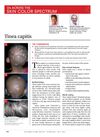
 This article describes cases of tinea capitis in young Black and Latina children, highlighting the condition's diverse presentations such as erythema, scaling, and subtle signs like comma hairs, but reports no new clinical results.
April 2021 in “Cermin Dunia Kedokteran” This report describes two cases of tinea capitis in young siblings, with cultures showing M. canis and Rhodotorulla, and notes improvement after treatment with ketoconazole lotion and shampoo for two months.
December 2020 in “Jurnal RSMH Palembang (Online)” This case report described a 50-year-old male with end-stage renal disease who experienced improvement in his black dot tinea capitis after treatment with griseofulvin and ketoconazole shampoo.