 1 citations
,
November 2020 in “International Journal of Dermatology”
1 citations
,
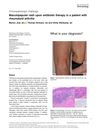
November 2020 in “International Journal of Dermatology” In this case report, the authors suggest that methotrexate-induced rheumatoid papular eruption is a rare side effect of methotrexate, resolved after discontinuation, which may be linked to rheumatic conditions.
10 citations
,
February 2022 in “JEADV Clinical Practice” This study suggests that dermoscopy can help identify and distinguish various rosacea subtypes, improving clinical diagnosis and treatment decisions.
 5 citations
,
December 2005 in “Clinical Techniques in Equine Practice”
5 citations
,
December 2005 in “Clinical Techniques in Equine Practice” This review discusses how skin lesions and haircoat changes in adult horses can indicate systemic diseases, emphasizing the need for veterinary evaluation, and reports no new clinical findings.
 2 citations
,
February 1981 in “Journal of the Royal Society of Medicine”
2 citations
,
February 1981 in “Journal of the Royal Society of Medicine” A three-year-old girl survived a rare serious infection caused by BCG vaccination, which improved after treatment with a leprosy drug.
 May 1991 in “Current problems in dermatology”
 This article reviews the relationship between the skin and the immune system and discusses how skin manifestations can indicate immunodeficiencies but reports no new research findings.
 243 citations
,
September 2016 in “Dermatology and Therapy”
243 citations
,
September 2016 in “Dermatology and Therapy” This article provides an overview of how dermoscopy can aid in the noninvasive diagnosis of various general dermatological disorders, grouped by clinical presentation, but reports no new clinical results.
 January 2026 in “Forum Dermatologicum”
 This study observed that 2.5% of patients with mycosis fungoides or Szary syndrome experienced alopecia, predominantly within skin lesions, with scalp metastases from other cancers also potentially causing hair loss, highlighting the diagnostic value of trichoscopy in differentiating alopecia types.
 January 2023 in “Bio web of conferences/BIO web of conferences”
 This study identified specific dermoscopic features for differentiating rosacea, seborrheic dermatitis, contact dermatitis, and atopic dermatitis, suggesting dermoscope's value in diagnosing facial erythema with atypical presentations.
 8 citations
,
January 2017 in “Fertility and Sterility”
8 citations
,
January 2017 in “Fertility and Sterility” This article reviews the impact of aging and related urologic conditions on male fertility, highlighting the effects of various treatments on sperm parameters and recommending pre-treatment counseling for fertility preservation. It reports no new clinical results.
 March 2026 in “Indian Dermatology Online Journal”
 This study reported that dermoscopy can aid in distinguishing secondary syphilis from other skin conditions by enhancing diagnostic accuracy, though there are no standardized criteria; further research is needed to confirm these findings.
 September 2025 in “Indian Dermatology Online Journal”
 This study explored the use of flower-inspired analogies in dermatology, highlighting how these vivid descriptions aid in diagnosing skin conditions by drawing parallels between clinical features and floral patterns, effectively blending scientific observation with artistic imagery.
August 2025 in “American Journal of Dermatopathology” In this study, researchers presented cases of cellular neurothekeoma in three male family members with early-onset in infancy, suggesting a potential genetic component and inheritance pattern, which deviates from the typical presentation seen mostly in women between 20–30 years.
This abstract compiles a list of medical syndromes and conditions related to tongue abnormalities and other systemic features but reports no new research findings.
23 citations
,
February 2003 in “British Journal of Dermatology” This case study describes a 40-year-old man diagnosed with pilotropic mycosis fungoides, a form of folliculotropic cutaneous T-cell lymphoma, characterized by lymphocytic infiltration of hair follicles and eccrine glands.
 8 citations
,
July 2018 in “European Journal of Dermatology”
8 citations
,
July 2018 in “European Journal of Dermatology” A medication may help with hair growth in psoriasis, and a skin condition might be linked to a specific bacteria.
5 citations
,
March 2013 in “Journal of Cutaneous Pathology” Granulomatous alopecia may be a distinct subtype of alopecia areata.
2 citations
,
May 2020 in “JAAD case reports” This review discusses the potential role of JAK inhibitors, like ruxolitinib, as emerging therapeutic agents in dermatology, but reports no new clinical results.
1 citations
,
March 2023 in “Medicine” This case report details a patient with Satoyoshi syndrome presenting with uveitis and impending central retinal vein occlusion, a previously undocumented complication, suggesting uveitis as a potential complication of the syndrome.
1 citations
,
January 2016 in “Australasian Journal of Dermatology” This case study describes a 54-year-old man with an E600A mutation in the NOD-2 gene associated with Blau syndrome, who presented with skin involvement, differing from typical cases, and initially responded to colchicine treatment.
June 2026 in “Indian Dermatology Online Journal” This study observed a rare case of alopecia areata with granulomatous inflammation, successfully treated with intralesional triamcinolone, leading to complete hair regrowth within two months, highlighting the need for careful diagnosis to distinguish it from other granulomatous alopecias.
June 2025 in “American Journal of Dermatopathology” This case report describes a rare instance of sarcoidal granulomatous alopecia areata in a 42-year-old man, with histopathological findings suggesting inflammation but ruling out causes like tuberculosis and syphilis, resulting in treatment with tofacitinib.
 July 2024 in “Romanian Journal of Veterinary Sciences”
 This study found that cyclosporine treatment led to clinical improvements in dogs with sebaceous adenitis, with noticeable benefits within four months and more substantial outcomes after 12 months of continuous therapy.
 November 2023 in “The Bovine practitioner”
 In this study, a 5-year-old Angus bull experienced systemic granulomatous disease and vasculitis potentially associated with grazing on hairy vetch, but other bulls in the same pasture showed no symptoms, suggesting variability in disease manifestation from similar exposures.
 June 2023 in “British journal of dermatology/British journal of dermatology, Supplement”
 This case report identified a distinct pattern of scarring alopecia with folliculocentric noncaseating granulomas, linked with granulomatous dermatitis in the breast, as a potential cutaneous manifestation of rheumatoid arthritis.
 June 2023 in “British journal of dermatology/British journal of dermatology, Supplement”
 In this report, a 46-year-old woman's sudden diffuse hair loss was diagnosed as granulomatous alopecia areata, with spontaneous hair regrowth observed after two months. This case highlights that granulomatous inflammation should not exclude the diagnosis of alopecia areata, emphasizing the importance of clinicopathological correlation.
January 2022 in “JAAD case reports” This article describes two new cases of granulomatous alopecia areata, a rare variant with few previously reported instances.
October 2015 in “The American Journal of Gastroenterology” This case report observed a unique presentation of microscopic colitis with granulomatous inflammation in a patient whose symptoms resolved with budesonide treatment, suggesting a possible drug reaction, potentially linked to allopurinol.
December 2009 in “Journal of Veterinary Clinics” The authors diagnosed a 5-year-old Pekinese dog with keratoacanthoma with granulomatous inflammation, and the mass did not recur 5 months after surgical removal.
14 citations
,
January 2019 in “Annals of plastic surgery” This case report details a face and scalp transplant in a patient with granulomatosis with polyangiitis and trauma, showing an encouraging 3-year outcome without disease relapse or severe complications.
August 1978 in “Archives of Dermatology” This case report details a rare instance of granulomatosis disciformis chronica et progressiva affecting both skin and lymph node tissue in a 31-year-old man.