February 2026 in “International Journal of Clinical Dermatology” This review found that microbiota-targeted interventions, particularly certain strains of probiotics, are associated with improvements in skin conditions, most notably in pediatric atopic dermatitis, but their efficacy varies across other dermatological diseases.
1 citations
,
January 2023 in “PubMed” January 2012 in “Chemical immunology/Fortschritte der Allergielehre/Progress in allergy/Chemical immunology and allergy” This abstract lists numerous topics and classifications related to drug-induced dermatological conditions and treatments but does not convey new research findings.
 304 citations
,
July 2006 in “Journal of The American Academy of Dermatology”
304 citations
,
July 2006 in “Journal of The American Academy of Dermatology” This study found that videodermoscopy enhances diagnostic accuracy for scalp and hair disorders beyond simple clinical inspection and reveals novel disease features that could improve clinical understanding.
2 citations
,
October 1931 in “Archives of Dermatology and Syphilology” This report describes a rare case of scalp kerion due to microsporosis in a Portuguese child, noting the unusual combination with other microsporid features and treatment details.
 23 citations
,
November 2001 in “Archives of Dermatology”
23 citations
,
November 2001 in “Archives of Dermatology” This review discusses recent advances in the genetic understanding of inherited hair and nail disorders and reports no new clinical results.
 April 2024 in “Oral Surgery Oral Medicine Oral Pathology and Oral Radiology”
 In this case report, the patient was diagnosed with oral lichen sclerosus following a detailed clinical and histological examination and referral to dermatology, and it underscores the importance of interdisciplinary collaboration in managing this rare condition and its associated risks.
87 citations
,
July 2009 in “Journal of Cell Science” The researchers found that corneodesmosin is crucial for maintaining skin barrier integrity and hair follicle architecture in mice, with its deletion leading to severe skin and hair abnormalities.
 1 citations
,
November 2017 in “EMJ Dermatology”
1 citations
,
November 2017 in “EMJ Dermatology” This review discusses the relationship between stress and skin disorders, highlighting psychodermatoses and recommending mind-body techniques and collaborative care involving dermatology, psychiatry, and psychology, without reporting new clinical results.
17 citations
,
July 2013 in “Amino Acids” This study found that elevated epidermal ODC activity in transgenic mice promotes skin tumor development by recruiting bulge stem cells, rather than through reactive oxygen species generation by polyamine catabolic oxidases.
June 2025 in “Journal of Face Aesthetics” In this review designed for continuing education, the authors highlight the importance for clinicians to differentiate facial disorders clinically, as some can be life-threatening, and critically assess laboratory methods for diagnosing pemphigus diseases.
March 2026 in “Institutional Repositories DataBase (IRDB)” This study observed an association between intense itching in anterior chest keloids and an increased density of nerve fibers in the epidermis, alongside elevated expression of the pruritus mediator substance P, though no difference was found in Langerhans cells related to pruritus, location, or region.
 February 2026 in “Indian Journal of Dermatology”
 This study from a dermatology department found that patch test positivity for allergic contact dermatitis is lower in geriatric patients than in adults, likely due to age-related immune changes and reduced allergen exposure.
 February 2024 in “Bőrgyógyászati és venerológiai szemle”
 This review presents possible classifications of psychological disorders that significantly impact dermatology, along with their clinical characteristics and comorbidities, highlighting lesions as potential warning signs based on DSM-5 and ICD-10 codes.
 2 citations
,
April 2021 in “Naukovì gorizonti”
2 citations
,
April 2021 in “Naukovì gorizonti” In this study, researchers observed that using a combination of medications, including Bravecto, Cefuroxime, Orungal, Apoquel, and Derinat, effectively treated pododermatitis in dogs, increasing therapy success from 28.6% to 66.7%, and reducing treatment duration while extending remission periods.
 9 citations
,
September 2015 in “Medical Clinics of North America”
9 citations
,
September 2015 in “Medical Clinics of North America” This article reviews common dermatologic procedures, focusing on skin biopsy techniques, with no new clinical results reported.
June 2005 in “Journal of Investigative Dermatology” A bull with a gene mutation was asymptomatic, synthetic retinoids cause hair loss, and new therapeutic targets were identified for skin diseases.
June 2019 in “PRISM (University of Calgary)” This research reported that dermal progenitor cells can enhance split-thickness skin graft outcomes by improving dermal layer qualities and reducing itch and offer potential in skin wound healing using a flowable hydrogel for better cell delivery and survival.
 5 citations
,
February 2015 in “New England journal of medicine/The New England journal of medicine”
5 citations
,
February 2015 in “New England journal of medicine/The New England journal of medicine” This diagnostic case study describes a 25-year-old man with oral ulcers, body rash, and erythematous nodules.
 December 2024 in “Indian Dermatology Online Journal”
 This study presents a compilation of dermatological disorders that are descriptively compared to the "Navaratnas," or nine planetary gems from Vedic astrology, highlighting unique diagnostic terms and their clinical presentations to make dermatology more accessible and memorable for practitioners and patients.
27 citations
,
January 2016 in “Indian Dermatology Online Journal” This article discusses the advantages and different techniques of dermoscopy for skin lesion visualization and reviewing no new clinical results; it emphasizes the integration of polarized light and the importance of training.
36 citations
,
May 2020 in “Journal of the European Academy of Dermatology and Venereology” Dermatologists should watch for skin symptoms in COVID-19 patients, prioritize urgent cases, and use telemedicine.
73 citations
,
August 2019 in “Cell Proliferation” This review explores the interactions between the skin, peripheral nervous system, and immune system and reports no new results; the authors highlight the importance of understanding these connections for various skin conditions.
 1 citations
,
June 2013 in “Medicine”
1 citations
,
June 2013 in “Medicine” This article reviews how to take a thorough dermatological history, conduct examinations, and discusses diagnostic tools; it reports no new clinical findings.
 August 2007 in “Journal of Investigative Dermatology”
 This review covers presentations from the 68th Annual Meeting of the Society of Investigative Dermatology and highlights research advances in dermatology, but reports no new clinical results.
 3 citations
,
May 2010 in “Archives of dermatology”
3 citations
,
May 2010 in “Archives of dermatology” This excerpt discusses website navigation and access details for JAMA Dermatology and reports no new research findings.
This chapter reviews various fungal zoonoses, including dermatophytoses and trichophytosis, and reports no new empirical findings.
38 citations
,
June 2005 in “International Journal of Dermatology” This case report describes a 28-year-old man with widespread pigmented basal cell carcinomas and recurrent infections that were challenging to control, associated with nevus comedonicus and a rudimentary toe.
 2 citations
,
December 2011 in “Annales de Dermatologie et de Vénéréologie”
2 citations
,
December 2011 in “Annales de Dermatologie et de Vénéréologie” 2011 dermatological research found new skin aging markers, hair loss causes, skin defense mechanisms, and potential for new treatments.
 January 2013 in “Journal of dermatology”
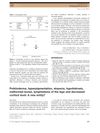
 This letter to the editor raises the possibility of a new medical entity characterized by symptoms such as poikiloderma, hyperpigmentation, alopecia, malformed bones, lymphedema, and decreased cortisol, but provides no clinical results.