August 2019 in “Anais Brasileiros de Dermatologia” This article reviews the case of a patient diagnosed with basal cell nevus syndrome and reports no new research findings.
 4 citations
,
May 2021 in “The American Journal of Surgical Pathology”
4 citations
,
May 2021 in “The American Journal of Surgical Pathology” This study suggests that cutaneous lymphadenoma is a distinct benign lymphoepithelial tumor characterized by androgen receptor expression, hair follicle stem cell markers, and common EGFR gene mutations.
2 citations
,
December 2018 This study found that dermatoscopy can quickly and non-invasively detect facial vellus hair involvement in patients with alopecia frontal fibrosante, occurring frequently and associated with specific facial lesions.
 33 citations
,
August 2013 in “British Journal of Dermatology”
33 citations
,
August 2013 in “British Journal of Dermatology” Lack of small, fine hair on the front hairline is a key sign of frontal fibrosing alopecia.
 January 2018 in “Our Dermatology Online”
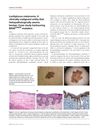
 This case report describes a carpenter who presented with contact dermatitis and trichopathy with whitish nodules in the axillary hair.
 1 citations
,
March 2015 in “Journal of the European Academy of Dermatology and Venereology”
1 citations
,
March 2015 in “Journal of the European Academy of Dermatology and Venereology” This letter to the editor shares a case study of lentiginous melanoma that appears clinically malignant but histopathologically benign, involving the BRAFV600R mutation.
January 2007 in “Linchuang pifuke zazhi” A case study reported a 15-year-old boy with a diagnosis of giant folliculosebaceous cystic hamartoma on his right buttock, characterized by malformed hair follicles and sclerotized collagen.
 9 citations
,
January 2015 in “Current problems in dermatology”
9 citations
,
January 2015 in “Current problems in dermatology” This review discusses partial longitudinal-follicular unit transplantation (PL-FUT) for hair loss and notes its potential to multiply hair follicles while preserving donor areas, but reports no new clinical results.
 January 2024 in “Diagnostic cytopathology”
 In this case report, the authors observed that understanding the cytological features of trichilemmal carcinoma is crucial for accurate FNAC diagnosis of its metastases in head and neck regions.
April 2012 in “The FASEB Journal” In this study, researchers observed that knocking down the LPA 4 receptor in zebrafish embryos led to vascular and lymph vessel development abnormalities, including edema and decreased heartbeats.
8 citations
,
January 2013 in “International journal of trichology” This report details two cases of alopecia areata with unusual annular and circinate patterns, highlighting atypical morphology of the condition.
58 citations
,
November 1969 in “British Journal of Dermatology” This report describes two patients with ichthyosis linearis circumflexa exhibiting symptoms resembling Netherton's disease, noting multiple hair shaft defects and discussing a possible connection to aminoaciduria.
1 citations
,
April 2025 in “SABRAO Journal of Breeding and Genetics” Infected shallots have more diverse metabolites, with certain compounds indicating resistance to Fusarium disease.
 3 citations
,
September 2006 in “Hair transplant forum international”
3 citations
,
September 2006 in “Hair transplant forum international” This paper reflects on the challenges and progress in hair restoration, highlighting ongoing efforts for improvement but providing no new empirical findings.
August 1994 in “Journal of Dermatological Science”  28 citations
,
November 2008 in “Facial Plastic Surgery”
28 citations
,
November 2008 in “Facial Plastic Surgery” This article reviews the development of follicular unit transplantation for hair replacement, highlighting its ability to provide natural-looking results with minimal recovery time, but results depend heavily on the skill and planning of the practitioner.
July 2024 in “Journal of Investigative Dermatology” Cell movements and forces shape feather growth in chicken skin.
December 2001 in “中華皮膚科醫學雜誌” This case report describes a rare instance of sebaceous trichofolliculoma identified in an 18-year-old boy, characterized by a dermal nodule on the nasal bridge with distinct histological features.
 5 citations
,
March 2009 in “Pediatric Dermatology”
5 citations
,
March 2009 in “Pediatric Dermatology” The study found that pili bifurcati causes hair to intermittently split into two branches, each with its own outer layer.
 34 citations
,
December 1995 in “Pediatric Dermatology”
34 citations
,
December 1995 in “Pediatric Dermatology” In this study, researchers reported a 0.11% occurrence of congenital triangular alopecia, recommending surgical treatment for women but not for men due to later potential development of androgenic alopecia.
 January 2025 in “Nature Communications”
 Using synchrotron X-ray imaging, this study mapped the complex innervation of male rat vibrissa follicles, revealing distinct types of myelinated afferent neurons and patterns of axonal organization that may inform sensory processing in the brainstem.
29 citations
,
July 2003 in “Experimental Dermatology” This study found that in anagen hair follicles, the basement membrane zone components showed decreased expression in the lower hair bulb, with a complete absence of BP230 at the dermal papilla junction, suggesting an incomplete hemidesmosome structure in these regions.
December 2025 in “Journal of Surgery Research and Practice” This study presented a method for female hairline transplantation that connects the Diverting Point and Part Line to recreate a natural hair flow, enhancing aesthetic outcomes by providing a more natural and feminine hairline.
 January 2014 in “Plastic Surgery”
 In this study, the authors describe a new technique using the Ventralex hernia patch for simultaneous umbilical hernia repair during abdominoplasty, observing its application in 11 female patients.
10 citations
,
November 2007 in “Annals of Diagnostic Pathology” This report presents a case of a superficial angiomyxoma with a trichofolliculoma in a 51-year-old man, characterized by myxomatous nodules and specific immunohistological markers.
 15 citations
,
May 2003 in “The Laryngoscope”
15 citations
,
May 2003 in “The Laryngoscope” In this study, researchers observed that spiral ganglion neurites created more branched networks near FGF-1-coupled beads compared to control beads, highlighting FGF-1's role in hair cell innervation development.
294 citations
,
February 2011 in “Cell” Nephronectin helps attach muscle cells to hair follicles.
 6 citations
,
February 2016 in “American Journal of Dermatopathology”
6 citations
,
February 2016 in “American Journal of Dermatopathology” This case study reports on an 11-year-old boy with woolly hair nevus, featuring twisted hair shafts and an abnormal hair cuticle, alongside epidermal nevi on his face and back.
May 2017 in “The journal of immunology/The Journal of immunology” This study reported that patients with specific Foxn1 mutations exhibited severe T-cell lymphopenia without the hair and nail abnormalities usually associated with these mutations.
 9 citations
,
September 2016 in “Plastic and reconstructive surgery. Global open”
9 citations
,
September 2016 in “Plastic and reconstructive surgery. Global open” In this study, a curved nonrotary punch was found to achieve the lowest follicular unit transection rates of less than 5% compared to conventional rotary punches in hair transplantation for patients with tightly curled Afro-textured hair.