 16 citations
,
February 2019 in “Pediatric Blood & Cancer”
16 citations
,
February 2019 in “Pediatric Blood & Cancer” In this study, 96% of children with CNS tumors receiving MAPK and mTOR inhibitors experienced common, treatable skin reactions, occasionally requiring therapy adjustments.
 30 citations
,
June 2008 in “Dermatologic Surgery”
30 citations
,
June 2008 in “Dermatologic Surgery” In this study, the SAFE System for follicular unit extraction demonstrated a favorable average follicle transection rate of 6.14% and is accessible for physicians with basic technical skills, showing promise for wider adoption.
4 citations
,
July 1979 in “Journal of the American Academy of Dermatology” This study describes "alarm reaction" histologic changes in pilosebaceous structures, including regression of hair matrix and alterations in sebaceous glands, affecting follicular and sebaceous gland morphology.
 32 citations
,
September 2015 in “Dermatology”
32 citations
,
September 2015 in “Dermatology” This study describes a newly recognized skin reaction associated with dasatinib, nilotinib, and ponatinib, marked by a lichenoid exanthem with severe pruritus that may necessitate discontinuation of therapy.
 25 citations
,
November 2013 in “Journal of the American Academy of Dermatology”
25 citations
,
November 2013 in “Journal of the American Academy of Dermatology” This study observed that 71% of chronic myeloid leukemia patients treated with second-generation tyrosine kinase inhibitors experienced adverse cutaneous reactions, which were generally less severe than those caused by imatinib.
19 citations
,
March 2016 in “British journal of dermatology/British journal of dermatology, Supplement” In this study, evidence that trichodysplasia spinulosa-associated polyomavirus targets follicular keratinocytes was observed in a pediatric case, suggesting these cells as the primary viral target.
13 citations
,
June 2008 in “International Journal of Dermatology” This case study reports a unique and severe papulopustular eruption, likely induced by sorafenib treatment in a patient with metastatic renal cancer, which manifested as hyperkeratotic spicules and improved with cessation of the drug.
14 citations
,
August 2017 in “International Journal of Immunopathology and Pharmacology” This case report describes a patient with painful skin lesions during sorafenib treatment whose symptoms improved after receiving photodynamic therapy, suggesting it might help manage similar refractory skin toxicity cases.
May 2025 in “International Journal of Trichology” This study highlights two cases of Mudichood dermatosis in Pune, Maharashtra, suggesting the condition may occur outside its typical geographic range due to hair management practices causing friction.
 36 citations
,
January 2012 in “International Journal of Trichology”
36 citations
,
January 2012 in “International Journal of Trichology” This review discusses madarosis, its diverse causes, and suggests follicular unit transplantation as a useful treatment for scarring types, but reports no new clinical results.
 26 citations
,
June 2018 in “Australasian Journal of Dermatology”
26 citations
,
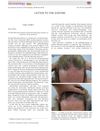
June 2018 in “Australasian Journal of Dermatology” Stopping sunscreen use on the forehead led to hair regrowth in a woman with frontal fibrosing alopecia.
 15 citations
,
December 2017 in “Journal of The European Academy of Dermatology and Venereology”
15 citations
,
December 2017 in “Journal of The European Academy of Dermatology and Venereology” This letter discusses potential pathogenetic links among frontal fibrosing alopecia, androgenetic alopecia, and fibrosing alopecia in a pattern distribution and reports no new clinical findings.
 11 citations
,
July 2008 in “Facial Plastic Surgery Clinics of North America”
11 citations
,
July 2008 in “Facial Plastic Surgery Clinics of North America” This article discusses the benefits of follicular unit transplantation for male hair restoration, highlighting its ability to achieve natural-looking results with minimal recovery time and low risk of complications, and reports no new clinical results.
7 citations
,
October 2013 in “International Journal of Dermatology” This study found that folliculitis after waxing is more common on the proximal extremities, with one-third of cases involving a foreign body reaction resembling pseudofolliculitis.
 6 citations
,
November 1999 in “Mycoses”
6 citations
,
November 1999 in “Mycoses” This case study of a 75-year-old Japanese man with kerion Celsi found that terbinafine treatment was effective and safe, achieving a cure with minimal side effects.
 February 2026 in “Journal of Craniofacial Surgery Open”
 This narrative review outlines the biological costs of hair extensions, such as traction leading to hair loss and scalp issues, and suggests a prevention-focused model involving risk assessment, surveillance, and tiered therapies to minimize alopecia risk and maintain scalp health.
March 2026 in “Anais Brasileiros de Dermatologia” Lichen planopilaris and frontal fibrosing alopecia are likely distinct diseases with different tissue involvement.
 1 citations
,
November 2017 in “Skin appendage disorders”
1 citations
,
November 2017 in “Skin appendage disorders” Ingrown hairs are a common feature in scarring alopecias due to follicular damage.
 1 citations
,
January 2006 in “Elsevier eBooks”
1 citations
,
January 2006 in “Elsevier eBooks” The conclusion is that different types of hair loss in dogs and cats can be cosmetic or serious, and affected animals should not be bred.
 17 citations
,
January 2015 in “International Journal of Trichology”
17 citations
,
January 2015 in “International Journal of Trichology” This case report suggests that frontal fibrosing alopecia with nail involvement may be associated with lichen planus and improved with oral dutasteride due to an inflammatory reaction related to androgenetic alopecia.
This article discusses folliculitis decalvans as a cicatricial alopecia caused by a neutrophilic immune reaction to microbial biofilms, but it reports no new clinical results.
 March 2023 in “Journal of Cosmetic Dermatology”
 This case report illustrates that fibrosing alopecia in a pattern distribution may be misdiagnosed as androgenetic alopecia due to similar hair loss patterns, but distinctive trichoscopic and histopathologic features help differentiate it.
 April 2012 in “Informa Healthcare eBooks”
 Lichen planopilaris is a rare, chronic condition causing hair loss, mainly in middle-aged women, and early treatment is important to prevent permanent baldness.
 27 citations
,
January 2006 in “Dermatologic Surgery”
27 citations
,
January 2006 in “Dermatologic Surgery” This study found that the SAFE System may improve follicular unit extraction by reducing follicle transection rates and broadening patient eligibility, with only minor adverse reactions reported.
15 citations
,
July 1993 in “The journal of investigative dermatology/Journal of investigative dermatology” In a C3H mouse model, this study found that topical retinoids can significantly alter hair-cycle dynamics by prolonging the anagen phase and shortening the telogen phase, a reaction connected to increased cellular retinoic acid-binding protein levels.
July 2019 in “Zenodo (CERN European Organization for Nuclear Research)” This case report highlights a rare instance of follicular mucinosis in a 15-year-old male, emphasizing its self-limiting, benign course but noting the need for long-term monitoring due to potential association with mycosis fungoides.
December 2023 in “Journal of clinical medicine” This study reports the case of an elderly patient with a keratosis pilaris-like skin eruption after beginning treatment with imatinib for chronic myeloid leukemia, discussing similar skin reactions to BCR-ABL inhibitors and exploring potential mechanisms behind these adverse cutaneous reactions.
 February 2026 in “SHILAP Revista de lepidopterología”
 This study demonstrated that engineered exosomes loaded with growth factors, EGF and FGF, could successfully repair the hair follicle microenvironment in an androgenetic alopecia mouse model, enhancing hair growth without causing adverse immune reactions or toxicity.
 17 citations
,
May 1987 in “Clinical and Experimental Dermatology”
17 citations
,
May 1987 in “Clinical and Experimental Dermatology” This study reports a new association of follicular mucinosis occurring in a patient with Sézary syndrome.
5 citations
,
January 1999 in “Journal of dermatological treatment” This study found that while Bioré pore strips effectively removed microcomedones and trichostatic bundles on the nose without causing irritation, they were less effective than cyanoacrylate extraction.