18 citations
,
January 2018 in “Advances in experimental medicine and biology” This review discusses the evolutionary history of keratins and reports no new results, highlighting key events that contributed to the development of mammalian hair and integument.
1 citations
,
September 2015 In this report, two cases of non-small cell lung cancer treated with gefitinib showed unexpected hair growth, suggesting a potential new application of EGFR-TKIs for alopecia.
 195 citations
,
June 2005 in “American Journal of Human Genetics”
195 citations
,
June 2005 in “American Journal of Human Genetics” Genetic variation in the androgen receptor gene mainly causes early-onset hair loss, with maternal inheritance playing a key role.
3 citations
,
April 2025 in “Science Advances” This study found that mice with a homozygous knockout of the Ten1 gene, developed through CRISPR-Cas9-mediated exon 3 deletion, exhibited telomere shortening and symptoms consistent with accelerated aging, such as reduced lifespan, skin changes, aplastic anemia, and cerebellar hypoplasia.
April 2026 in “Human Genome Variation” This study identified a specific hemizygous intronic variant in the MBTPS2 gene associated with IFAP syndrome in a patient, revealing exon skipping and reduced normal transcript expression through long-read RNA sequencing.
 28 citations
,
August 2014 in “Journal of Assisted Reproduction and Genetics”
28 citations
,
August 2014 in “Journal of Assisted Reproduction and Genetics” This study found that the VEGF +405G/C polymorphism may be an inheritable risk factor for polycystic ovary syndrome in south Indian women.
 74 citations
,
January 2006 in “The journal of investigative dermatology/Journal of investigative dermatology”
74 citations
,
January 2006 in “The journal of investigative dermatology/Journal of investigative dermatology” This study identified novel compound heterozygous mutations in the DSG4 gene in a Japanese patient with congenital hypotrichosis, suggesting overlap between localized autosomal recessive hypotrichosis and monilethrix.
 40 citations
,
January 2013 in “Frontiers in Endocrinology”
40 citations
,
January 2013 in “Frontiers in Endocrinology” Finger length ratios are not linked to the number of specific gene repeats affecting testosterone sensitivity.
 28 citations
,
October 2004 in “Differentiation”
28 citations
,
October 2004 in “Differentiation” This study identified a large deletion in the desmoglein 4 gene as the genetic basis of the Iffa Credo "hairless" rat's skin phenotype, linking it to lanceolate hair mutations.
 2 citations
,
July 2011 in “AFRICAN JOURNAL OF BIOTECHNOLOGY”
2 citations
,
July 2011 in “AFRICAN JOURNAL OF BIOTECHNOLOGY” This study identified genetic variations in the DSG4 gene among sheep, revealing valuable markers for assessing their impact on wool traits.
 January 2013 in “International Journal of Trichology”
 This case report highlights the discovery of a novel TRPS1 gene mutation in a 17-year-old with TRPS type I, underscoring the diagnostic importance of hair symptoms in congenital hair diseases.
 19 citations
,
March 2017 in “Scientific Reports”
19 citations
,
March 2017 in “Scientific Reports” This study suggests that the protease HAT-L4 plays a significant role in maintaining epidermal barrier function to prevent body fluid loss, as its absence in mice led to increased fluid loss and higher mortality.
 93 citations
,
April 2003 in “Proceedings of the National Academy of Sciences of the United States of America”
93 citations
,
April 2003 in “Proceedings of the National Academy of Sciences of the United States of America” This study identified an unexpected critical role for the FATP4 protein in skin and hair development in mice, linking it to a potential candidate gene for restrictive dermopathy in humans.
 54 citations
,
April 2010 in “Baillière's best practice and research in clinical endocrinology and metabolism/Baillière's best practice & research. Clinical endocrinology & metabolism”
54 citations
,
April 2010 in “Baillière's best practice and research in clinical endocrinology and metabolism/Baillière's best practice & research. Clinical endocrinology & metabolism” This review discusses 46,XY disorders of sex development caused by defects in androgen production and highlights the need for long-term care from experienced multidisciplinary teams, but it reports no new clinical findings.
 27 citations
,
June 2005 in “The journal of investigative dermatology/Journal of investigative dermatology”
27 citations
,
June 2005 in “The journal of investigative dermatology/Journal of investigative dermatology” This study identified numerous size polymorphisms in the human ultrahigh sulfur KAP4 genes due to intragenic sequence variations, suggesting these polymorphisms may have arisen through deletions and duplications during evolution.
 18 citations
,
March 2015 in “Journal of Endocrinological Investigation”
18 citations
,
March 2015 in “Journal of Endocrinological Investigation” This study found that ZP4 expression was highest among PCOS patients with regular menstrual cycles, which may be linked to mature follicle presence, but no correlation with clinical indices was observed.
 1 citations
,
November 2015 in “Indian Journal of Clinical Biochemistry”
1 citations
,
November 2015 in “Indian Journal of Clinical Biochemistry” The conference presented findings on how vitamin D levels, genetic factors, and lifestyle choices like smoking and yoga affect various health conditions and diseases.
 October 2017 in “The Indian Journal of Animal Sciences”
 This study found that prolactin gene polymorphism in Changthangi goats showed no significant association with Cashmere quality traits, indicating the need for further research with larger sample sizes.
 1 citations
,
June 2022 in “JCRPE”
1 citations
,
June 2022 in “JCRPE” This study reports that metreleptin treatment in a boy with congenital generalized lipodystrophy significantly improved metabolic complications and overall health outcomes during the first year of therapy.
 March 2021 in “bioRxiv (Cold Spring Harbor Laboratory)”
 This study found that the absence of Hif-p4h-2 in specific mouse skin cells disrupted hair follicle development, leading to hair loss due to irregular keratin formation and pathway signaling.
 May 2015 in “Endocrinología y nutrición”
 This study described four adult male cases of Kennedy disease with typical neurological symptoms and noted gynecomastia as the most frequent endocrinological manifestation, accompanied by an abnormal expansion in the androgen receptor gene.
 December 2013 in “Appetite”
 This study identified a nonfunctional Itpr3 gene in BTBR mice, attributed to a 12-bp deletion, which likely causes their simultaneous hair loss and taste perception deficits.
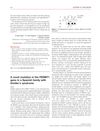 8 citations
,
December 2009 in “Journal of The European Academy of Dermatology and Venereology”
8 citations
,
December 2009 in “Journal of The European Academy of Dermatology and Venereology” This article discusses a novel mutation in the FERMT1 gene identified in a Spanish family with Kindler’s syndrome but reports no new clinical results.
 5 citations
,
September 2013 in “The Journal of Dermatology”
5 citations
,
September 2013 in “The Journal of Dermatology” Researchers found a new mutation in the HR gene causing hair loss and skin bumps in a Pakistani family.
 1 citations
,
September 2019 in “Journal of Investigative Dermatology”
1 citations
,
September 2019 in “Journal of Investigative Dermatology” In this study, researchers used a CRISPR-based method to correct mutations in the COL7A1 gene in stem cells from RDEB patients, restoring normal collagen expression in engineered skin grafts in mice.
 August 2020 in “Pakistan Journal of Zoology”
 This study identified a novel genetic mutation, c.429delC in the hairless gene, associated with atrichia with papular lesions in two Pakistani families.
August 2025 in “American Journal of Case Reports” In this case report, researchers describe a 13-year-old phenotypic female with 46,XY karyotype, previously misdiagnosed with androgen insensitivity syndrome, who was later identified to have 17-beta-hydroxysteroid dehydrogenase type 3 deficiency, underscoring the importance of genetic and hormonal tests for accurate diagnosis of sex development disorders.
 125 citations
,
September 2019 in “Journal of Clinical Immunology”
125 citations
,
September 2019 in “Journal of Clinical Immunology” This review summarizes recent advances in Treg cell biology, focusing on Foxp3's role in immune regulation and therapeutic reprogramming for immune dysregulatory disorders, but reports no new clinical results.
81 citations
,
March 2006 in “Journal of Investigative Dermatology” Mutations in the DSG4 gene cause specific hair and scalp issues.
44 citations
,
August 2004 in “Journal of Investigative Dermatology” A gene deletion in DSG4 causes sparse hair in some Pakistani families.