11 citations
,
September 2021 in “American Journal of Medical Genetics Part A” This study reports that newly diagnosed patients with Bachmann-Bupp syndrome exhibit a broader phenotype than previously documented, including late-onset seizures, and suggests a possible universal biochemical mechanism involving elevated ODC activity.
This study found that the survival and proliferation of mouse melanocytes expressing the GNAQQ209L oncogene were impaired by interactions with the epidermal microenvironment, suggesting a possible mechanism for the rarity of these mutations in epidermal melanomas.
 9 citations
,
February 2018 in “The Journal of Dermatology”
9 citations
,
February 2018 in “The Journal of Dermatology” This study identified a novel splice site mutation in the LIPH gene associated with autosomal recessive woolly hair, contributing to understanding the genetic basis of this condition.
 16 citations
,
February 2018 in “BMC Genomics”
16 citations
,
February 2018 in “BMC Genomics” This paper reviews genome-based personalized medicine developments using Web services for analyzing SNPs in reproductive potential but reports no new clinical findings.
 1 citations
,
August 2018 in “bioRxiv (Cold Spring Harbor Laboratory)”
1 citations
,
August 2018 in “bioRxiv (Cold Spring Harbor Laboratory)” This study reports that a novel gain-of-function mutation in TMEM173, combined with polymorphisms in TMEM173 and IFIH1, results in a distinct clinical phenotype with features of SAVI, including alopecia and photosensitivity.
449 citations
,
December 2005 in “The Plant Cell” This study found that the BIK1 gene in Arabidopsis thaliana modulates defense responses to pathogens and is essential for normal root growth and development.
 2 citations
,
January 2008 in “International Journal of Neuroscience”
2 citations
,
January 2008 in “International Journal of Neuroscience” This article presents a case of delayed diagnosis of Kearns-Sayre syndrome in a 38-year-old man and reviews clinical and laboratory findings associated with the disorder, reporting no new results.
December 2012 in “Expert review of dermatology” This review summarizes current knowledge about Birt–Hogg–Dubé syndrome, discussing recent findings on its pathogenesis and treatment, but reports no new clinical results; the authors emphasize understanding its cutaneous manifestations.
1 citations
,
October 2023 in “European Journal of Dermatology” This study found that combining hair transplantation with platelet-rich plasma led to significantly better outcomes, such as reduced hair loss area and increased hair regeneration, compared to hair transplantation alone in patients with androgenic alopecia.
 47 citations
,
April 2000 in “The American journal of pathology”
47 citations
,
April 2000 in “The American journal of pathology” This study found that overexpressing human Bcl-2 in mice protected epidermal keratinocytes from UVB-induced apoptosis but unexpectedly increased apoptosis during hair follicle regression and chemotherapy.
 June 2026 in “Strathprints: The University of Strathclyde institutional repository (University of Strathclyde)”
 In this study, researchers found that inhibiting IKKα in patient-derived CCS tumour models reduces tumour viability, supporting the potential for topical IKKα inhibitors as a treatment for CCS.
48 citations
,
November 2002 in “Journal of biological chemistry/The Journal of biological chemistry” In this study, researchers found that size polymorphisms in certain hKAP1 genes are linked to the hKAP1.1B and hKAP1.3 genes, arising from intragenic deletions and duplications in Japanese and Caucasian populations.
 72 citations
,
November 2012 in “PloS one”
72 citations
,
November 2012 in “PloS one” This study found that dysregulation of the folliculin-p0071 interaction may lead to changes in cell adhesion and signaling, contributing to conditions like emphysema and renal cell carcinoma.
32 citations
,
November 2020 in “UNC Libraries” This study identified a mutation in the steroid-binding domain of the androgen receptor gene associated with complete androgen insensitivity syndrome, impairing male sexual development due to altered androgen receptor protein function.
 39 citations
,
January 2019 in “Cells”
39 citations
,
January 2019 in “Cells” This review discusses the molecular mechanisms of Hutchinson-Gilford progeria syndrome and evaluates current research trends, available mouse models, and prospects for developing therapies, but reports no new clinical findings.

This study found that CYP21A2 gene mutations are the most common cause of non-classic congenital adrenal hyperplasia, while CYP11B1 mutations are rare and may partially impair enzyme activity.
 July 2022 in “The journal of investigative dermatology/Journal of investigative dermatology”
 This case study reports that a 26-year-old woman with epidermolysis bullosa prurogompsa also presented with unique findings of co-existing muscular dystrophy and immune-based myasthenia gravis, with significant improvement following steroid treatment.
 1 citations
,
March 2015 in “Journal of the European Academy of Dermatology and Venereology”
1 citations
,
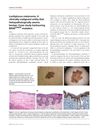
March 2015 in “Journal of the European Academy of Dermatology and Venereology” This letter to the editor shares a case study of lentiginous melanoma that appears clinically malignant but histopathologically benign, involving the BRAFV600R mutation.
1 citations
,
October 2000 in “Journal of Investigative Dermatology” The Thr1022Ala variant in the hairless gene is not a disease-causing mutation.
16 citations
,
March 2011 in “Ophthalmic genetics” This case report documents a 63-year-old with Birt-Hogg-Dubé Syndrome who developed choroidal melanoma alongside multiple lid folliculomas, marking the first known association of these conditions.
75 citations
,
February 2017 in “Aging” This study found that treating mtDNA mutator mice with the antioxidant SkQ1 delayed aging traits and extended their lifespan, potentially by alleviating mitochondrial dysfunction caused by reactive oxygen species.
 11 citations
,
September 2012 in “The journal of investigative dermatology/Journal of investigative dermatology”
11 citations
,
September 2012 in “The journal of investigative dermatology/Journal of investigative dermatology” This study identified a missense mutation in the keratin 71 gene as the cause of autosomal dominant woolly hair/hypotrichosis in a Japanese family, marking the first human mutation in KRT71 linked to a hair disorder.
 November 2022 in “Journal of Investigative Dermatology”
 This study identified a novel LZTR1 mutation associated with hybrid schwannoma and neurofibroma in a patient with schwannomatosis, but not all cases of hybrid tumors are linked to this condition.
 4 citations
,
January 2011 in “Annals of Dermatology”
4 citations
,
January 2011 in “Annals of Dermatology” This article discusses the role of HR gene mutations in differentiating atrichia with papular lesions from alopecia universalis, but presents no new experimental results.
16 citations
,
September 2015 in “International Journal of Molecular Sciences” In this study, a genetic analysis identified a pathogenic variant in the ALOXE3 gene associated with non-bullous congenital ichthyosiform erythroderma, and the patient's response to antifungal treatment highlights the risk of cutaneous fungal infections.
1 citations
,
August 2019 in “Journal of pediatric & adolescent gynecology” This report describes a novel AR gene mutation in a female patient, contributing to androgen insensitivity syndrome, and emphasizes its potential impact on genetic counseling.
 January 2026 in “BMC Veterinary Research”
 The researchers reported finding a recessive nonsense variant in the EGFR gene responsible for perinatal lethality in the "Blonde d'Aquitaine" cattle breed, prompting the development of a screening test to help eradicate this genetic flaw.
March 2021 in “Medico-Legal Update” In this study, no significant change in androgen receptor gene expression was found in females with recurrent spontaneous abortion, but a mutant genotype may offer some protection against the condition.
August 2005 in “The Journal of Cell Biology” This abstract provides a graphic illustrating that mice lacking the Sgk3 gene exhibit thin coats and abnormal hair, suggesting a role for Sgk3 kinase in hair follicle growth, but reports no new experimental findings.
 2 citations
,
September 2022
2 citations
,
September 2022 In this study, researchers found that a PER3 gene SNP may be pathogenic for a new subtype of dyschromatosis universalis hereditaria, especially when combined with a SASH1 mutation.