 37 citations
,
January 2017 in “International Journal of Dermatology”
37 citations
,
January 2017 in “International Journal of Dermatology” This study found that trichoscopic features like exclamation mark hairs and angulated hairs were more indicative of alopecia areata in an Asian population, while features like broken hairs of different lengths and flame hairs were more common in trichotillomania.
This case report describes a unique dermatologic condition called SCRATCH, occurring in a runner due to shirt friction, which resulted in clumped axillary hairs and temporary alopecia.
10 citations
,
March 1997 in “Pediatric Dermatology” This case report describes a patient with trichothiodystrophy presenting with autism, mental retardation, and seizures, characterized by distinct hair abnormalities under microscopy.
26 citations
,
January 1993 in “Dermatology” This report describes a new case of isolated trichothiodystrophy with characteristic brittle hair and suggests a simplified classification scheme for understanding sulfur-deficient hair disorders.
 7 citations
,
August 2013 in “Journal of the European Academy of Dermatology and Venereology”
7 citations
,
August 2013 in “Journal of the European Academy of Dermatology and Venereology” This study reported that atypical variants of alopecia areata made up less than 25% of all cases in their specialized trichology unit, suggesting a potential selection bias.
 April 2012 in “Informa Healthcare eBooks”
 Temporal triangular alopecia is a lifelong condition with hairless patches on the side of the head that may be present from birth.
42 citations
,
September 1985 in “British Journal of Dermatology” This study found that trichothiodystrophic hair shows reduced and disoriented protein deposition in follicles, with both the cuticle and cortex affected, providing localized structural insights into keratin abnormalities.
November 2025 in “Pediatric Dermatology” In this case study, a previously healthy 7-year-old boy was treated with a combination of topical minoxidil, retinoic acid, and clobetasol for a rare presentation of linear alopecia areata, resulting in full hair regrowth one year later.
 December 2023 in “Journal of ethnopharmacology”
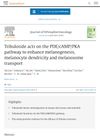
 This study found that tribuloside, a flavonoid from Tribulus terrestris L., enhances melanin production in human melanocytes, zebrafish, and human skin samples without causing toxicity, potentially through inhibiting PDE to increase cAMP levels and promote the melanin biosynthesis pathway.
 6 citations
,
January 2011 in “Journal of pediatric endocrinology & metabolism/Journal of pediatric endocrinology and metabolism”
6 citations
,
January 2011 in “Journal of pediatric endocrinology & metabolism/Journal of pediatric endocrinology and metabolism” This report details the case of an 11-year-old girl with APECED syndrome carrying a unique homozygous mutation in the AIRE gene, the first of its kind documented.
 5 citations
,
September 2013 in “The Journal of Dermatology”
5 citations
,
September 2013 in “The Journal of Dermatology” Researchers found a new mutation in the HR gene causing hair loss and skin bumps in a Pakistani family.
 1 citations
,
January 2020 in “Indian Dermatology Online Journal”
1 citations
,
January 2020 in “Indian Dermatology Online Journal” This article reviews the Directory of Open Access Journals, an extensive global index of quality open access journals, and reports no new results.
 August 2024 in “Skin Appendage Disorders”
 This study introduces "alopecia areata in a male or female pattern distribution" as a new clinical subtype of alopecia areata, observed in three adult cases, to enhance diagnostic precision and treatment personalization.
 26 citations
,
August 1971 in “Journal of Morphology”
26 citations
,
August 1971 in “Journal of Morphology” In this study, researchers observed that the epidermal specializations on the tail scales of Lygodactylus lizards, including sensory organs and specific secretory glands, are fully restored with similar structure and distribution on regenerated tails.
August 2026 in “LUMEN ET VIRTUS” This study review reports that alopecia areata is often associated with autoimmune thyroid diseases like Hashimoto thyroiditis, suggesting targeted thyroid screening based on symptoms and risk factors may improve detection while minimizing unnecessary tests.
 2 citations
,
June 2023 in “Journal of cell science”
2 citations
,
June 2023 in “Journal of cell science” In this study, researchers found that specific mutations in iRhom2 in mice lead to skin and hair abnormalities which depend on the presence of the protein ADAM17, suggesting a complex role for iRhom2 in tissue development and potential implications for treating tylosis with oesophageal cancer.
 8 citations
,
January 2015 in “International journal of trichology”
8 citations
,
January 2015 in “International journal of trichology” In this case report, the authors describe complete recovery from acute diffuse and total alopecia linked to Borrelia infection after treatment with intravenous ceftriaxone and topical clobetasol foam.
 14 citations
,
December 2007 in “Pediatric allergy and immunology”
14 citations
,
December 2007 in “Pediatric allergy and immunology” In this study, researchers found that mast cells in Erythema Toxicum lesions in newborns are actively involved in the immune response around hair follicles, but do not express the antimicrobial peptide LL-37.
9 citations
,
July 1993 in “Archives of dermatology” This report describes ten cases of pityriasis amiantacea to raise awareness of this uncommon scalp condition, highlighting its negative test findings and its uncertain association with other skin diseases.
 74 citations
,
January 2006 in “The journal of investigative dermatology/Journal of investigative dermatology”
74 citations
,
January 2006 in “The journal of investigative dermatology/Journal of investigative dermatology” This study identified novel compound heterozygous mutations in the DSG4 gene in a Japanese patient with congenital hypotrichosis, suggesting overlap between localized autosomal recessive hypotrichosis and monilethrix.
This review emphasizes the importance of accurately distinguishing between diffuse alopecia areata and telogen effluvium in dermatological practice due to differing treatment implications and long-term patient expectations, but reports no new clinical results.
 4 citations
,
January 2011 in “Annals of Dermatology”
4 citations
,
January 2011 in “Annals of Dermatology” This article discusses the role of HR gene mutations in differentiating atrichia with papular lesions from alopecia universalis, but presents no new experimental results.
July 2024 in “Journal of Investigative Dermatology” This study found that in mice with alopecia areata, CD8+ T cells showed clonal expansion and specific regulatory networks, which might help identify new therapeutic targets for patients not responding to JAK inhibitors.
 May 2024 in “Drug discovery today”
 This review discusses the potential role of thyroid receptor β agonists in treating androgenetic alopecia, reporting no new clinical results while highlighting their mechanism and anti-alopecia efficacy.
1 citations
,
April 2016 in “Journal of the American Academy of Dermatology” Autoimmune conditions can be linked to trichoepitheliomas, with treatment focusing on cosmetic concerns.
 2 citations
,
May 2022 in “Journal of the American Academy of Dermatology”
2 citations
,
May 2022 in “Journal of the American Academy of Dermatology” This study observed that most patients with traction alopecia showed improved or stabilized hair loss with therapeutic counseling and adjunctive treatments, but follow-up was often inconsistent, highlighting the need for better awareness and management.
 26 citations
,
August 2013 in “Australasian Journal of Dermatology”
26 citations
,
August 2013 in “Australasian Journal of Dermatology” This study found that certain trichoscopic patterns, like exclamation mark hairs, were associated with active or mild alopecia areata in Turkish patients, aiding in diagnosis and prediction of the disease.
July 2019 in “Dermatology practical & conceptual” This report presents personal observations of alopecia areata in twins with autoimmune thyroiditis and suggests a possible link, though it does not provide new clinical results.
 January 2007 in “Revista del Centro Dermatológico Pascua”
 This case report describes a 2-year-old boy diagnosed with trichothiodystrophy, characterized by fragile hair, intellectual damage, diminished fertility, and short stature.
35 citations
,
January 2000 in “Journal of comparative neurology” This study re-examined the structure of lanceolate endings in rat vibrissae, suggesting that their apical cones may function as a transducer site for detecting hair movements.