 70 citations
,
April 2016 in “Experimental Dermatology”
70 citations
,
April 2016 in “Experimental Dermatology” In this study, oral tofacitinib treatment led to significant hair regrowth and changes in skin and blood biomarkers in a patient with alopecia areata.
January 2025 in “The Journal of Dermatology” This study found that patients with severe alopecia areata are willing to accept increased risks of serious infection, cancer, and blood clots when opting for a higher dose of ritlecitinib, valuing the potential for greater hair regrowth efficacy compared to a lower dose.
June 2025 in “Revista Foco” This review assessed randomised clinical trials on the efficacy and safety of topical and systemic JAK inhibitors for alopecia areata, finding significant hair coverage improvement with ritlecitinibe and baricitinibe, though prolonged treatment is often needed to maintain results.
August 2022 in “Journal of Investigative Dermatology” Baricitinib reduces inflammation and mitochondrial damage in skin cells.
 40 citations
,
September 2018 in “Journal of the American Academy of Dermatology”
40 citations
,
September 2018 in “Journal of the American Academy of Dermatology” This letter discusses the emerging use of Janus kinase inhibitors, specifically oral tofacitinib, for treating alopecia areata in children, but reports no new clinical findings.
 January 2026 in “Dermatology and Therapy”
 This study found that patients with alopecia areata receiving ritlecitinib showed immune responses to meningococcal and tetanus vaccines, achieving significant antibody levels after vaccination, and no vaccine-related adverse events or disease exacerbations were reported despite a small sample size.
 1 citations
,
December 2022 in “The Nishinihon Journal of Dermatology”
1 citations
,
December 2022 in “The Nishinihon Journal of Dermatology” This source reports that based on international Phase 3 trial results, the JAK1/2 inhibitor baricitinib was approved in Japan in June 2022 for treating extensive alopecia areata, offering a potentially useful treatment option.
 October 2015 in “Elsevier eBooks”
 Aldesleukin can treat certain cancers and increase HIV patient CD4+ counts but often causes severe side effects.
April 2019 in “The journal of investigative dermatology/Journal of investigative dermatology” This study found that JAK1 and JAK3 inhibitors effectively reversed alopecia in a mouse model of AA by reducing skin inflammation, while JAK2 inhibition did not promote hair regrowth.
2 citations
,
May 2025 in “Journal of Clinical Medicine” This study reported that in a case series of three adolescents with alopecia areata and atopic dermatitis, treatment with 15 mg/day of upadacitinib led to rapid improvement in skin symptoms and significant hair regrowth over 12 months, with no severe adverse events observed.
 20 citations
,
February 2023 in “American Journal of Clinical Dermatology”
20 citations
,
February 2023 in “American Journal of Clinical Dermatology” In this study, 40.9% of patients taking 4 mg baricitinib and 21.2% taking 2 mg achieved significant hair regrowth over 52 weeks, indicating potential long-term benefits for adults with severe alopecia areata without introducing new safety concerns.
2 citations
,
March 2026 in “Journal of Dermatological Treatment” This study found that JAK inhibitors used to treat alopecia areata have varied safety profiles, with different adverse events associated with each drug; tofacitinib and ruxolitinib had earlier onset of events, while baricitinib and ritlecitinib showed distinct delayed patterns.
 1 citations
,
September 2023 in “Dermatology and Therapy”
1 citations
,
September 2023 in “Dermatology and Therapy” In this phase 3 trial analysis, baricitinib improved scalp hair growth in adults with severe alopecia areata, with a faster and higher response in those receiving 4 mg compared to 2 mg, but response varied with severity at baseline and continued through week 52.
91 citations
,
December 2019 in “The EMBO Journal” This study found that the E3 ligases NEDD4 and NEDD4L regulate intestinal stem cell priming by degrading the LGR5 receptor, and their loss leads to increased Wnt activation and crypt proliferation, which in turn accelerates intestinal tumor progression in mice.
3 citations
,
September 2016 in “Dermatologic Therapy” In this study, Deplanque et al. (2016) explored doxycycline's role in preventing erlotinib-induced folliculitis in patients with non-small-cell lung cancer, highlighting skin toxicity as a common side effect that can affect patient adherence to treatment.
 April 2024 in “Frontiers in pharmacology”
 This study compared JAK inhibitors for moderate-to-severe alopecia areata and found brepocitinib 30mg and deuruxolitinib 12mg to be most effective, though deuruxolitinib may cause more adverse events. Further research is needed for long-term efficacy and safety.
 June 2024 in “Journal of Clinical Oncology”
 In this retrospective study, combining TACE with Donafenib showed promising results as a first-line treatment for Chinese patients with unresectable hepatocellular carcinoma, yielding a median progression-free survival of 12.8 months and a one-year overall survival rate of 87.5%, along with a favorable safety profile.
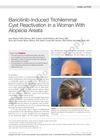
Baricitinib may reactivate trichilemmal cysts in people with a history of these cysts.

In this study using C3H/HeJ mice, a single subcutaneous injection of the fusion protein PTH-CBD increased anagen hair follicle counts and promoted hair regrowth comparably to daily oral ruxolitinib, potentially by enhancing beta-catenin production and stimulating anagen transition.
In a retrospective clinical study, this research found that baricitinib is effective for alopecia areata, with 42.3% of patients achieving a significant reduction in hair loss by week 36, and 52.4% by week 52, outperforming previous trials.
2 citations
,
February 2021 in “Indian Dermatology Online Journal” This case report describes the first instance of classical lichen planopilaris with atrophic lichenoid plaques developing in a Blaschko-linear pattern due to imatinib treatment in a patient with chronic myeloid leukemia.
October 2025 in “Postgraduate Medical Journal” This study found that among various JAK inhibitors for severe alopecia areata, baricitinib_4 mg demonstrated significant efficacy with high precision, while deuruxolitinib_12 mg showed the best efficacy but with wider confidence intervals, providing clinicians valuable information for treatment selection.
 2 citations
,
June 2005 in “Clinical Oncology”
2 citations
,
June 2005 in “Clinical Oncology” This case report documents new hair growth in a 57-year-old man with androgenic alopecia after receiving gefitinib treatment for non-small-cell lung cancer.
 December 2023 in “Journal of Cosmetic Dermatology”
 This study found that baricitinib, taken for 24 weeks, significantly reduced alopecia severity in patients with moderate-to-severe alopecia areata, with 50% showing marked improvement and overall favorable safety and efficacy reported.
 3 citations
,
September 2022 in “Journal of the American Academy of Dermatology”
3 citations
,
September 2022 in “Journal of the American Academy of Dermatology” In this study, baricitinib treatment for severe alopecia areata showed similar safety and led to hair regrowth improvements independent of atopic background, with 40.8% of patients with atopy achieving a significant response compared to 30.2% without atopy when using a 4 mg dose.
September 2002 in “Oncology Times” This study presented at the ASCO Annual Meeting reported that the epidermal growth factor receptor antibody ABX-EGF showed preliminary efficacy in renal cell cancer patients, with tolerable side effects, while bortezomib demonstrated clinical benefit in a significant proportion of multiple myeloma patients.
9 citations
,
April 2010 in “Lung cancer” This study reported that a gemcitabine and pemetrexed regimen was moderately active in advanced NSCLC but did not offer an advantage over the paclitaxel and gemcitabine regimen and is not recommended for further evaluation.
 58 citations
,
March 2020 in “Scientific Reports”
58 citations
,
March 2020 in “Scientific Reports” This study mapped the safety profile of EGFR-TKIs by analyzing FDA adverse event reports, highlighting unexpected reactions like intestinal obstruction and hypokalaemia with gefitinib and erlotinib.
1 citations
,
August 2021 in “Journal of Investigative Dermatology” ASLAN004 was safe and well-tolerated, supporting further development for treating certain diseases.
 6 citations
,
February 2023 in “Journal of the American Academy of Dermatology”
6 citations
,
February 2023 in “Journal of the American Academy of Dermatology” This article addresses the pathogenesis of alopecia areata and discusses the emerging role of oral and topical JAK inhibitors in its treatment, but reports no new clinical findings.