January 2023 in “International Journal of Trichology” This study found that bicalutamide mesotherapy resulted in subtle hair density improvements and was well tolerated by premenopausal women with androgenetic alopecia.
 49 citations
,
March 2017 in “Journal of the American Academy of Dermatology”
49 citations
,
March 2017 in “Journal of the American Academy of Dermatology” This case series found that oral tofacitinib treatment in eight adolescents with alopecia universalis led to significant regrowth of hair, though relapse is likely after stopping therapy.
 1 citations
,
June 2017 in “Skin”
1 citations
,
June 2017 in “Skin” This study is the first to report that apremilast may be effective in treating refractory lichen planopilaris and frontal fibrosing alopecia, though some patients experienced adverse effects leading to discontinuation.
September 2026 in “Apollo Medicine” In this case report, researchers observed that a 35-year-old male with alopecia universalis achieved full regrowth of scalp, eyebrow, and facial hair with oral upadacitinib treatment after previous therapies failed to provide lasting relief.
1 citations
,
June 2025 in “Asian Journal of Medical Sciences” In this study, MMF plus prednisolone was found to induce remission in 81% of patients with proliferative lupus nephritis, with fewer adverse effects such as alopecia and amenorrhea compared to CYC plus prednisolone, despite similar overall remission rates.

In this six-year study of a Saudi cohort, oral tofacitinib showed favorable long-term effectiveness for patients with AA, with manageable adverse events requiring regular monitoring.
 3 citations
,
June 1983 in “Archives of Dermatology”
3 citations
,
June 1983 in “Archives of Dermatology” This article discusses the effectiveness of adrenal cortex compounds E and F in treating connective tissue disorders like rheumatoid arthritis and lupus erythematosus, but it reports no new clinical results.
 August 2025 in “Scientific Electronic library online (Sciences Carlos III Health Institute)”
 This study reviewed various studies and concluded that Janus kinase inhibitors, particularly tofacitinib, seem to promote hair regrowth in about half of patients with alopecia areata, though expected class-specific adverse effects were observed.
This article lists the clinically important interactions and skin reactions of several drugs and substances, including THA, FK506, tamoxifen, tamsulosin, tartrazine, tea tree oil, temazepam, and temozolomide, but provides no new clinical results.
 16 citations
,
January 2017 in “Acta dermatovenerologica Alpina, Pannonica et Adriatica (Tiskana izd.)”
16 citations
,
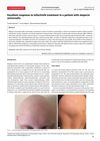
January 2017 in “Acta dermatovenerologica Alpina, Pannonica et Adriatica (Tiskana izd.)” This case study reports that a 23-year-old woman with alopecia universalis experienced complete hair regrowth after six months of treatment with tofacitinib, a JAK-3 inhibitor.
3 citations
,
May 2017 in “Bioorganic & medicinal chemistry letters” This study identified compounds 11d and 11k as potential dual 5α-reductase inhibitors and AR antagonists with significant anti-proliferative effects on prostate cancer cell lines, suggesting they may offer therapeutic value.
February 2025 in “Journal of the European Academy of Dermatology and Venereology” This article reviews current therapeutic strategies for frontal fibrosing alopecia and discusses the potential of oral dutasteride as a first-line treatment, emphasizing the need for more clinical trials.
January 2017 in “The American Pharmacists Association eBooks” January 2017 in “The American Pharmacists Association eBooks”  20 citations
,
January 2014 in “Journal of the European Academy of Dermatology and Venereology”
20 citations
,
January 2014 in “Journal of the European Academy of Dermatology and Venereology” This article includes no new results; it discusses ongoing treatment approaches for frontal fibrosing alopecia and lichen planopilaris.
 6 citations
,
March 2014 in “Annals of Pharmacotherapy”
6 citations
,
March 2014 in “Annals of Pharmacotherapy” This case report suggests that anidulafungin may be associated with hair loss, highlighting the need for physicians to monitor this potential adverse effect.
July 2026 in “Cosmoderma” This study highlights that alopecia areata, an autoimmune condition often starting in childhood, poses a higher risk of becoming chronic with an early onset and can result in poor therapy response.
1 citations
,
September 1977 in “JAMA” This case report describes a 45-year-old man with male pattern baldness who began regrowing hair after receiving fluorouracil treatment for scalp actinic keratosis.
December 2024 in “The American Journal of Gastroenterology” This case report highlights the successful use of tofacitinib in a 12-year-old patient with Crohn’s disease who developed alopecia areata following infliximab treatment, showing significant hair regrowth and complete resolution of alopecia within eight months while maintaining remission of Crohn’s symptoms.
 5 citations
,
July 2021 in “bioRxiv (Cold Spring Harbor Laboratory)”
5 citations
,
July 2021 in “bioRxiv (Cold Spring Harbor Laboratory)” This study found that a 14-day treatment with proxalutamide significantly reduced the 28-day mortality rate in hospitalized COVID-19 patients compared to placebo, with greater benefits observed among those who adhered to the treatment.
March 2014 in “Oxford University Press eBooks” This narrative review explores the failure of fludalanine as an orally active antibiotic and highlights valuable insights into problem-solving strategies in drug discovery, without reporting new clinical results.
 1 citations
,
May 2025 in “Frontiers in Medicine”
1 citations
,
May 2025 in “Frontiers in Medicine” In this case series, dual-targeted therapy was observed to provide promising clinical responses in refractory inflammatory bowel disease, with 88.23% to 100% response rates across 9 months and an endoscopic response in 88.89% of evaluated patients, though some adverse events occurred.
 14 citations
,
January 2017 in “Annals of Dermatology”
14 citations
,
January 2017 in “Annals of Dermatology” In this retrospective study, low-dose methotrexate was observed to be effective and well-tolerated in treating recalcitrant alopecia areata multiplex, achieving complete or near-complete hair regrowth in about 90% of patients despite some experiencing elevated liver enzymes and gastrointestinal discomfort.
January 2017 in “Journal of Pakistan Association of Dermatologists” This study found that scabies was the most common skin condition among children up to 15 years old at a Karachi hospital in 2005.
 14 citations
,
November 2016 in “Annals of Internal Medicine”
14 citations
,
November 2016 in “Annals of Internal Medicine” Tofacitinib, an arthritis drug, helped hair growth in alopecia universalis but long-term safety needs more research.
July 2025 in “Journal of Investigative Dermatology” Leflunomide may reduce the risk of alopecia areata, while methotrexate, cyclosporine, and rituximab may increase it.
65 citations
,
February 2011 in “Molecular cancer therapeutics” This study reported that the novel AKT inhibitor CCT128930 demonstrated significant antitumor activity in human cancer cell lines and xenografts, highlighting its potential as an anticancer therapy.
July 1999 in “Journal of the American Academy of Dermatology” This review discusses valproic acid as a common antiseizure medication associated with alopecia and highlights the need for its inclusion in relevant medical guides, without presenting new clinical findings.
 20 citations
,
January 2016 in “Intractable & Rare Diseases Research”
20 citations
,
January 2016 in “Intractable & Rare Diseases Research” In this clinical experience, treating frontal fibrosing alopecia with oral finasteride, hydroxychloroquine, tacrolimus, and excimer laser was associated with optimal results in patients with active inflammation.
 February 2023 in “European Journal of Dermatology”
 In this retrospective study from North France, apremilast was used in patients with psoriasis and recent cancer, showing a good safety profile and improved quality of life, though with 65.2% experiencing non-serious adverse events. The need for further research on oncological safety was highlighted.