 30 citations
,
April 2009 in “Dermatologic Surgery”
30 citations
,
April 2009 in “Dermatologic Surgery” This study found that miniaturization of hair is present in some women with androgenetic alopecia, but diagnosis may also be based on differences in hair shaft diameter between scalp regions.
 81 citations
,
March 2009 in “Seminars in Cutaneous Medicine and Surgery”
81 citations
,
March 2009 in “Seminars in Cutaneous Medicine and Surgery” This review discusses the classifications, diagnostic methods, and treatment strategies for female pattern hair loss, but reports no clinical results.
 18 citations
,
June 2008 in “Archives of Dermatology”
18 citations
,
June 2008 in “Archives of Dermatology” This study found that a 60-second hair count is a reliable and consistent method to assess hair shedding in healthy men without alopecia.
 7 citations
,
November 2007 in “PubMed”
7 citations
,
November 2007 in “PubMed” This study found that Turkish women with female pattern hair loss had significantly lower mid-scalp hair density and anagen ratio compared to healthy controls, with digital image analysis underestimating hair density.
 304 citations
,
July 2006 in “Journal of The American Academy of Dermatology”
304 citations
,
July 2006 in “Journal of The American Academy of Dermatology” This study found that videodermoscopy enhances diagnostic accuracy for scalp and hair disorders beyond simple clinical inspection and reveals novel disease features that could improve clinical understanding.
 40 citations
,
April 2006 in “Journal of the European Academy of Dermatology and Venereology”
40 citations
,
April 2006 in “Journal of the European Academy of Dermatology and Venereology” This study reported that Trichoscan, a computer-assisted hair measurement system, was not supported as accurate for clinical trials due to errors in signal detection, despite its analysis speed.
 63 citations
,
October 2005 in “Archives of Dermatology”
63 citations
,
October 2005 in “Archives of Dermatology” This study reports that a hair shedding threshold of 100 hairs or more may provide the best concordance with clinical diagnosis for distinguishing chronic telogen effluvium from androgenetic alopecia.
 137 citations
,
July 2004 in “Journal of The American Academy of Dermatology”
137 citations
,
July 2004 in “Journal of The American Academy of Dermatology” This study observed that triple horizontal scalp biopsies provided a more accurate diagnosis of female pattern hair loss in women than a single horizontal biopsy, especially for those with advanced hair loss.
 51 citations
,
January 2004 in “Skin Pharmacology and Physiology”
51 citations
,
January 2004 in “Skin Pharmacology and Physiology” This review discusses various techniques for evaluating hair shedding and alopecia but reports no new clinical results. The authors emphasize the value of specific clinical and instrumental methods in assessing hair growth.
 25 citations
,
June 2003 in “Journal of Investigative Dermatology Symposium Proceedings”
25 citations
,
June 2003 in “Journal of Investigative Dermatology Symposium Proceedings” This study found that among Japanese women with diffuse hair loss, decreased hair density without changes in vellus hair was the most common and distinct pattern observed, highlighting differences from previous observations in other populations.
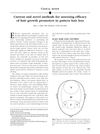 86 citations
,
February 2003 in “Journal of The American Academy of Dermatology”
86 citations
,
February 2003 in “Journal of The American Academy of Dermatology” This article discusses various mechanisms for promoting hair growth in pattern hair loss and highlights the challenge of balancing short-term measurable results in trials with the need for long-term efficacy data.
 41 citations
,
July 2002 in “Clinical and Experimental Dermatology”
41 citations
,
July 2002 in “Clinical and Experimental Dermatology” This review evaluates hair growth measurement methods for human scalp hair, suggesting that combining highly resolutive analytical approaches with global calibrated methods is recommended for assessing hair changes in clinical settings.
 31 citations
,
August 2001 in “PubMed”
31 citations
,
August 2001 in “PubMed” This study found that the TrichoScan method detected significant increases in hair counts and cumulative hair thickness in men after finasteride treatment, suggesting its potential for monitoring hair treatment responses.
12 citations
,
August 2001 in “PubMed” This study found that contrast enhanced phototrichogram (CE-PTG) significantly improved detection of various hair types and growth stages in androgenetic alopecia compared to standard PTG and was comparable to biopsy analysis.
 115 citations
,
November 1999 in “Journal of The American Academy of Dermatology”
115 citations
,
November 1999 in “Journal of The American Academy of Dermatology” In this study, men using 2% and 5% minoxidil solutions experienced a significant increase in hair weight for 96 weeks compared to placebo, with effects diminishing after treatment cessation.
 187 citations
,
June 1999 in “Journal of The American Academy of Dermatology”
187 citations
,
June 1999 in “Journal of The American Academy of Dermatology” This study reported that finasteride 1 mg/day significantly increased hair growth and slowed hair loss in men with frontal scalp hair thinning over one year, and these benefits continued or improved in the second year.
 102 citations
,
October 1996 in “Dermatologic Clinics”
102 citations
,
October 1996 in “Dermatologic Clinics” Photographic documentation crucial for evaluating hair growth in androgenetic alopecia.
 309 citations
,
May 1993 in “Journal of The American Academy of Dermatology”
309 citations
,
May 1993 in “Journal of The American Academy of Dermatology” This study concluded that horizontal sections of scalp biopsy specimens provide more diagnostic information for male pattern androgenetic alopecia than vertical sections and can predict hair regrowth potential following topical minoxidil therapy.
 90 citations
,
October 1983 in “British Journal of Dermatology”
90 citations
,
October 1983 in “British Journal of Dermatology” This study found that individuals with androgenic alopecia have an increased number of thin hairs (less than 40 microns in diameter) per cm², which may affect their clinical appearance.