 42 citations
,
March 2010 in “Endocrinology”
42 citations
,
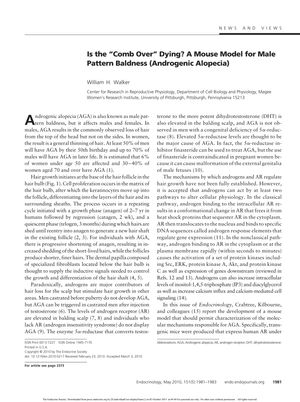
March 2010 in “Endocrinology” This study reports the development of the first rodent model for androgenetic alopecia, demonstrating that overexpression of androgen receptors in mice delays hair regeneration and can be used to test new treatments.
 70 citations
,
January 2009 in “The Journal of clinical endocrinology and metabolism/Journal of clinical endocrinology & metabolism”
70 citations
,
January 2009 in “The Journal of clinical endocrinology and metabolism/Journal of clinical endocrinology & metabolism” This study explored the interaction between androgen and Wnt signaling in dermal papilla cells, targeting the effects of androgen on hair growth reduction.
 229 citations
,
August 2002 in “Experimental Gerontology”
229 citations
,
August 2002 in “Experimental Gerontology” This paper discusses key mechanisms of androgen metabolism in androgenetic alopecia and reports the effectiveness of treatments like oral finasteride and topical minoxidil, highlighting the limited success rate due to factors like follicular inflammation.
 370 citations
,
September 1999 in “The New England Journal of Medicine”
370 citations
,
September 1999 in “The New England Journal of Medicine” This article discusses the treatment of androgenetic alopecia and alopecia areata with finasteride and minoxidil but reports no new clinical results.
 416 citations
,
September 1997 in “Journal of Investigative Dermatology”
416 citations
,
September 1997 in “Journal of Investigative Dermatology” People with hair loss have more androgen receptors and enzymes in certain follicles, with men and women showing different patterns.
 143 citations
,
October 1996 in “Dermatologic Clinics”
143 citations
,
October 1996 in “Dermatologic Clinics” Too much androgen can cause hair loss; finasteride may help.
124 citations
,
April 1992 in “Journal of Endocrinology/Journal of endocrinology” This study observed that cells from androgen-sensitive areas like the beard and scrotum showed higher androgen receptor levels compared to those from non-balding scalp areas, supporting the role of dermal papilla in follicle growth responses to androgens.