2 citations
,
September 2022 in “American Journal of Clinical Dermatology”  January 2022 in “Journal of Cosmetic Dermatology”
 This study found that combining basic fibroblast growth factor with minoxidil improved hair treatment efficiency and patient satisfaction compared to minoxidil alone for early-stage androgenetic alopecia in men.
1 citations
,
November 2021 in “CRC Press eBooks” This paper discusses treatments for male androgenetic alopecia, highlighting the effectiveness of finasteride and minoxidil, but reports no new study results.
 July 2020 in “Journal of Cosmetic and Laser Therapy”
 This study found that platelet-rich plasma injections significantly increased hair density and width while improving patient satisfaction in androgenic alopecia treatment without adverse effects.
 9 citations
,
January 2020 in “Skin appendage disorders”
9 citations
,
January 2020 in “Skin appendage disorders” This case report presents two instances where typically irreversible lichen planopilaris and frontal fibrosing alopecia showed signs of hair regrowth and symptom improvement following specific treatments.
 5 citations
,
January 2020 in “Skin appendage disorders”
5 citations
,
January 2020 in “Skin appendage disorders” This study found that oral dutasteride increased hair count more than intralesional administration in androgenetic alopecia, but more research is needed for a reliable comparison.
 43 citations
,
July 2018 in “Journal of The European Academy of Dermatology and Venereology”
43 citations
,
July 2018 in “Journal of The European Academy of Dermatology and Venereology” This study found that a topical solution combining 0.25% finasteride with 3% minoxidil significantly improved hair growth, as measured by hair density, diameter, and global assessment, in men with androgenetic alopecia, compared to 3% minoxidil alone, over 24 weeks without systemic adverse effects reported.
 15 citations
,
January 2017 in “JAMA Dermatology”
15 citations
,
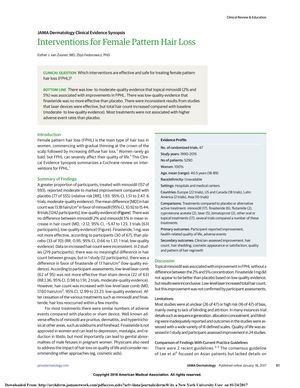
January 2017 in “JAMA Dermatology” This study found that topical minoxidil improved female pattern hair loss, finasteride was not more effective than placebo, and laser devices showed inconsistent results but increased hair count compared to baseline.
 8 citations
,
January 2016 in “European Journal of Plastic Surgery”
8 citations
,
January 2016 in “European Journal of Plastic Surgery” This study found that plasma rich in growth factors was a safe and more effective treatment for androgenetic alopecia than topical minoxidil, showing greater improvements in hair growth phases.
 72 citations
,
January 2001 in “Drugs”
72 citations
,
January 2001 in “Drugs” This review discusses current and emerging drug therapies for treating androgenetic alopecia and alopecia areata, and reports no clinical results; it highlights a need for improved and novel treatments.