 1 citations
,
October 2022 in “PubMed”
1 citations
,
October 2022 in “PubMed” This abstract describes androgenetic alopecia, a common dermatological condition, and does not provide new clinical findings.

This article reviews various aspects of hair and hair loss but does not report new research findings.

This article discusses the nature and causes of hair loss, including hereditary factors, but reports no new clinical findings.
July 2013 in “DeckerMed Medicine” This review discusses various types of hair loss, including androgenetic alopecia, telogen effluvium, and alopecia areata, and reports no new experimental findings.
 75 citations
,
December 2011 in “British Journal of Dermatology”
75 citations
,
December 2011 in “British Journal of Dermatology” This review discusses female pattern hair loss, its psychological impact, and available treatments but provides no new clinical findings; the authors emphasize early intervention for better outcomes.
 32 citations
,
January 1994 in “Skin Pharmacology and Physiology”
32 citations
,
January 1994 in “Skin Pharmacology and Physiology” In this study, scalp skin from stumptailed macaques demonstrated minoxidil sulfotransferase activity primarily in hair follicles, which may explain minoxidil's hair growth stimulation in this model.

This article reviews various discoveries about hair follicle cycles, androgenic alopecia, and the role of dihydrotestosterone, emphasizing the effectiveness of hair transplantation and reports no new findings.
7 citations
,
January 1989 Minoxidil and 4-MA can help treat hair loss.
19 citations
,
October 1988 in “Clinics in dermatology” This article discusses potential roles for retinoids in hair regrowth and proposes future studies, reporting no new experimental results.
 78 citations
,
March 1987 in “Journal of The American Academy of Dermatology”
78 citations
,
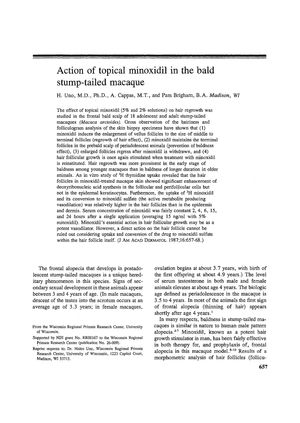
March 1987 in “Journal of The American Academy of Dermatology” Minoxidil promotes hair growth but stops working when discontinued.