 November 2024 in “Medicina”
 This case report details a unique instance of pityriasis rubra pilaris affecting only the scalp, highlighting novel trichoscopic features and emphasizing the importance of recognizing this rare presentation for improved diagnosis and treatment.
 January 2024 in “Journal of Cosmetic Dermatology”
 This study suggests that male androgenetic alopecia and female pattern hair loss follow distinct progression pathways, characterized by different trichoscopic patterns related to hair diameter and follicular unit changes.

This review discusses various non-invasive methods for diagnosing alopecia areata, highlighting that trichoscopy signs like short vellus hairs and yellow dots are sensitive indicators of the condition, while advanced imaging techniques provide valuable information on hair follicle status and scalp inflammation.
 July 2021 in “Indian journal of dermatopathology and diagnostic dermatology”
 In this study, researchers documented several trichoscopic features that were statistically significant indicators of alopecia and scalp disorders compared to healthy controls.
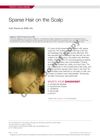
This case study describes a young girl with sparse, brittle scalp hair and multiple keratotic papules, but no systemic or familial abnormalities were found.
 July 2018 in “Elsevier eBooks”
 This chapter details the causes and diagnostic process of pediatric alopecia, including trichoscopic findings, but reports no new clinical results.
 July 2018 in “Elsevier eBooks”
 This review discusses the evolving understanding of frontal fibrosing alopecia as a generalized skin condition with diverse manifestations, and reports no new clinical results.
 May 2017 in “InTech eBooks”
 This review discusses trichotillomania and traction alopecia, focusing on their clinical features, diagnostic criteria, and treatment options, but it reports no new research findings.
October 2025 in “JMIR Dermatology” This study observed that in a series of 28 patients with different types of alopecia, specific trichoscopic markers like exclamation-mark hairs and yellow dots helped distinguish alopecia areata from conditions like lichen planopilaris and discoid lupus erythematosus, which showed follicular ostia loss and white scarring.
 74 citations
,
July 2008 in “Journal of Dermatological Case Reports”
74 citations
,
July 2008 in “Journal of Dermatological Case Reports” This study found that trichoscopy can diagnose genetic hair shaft abnormalities without plucking or cutting hair, by visualizing characteristic features in a single session.
 46 citations
,
June 2018 in “American Journal of Clinical Dermatology”
46 citations
,
June 2018 in “American Journal of Clinical Dermatology” This review summarizes the clinical, trichoscopic, and histopathological features of alopecia types associated with cutaneous and systemic lupus erythematosus and explores their links to disease activity, but it reports no new clinical results.
 7 citations
,
January 2015 in “Hair therapy & transplantation”
7 citations
,
January 2015 in “Hair therapy & transplantation” This review discusses the impact of air pollution on hair loss and sensitive scalp syndrome, evaluating possible causes and management strategies, but reports no new clinical results.
 4 citations
,
February 2021 in “International Journal of Women's Dermatology”
4 citations
,
February 2021 in “International Journal of Women's Dermatology” This study determined that trichoscopy is a sensitive and specific tool that effectively aids in diagnosing alopecia in women, especially when clinical diagnosis is uncertain.
 3 citations
,
January 2016 in “Annals of Dermatology”
3 citations
,
January 2016 in “Annals of Dermatology” This study suggests that 2% minoxidil and Kerium may promote hair regrowth in rats, while Aminexil showed the least effect among tested treatments; human-use products varied in efficacy in this animal model.
 1 citations
,
July 2025 in “The Ewha Medical Journal”
1 citations
,
July 2025 in “The Ewha Medical Journal” The Ewha Medical Journal is now in PubMed, has an AI article editor, and offers Korean reporting guidelines.
 1 citations
,
November 2024 in “Archives of Dermatological Research”
1 citations
,
November 2024 in “Archives of Dermatological Research” The authors discuss that hair loss affecting the occipital scalp is understudied and may be caused by factors like movement irritation and clothing occlusion; this lack of data can lead to missed diagnoses and inadequate treatment.
 1 citations
,
May 2024 in “Dermatology and Therapy”
1 citations
,
May 2024 in “Dermatology and Therapy” This review article examines the current understanding of frontal fibrosing alopecia, noting its prevalence in different demographics and the roles of genetic and environmental factors in its pathogenesis, while highlighting that treatment approaches remain varied and lack standardization.
 1 citations
,
July 2008 in “Expert Review of Dermatology”
1 citations
,
July 2008 in “Expert Review of Dermatology” Normal hair thickness varies by scalp area and a mix of hair thicknesses is typical in healthy individuals.
July 2026 in “Journal of Dermatological Treatment” In this randomized trial of Iranian men with moderate to severe androgenetic alopecia, researchers found that both finasteride and dutasteride improved hair density over 24 weeks, with dutasteride showing stronger PSA reduction but similar safety to finasteride.
 December 2024 in “Journal of Skin and Stem Cell”
 This review discusses the role of trichoscopy in diagnosing and managing various alopecia types, highlighting its ability to detect specific patterns in both scarring and non-scarring forms, thus aiding in treatment decisions and reducing biopsy necessity.

In this case report, researchers documented a 19-year-old male professional athlete with acquired trichorrhexis nodosa, noting environmental factors like chlorine exposure during swimming may have contributed to his condition, which improved after advice on hair care changes.
 October 2023 in “European medical journal. Dermatology”
 This review outlines a systematic approach for dermatologists to accurately diagnose hair loss disorders, emphasizing the importance of differentiating between scarring and non-scarring alopecia to guide appropriate treatment decisions.
 March 2023 in “Journal of skin and stem cell”
 This study concluded that trichoscopy is a reliable, non-invasive, and faster diagnostic method for ambiguous cases of alopecia.
January 2020 in “Revista Dermatológica Centro Uraga” This article describes how recognizing distinct trichoscopic features aids in diagnosing various dermatological conditions and hair loss, but it reports no new clinical findings.
 290 citations
,
December 2017 in “Journal of The American Academy of Dermatology”
290 citations
,
December 2017 in “Journal of The American Academy of Dermatology” This article reviews the epidemiology, clinical evaluation, and pathogenesis of alopecia areata and highlights recent advancements, but it does not report new clinical findings.
 29 citations
,
June 2013 in “Journal of the Saudi Society of Dermatology & Dermatologic Surgery”
29 citations
,
June 2013 in “Journal of the Saudi Society of Dermatology & Dermatologic Surgery” This review outlines the mechanisms, clinical features, and management strategies for alopecia areata and presents no new experimental findings.
 11 citations
,
December 2006 in “Expert Review of Dermatology”
11 citations
,
December 2006 in “Expert Review of Dermatology” This article examines the emerging role of dermoscopy in skin cancer diagnosis and reports no new clinical findings; the authors highlight its potential to enhance dermatological practice.
 10 citations
,
May 2018 in “Forensic Science International”
10 citations
,
May 2018 in “Forensic Science International” This study concluded that the process of mummification disfigures facial features, making identification challenging, but commercial shrunken heads retain more defining features compared to ceremonial ones.
 10 citations
,
January 2012 in “Journal of biomedical optics”
10 citations
,
January 2012 in “Journal of biomedical optics” This study used ultrahigh-resolution optical coherence tomography to observe hair shaft structures, finding melanin granules absent only in white hair, which may explain color differences between black and white hair.

The researchers presented a rare case of a four-year-old developing scarring alopecia after a two-week ICU stay, highlighting the challenge of diagnosing pressure alopecia in children and the crucial role of early detection and trichoscopy in preventing permanent hair loss.