
This study found that activating Toll-like receptor 3 signaling in periodontal ligament stem cells may enhance their immunomodulatory properties, suggesting potential implications for future stem cell therapy applications.
1 citations
,
December 2025 in “PLoS ONE” This study evaluated the real-world safety of Tepotinib for treating NSCLC with METex14 skipping mutations, confirming known adverse events and identifying new signals like deafness and taste disorder, especially highlighting early monitoring.
May 2024 in “International journal of medicine and psychology.” This article underscores the need for maritime education to develop future seafarers' tolerance to uncertainty, emphasizing its importance for making informed decisions and adapting to modern challenges in a rapidly changing maritime environment.
24 citations
,
March 2016 in “Journal of Investigative Dermatology” This study suggests that TIP39 and its receptor PTH2R, identified in human epidermis, may play a role in keratinocyte function and influence skin differentiation.
 May 2024 in “Clinical, cosmetic and investigational dermatology”
 This case report describes an adolescent boy with congenital triangular alopecia who showed significant hair regrowth after eight months of treatment with 5% topical minoxidil, achieving full coverage of the affected area without adverse effects.
January 2025 in “Animal Science Journal” This study reported that the coat hairs of golden takin, living in harsh environments, have unique structural features compared to cattle, with overcoat hairs having continuous medullated tissue and undercoat hairs being finely crimped, potentially contributing to temperature regulation in cold conditions.
 1 citations
,
August 2018 in “bioRxiv (Cold Spring Harbor Laboratory)”
1 citations
,
August 2018 in “bioRxiv (Cold Spring Harbor Laboratory)” This study reports that a novel gain-of-function mutation in TMEM173, combined with polymorphisms in TMEM173 and IFIH1, results in a distinct clinical phenotype with features of SAVI, including alopecia and photosensitivity.
 January 2022 in “Figshare”
 I cannot summarize the document because it cannot be parsed.
December 2014 in “Journal of Biomedical Research” In a mouse model of peripheral vascular disease, this study found that recombinant thymosin β4 treatment increased expression levels of certain proteins, promoting angiogenesis.

This study suggests that Tenebrio molitor larvae extract may promote hair growth and prevent hair loss by enhancing cell proliferation and protecting against cytotoxicity in laboratory settings.
 January 2026 in “Cell and Tissue Biology”
 The researchers reported that administration of the antioxidant compound TS-13 in mice with chemotherapy-induced alopecia accelerated hair regrowth, although it did not fully prevent chemotherapy-related hair loss, suggesting TS-13 may aid in managing hair loss without negating the cancer treatment's effectiveness.

This article examines how digital technologies, drawing on Marshall McLuhan's concept of media as an "extension of man," transform design thinking by creating new possibilities without replacing it, emphasizing the need for a hybrid, reflective practice in design.
 30 citations
,
March 2015 in “PLoS ONE”
30 citations
,
March 2015 in “PLoS ONE” This study found that thyroxine modulates peripheral molecular clock gene expression in human hair follicles, which may have implications for treating clock-related diseases in patients with thyroid dysfunction.
 33 citations
,
November 2014 in “Military Medicine”
33 citations
,
November 2014 in “Military Medicine” This retrospective review of the U.S. military's teledermatology program from 2004 to 2012 found that timely consultations helped avoid unnecessary medical evacuations and facilitated necessary ones for service members and coalition partners.
 January 2025 in “International Journal of Dermatology”
 This case report describes a patient with eruptive tumor of follicular infundibulum, emphasizing the need for dermatologists to include it in the differential diagnosis of acquired facial hypopigmentation.
 58 citations
,
June 2012 in “Journal of Alternative and Complementary Medicine”
58 citations
,
June 2012 in “Journal of Alternative and Complementary Medicine” This review analyzes the traditional Iranian medicine uses of Citrullus colocynthis and compares them with modern phytotherapy findings, reporting no new clinical results but noting safety concerns and dosage considerations.
 January 2001 in “Biomedical Research”
 This study observed that PAD type III and trichohyalin are expressed earlier than their deiminated form during the first and second hair cycles in rat hair follicles, indicating a potential additional factor is involved in triggering deimination.
January 2023 in “RSC Advances” This study found that two eco-friendly analytical methods for quantifying Finasteride and Tadalafil in a new dosage form were effective, green, and suitable for quality control.
51 citations
,
May 2008 in “Mycoses” This study found that terbinafine HCl nail solutions with or without DDAIP HCl significantly outperformed ciclopirox nail lacquer in treating guinea pig dermatophytosis, suggesting potential effectiveness for human nail infections.
 1 citations
,
January 2013 in “International Journal of Trichology”
1 citations
,
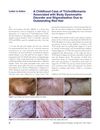
January 2013 in “International Journal of Trichology” A girl with red hair developed hair-pulling and body image disorders after being bullied for her hair color.
 2 citations
,
April 2002 in “Animal Science/Animal science”
2 citations
,
April 2002 in “Animal Science/Animal science” This study found that melatonin administration effectively shortened the fur maturation period and altered hair follicle cycling in chinchillas.
5 citations
,
November 2010 in “Veterinary Record” Treatment with oral terbinafine and topical enilconazole was successful in resolving a Trichophyton dermatophytosis outbreak in L'Hoest's monkeys, with complete mycological cure achieved after eight weeks.
13 citations
,
February 2012 in “International Journal of Dermatology” This case report identifies a novel nonsense mutation in the CDH3 gene associated with hypotrichosis and juvenile macular dystrophy.

In this pilot study, researchers found that ex vivo treatment with topical melatonin reduced chemotherapy-induced apoptosis and DNA damage in hair follicle stem cells of human scalp cultures, suggesting melatonin's potential as a protective agent against taxane-induced permanent hair loss.
 December 2024 in “Animals”
 In this study, Tithonia diversifolia extract was found to improve certain digestive parameters in crossbred sheep but did not enhance growth performance, as the improvements in digestion did not translate into increased body weight or feed conversion.
October 2022 in “Hair Transplantation” This chapter discusses aesthetic principles and surgical techniques for reconstructing a natural hairline in cases of thinning or loss of hair in the temporal area, but reports no new results.
 November 2002 in “Hair transplant forum international”
 This announcement from the President of the American Board of Hair Restoration Surgery reports the formation and incorporation of the International Board of Hair Restoration Surgery, but offers no new research findings.
12 citations
,
May 2012 in “Journal of Biomedical Optics” In this study, Trichoscan®, reflectance confocal microscopy, and optical coherence tomography were found to be reliable noninvasive tools for measuring hair growth and follicle analysis after hair removal.

This abstract contains subscription and access information for Wolters Kluwer Health journals but reports no research findings.
In this study of hydroponically grown tomatoes, the authors reported that adding melatonin at 10-30 μmol·L-1 effectively enhanced lateral root development, root hair growth, biomass accumulation, and root activity by influencing related gene expression and hormone levels.