5 citations
,
October 2021 in “American Journal of Medical Genetics Part A” This case report identifies a novel maternally inherited MBTPS2 variant associated with an expanded phenotypic spectrum of BRESHECK syndrome, including cytopenias, bone marrow fibrosis, and chronic diarrhea.
110 citations
,
April 2009 in “Cell Motility and the Cytoskeleton” This review discusses the intracellular activity of β-thymosins and their role in modulating the actin cytoskeleton, but it reports no new experimental results.
 July 2012 in “European journal of cancer”
 This study demonstrated that switching aE-catenin to aT-catenin in murine skin substantially rescued hyperproliferative and pre-cancerous conditions, but led to partial baldness, indicating potential functional discrepancies.
April 2019 in “The journal of investigative dermatology/Journal of investigative dermatology” This study in mice suggests that defects in hair follicles with mesenchymal TSC2 disruption may result from an impaired TGFβ1 response, indicating a potential novel treatment approach for tuberous sclerosis complex.
 111 citations
,
August 2002 in “Journal of Medicinal Chemistry”
111 citations
,
August 2002 in “Journal of Medicinal Chemistry” This study reports that 2-(1-Adamantyl)-4H-thiochromen-4-on-6-O-sulfamate is the most potent steroid sulfatase inhibitor identified so far, exhibiting 170-fold higher activity than the lead compound estrone sulfamate.
175 citations
,
December 1980 in “Archives of Dermatology” In this study, researchers examined two new cases of trichothiodystrophy and observed that the condition is linked to decreased synthesis of high-sulfur matrix proteins in hair.
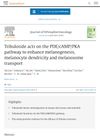 December 2023 in “Journal of ethnopharmacology”
 This study found that tribuloside, a flavonoid from Tribulus terrestris L., enhances melanin production in human melanocytes, zebrafish, and human skin samples without causing toxicity, potentially through inhibiting PDE to increase cAMP levels and promote the melanin biosynthesis pathway.
 28 citations
,
January 2012 in “Case Reports in Medicine”
28 citations
,
January 2012 in “Case Reports in Medicine” This article discusses Hair-thread Tourniquet Syndrome in children, emphasizing the need for prompt examination and intervention to prevent severe complications, but reports no new clinical results.
 13 citations
,
October 2004 in “Anais Brasileiros De Dermatologia”
13 citations
,
October 2004 in “Anais Brasileiros De Dermatologia” This article reviews various self-aggressive hair disorders such as trichotillomania and emphasizes the psychiatric aspects of these conditions, but reports no new clinical findings.
7 citations
,
January 2023 in “Skin Appendage Disorders” This review discusses the characteristics, potential triggers, and challenges in diagnosing and treating sensitive scalp, reporting no new clinical results, and noting the need for further investigation.
 29 citations
,
March 2008 in “Dermatologic Surgery”
29 citations
,
March 2008 in “Dermatologic Surgery” This study developed a prototype device that suggests potential for diagnosing changes in hair quantity, diameter, and density, though formal clinical studies are needed to confirm these findings.
June 2025 in “Proceedings of the National Academy of Sciences” In this study, a mouse model with a PIK3CA gain-of-function mutation in Schwann cells revealed unique communication with neighboring cells and a glycolytic shift in peripheral nerves, and early alpelisib treatment significantly improved symptoms, though efficacy declined with delayed administration due to limited drug penetration.
 August 2022 in “Archives of pediatric surgery”
 This article reviews cultural differences in the incidence of hair-thread tourniquet syndrome and finds it may be less prevalent in Iranian children compared to Europe, possibly due to social and cultural factors.
November 2025 in “Contribuciones a las Ciencias Sociales” This study suggests that incorporating laboratory tests into routine aesthetic procedures may improve result predictability and reduce risks, underscoring the importance of professional expertise in the evaluation process.
September 2024 in “Actas Dermo-Sifiliográficas” This study discusses trichodynia, a painful scalp condition often linked to various forms of alopecia and psychiatric comorbidities, highlighting its clinical diagnosis, lack of specific treatments, and suggesting the need for more research to explore effective therapies.
 2 citations
,
July 2008 in “Dermatologic Surgery”
2 citations
,
July 2008 in “Dermatologic Surgery” This study suggests that a prototype device may accurately measure hair quantity, diameter, and density in balding patients, potentially aiding in diagnostic assessments, though formal clinical studies are needed to confirm its effectiveness.
 October 2008 in “Clin-alert”
 This abstract lists keywords related to various medications and therapies, but it does not provide new study results or findings.
5 citations
,
July 1996 in “Journal of Cutaneous Medicine and Surgery” This study explains that while trichothiodystrophy and xeroderma pigmentosum share genetic defects, TTD patients primarily exhibit issues in transcription initiation, not the increased skin cancer risk seen in XP.
 November 2022 in “The journal of investigative dermatology/Journal of investigative dermatology”
 In this case study, a 26-year-old female with PLEC mutations and features of muscular dystrophy and myasthenia gravis showed significant improvement in symptoms following steroid treatment.

The researchers reported a case where treatment with tofacitinib improved both hair loss and skin lesions in a patient with Graham-Little-Piccardi-Lassueur Syndrome and hidradenitis suppurativa over six months, with no recurrence or adverse events during two-year follow-up.
 18 citations
,
November 2016 in “Neuromuscular Disorders”
18 citations
,
November 2016 in “Neuromuscular Disorders” This study found that patients with myotonic dystrophy types 1 and 2 often exhibit skin abnormalities, which correlate with genotype severity and serum vitamin D levels, and suggest premature aging.
2 citations
,
May 2007 in “Pediatrics in Review” This case study reports a teenage boy with juvenile polyposis syndrome, presenting with microcytic anemia, growth failure, and rectal bleeding, leading to the diagnosis following colonoscopy and histologic examination of colonic polyps.
108 citations
,
February 2013 in “JAMA” This review discusses the therapeutic options for transgender individuals, including hormonal and surgical treatments, and reports no new clinical results; the authors highlight the need for more research on long-term effects.

This study identified ten key magistral dermatological formulations, such as personalized trichological preparations and Kligman’s formula, which fill critical gaps unmet by standardized products, particularly in cases like pediatric scabies or autoimmune mucosal diseases, illustrating the role of compounding in precision medicine.
 10 citations
,
November 2018 in “Genetics in medicine”
10 citations
,
November 2018 in “Genetics in medicine” This study identified a genetic variant in the CTS6 gene associated with a hypotrichosis syndrome, emphasizing the significant role of cystatin M/E in hair and skin health.
This study found that P144 (Disitertide) significantly reduced collagen deposition and improved muscle organization in a rabbit model of post-radiotherapy fibrosis, suggesting potential antifibrotic effects.
 1 citations
,
August 2024 in “Transgenic Research”
1 citations
,
August 2024 in “Transgenic Research” In this study, the researchers observed that inducing and then withdrawing β-catenin expression in a bigenic mouse model caused reversible changes in skin morphology, indicating dependence on β-catenin signaling.
25 citations
,
September 2014 in “Pharmacotherapy” This review covers cross-sex hormone therapy for gender dysphoria, noting improvements in psychological symptoms and quality of life but lacking definitive long-term safety data.
2 citations
,
September 2023 in “Journal of the American Academy of Dermatology” CTP-543 effectively promotes hair regrowth in adults with moderate to severe alopecia areata.