 11 citations
,
December 1921 in “Archives of dermatology and syphilology”
11 citations
,
December 1921 in “Archives of dermatology and syphilology” This article reviews historical cases and descriptions of perifolliculitis capitis abscedens et suffodiens, highlighting its characteristics and treatment, but reports no new clinical findings.
2 citations
,
March 2010 in “European journal of dermatology/EJD. European journal of dermatology” This case report describes a 5-year-old girl with trichorrhexis nodosa and highlights the presence of isolated curly hairs on her scalp despite hair loss over four months.
5 citations
,
September 1997 in “Archives of Dermatology” This case report describes a 5-year-old boy with a solitary patch of hair loss, indicating possible fungal involvement after initial antibiotic treatment was minimally effective.
4 citations
,
September 2024 in “Cell Reports” This study found that mice lacking the CXCR2 receptor regenerated tissue scarlessly in various injury models and that administering plasma or G-CSF from these mice to wild-type mice also reduced scarring, suggesting potential therapeutic strategies to improve human skin wound healing.
1 citations
,
March 2006 in “Journal of Cosmetic Dermatology” This case report describes a 79-year-old woman whose skin lesions were attributed to a cosmetic product, with complete resolution following mechanical removal of material and metronidazole treatment.
 24 citations
,
January 2019 in “Theranostics”
24 citations
,
January 2019 in “Theranostics” This study found that loss of the Pten gene in Lgr5+ hair follicle stem cells promoted squamous cell carcinoma formation through the Akt/β-catenin signaling pathway.
 November 2022 in “Journal of Investigative Dermatology”
 This study explores the role of cell competition in maintaining genomic quality in epidermal stem cells and proposes that this process might influence cancer development in skin tissues.
 May 2024 in “Frontiers in medicine”
 In this study, a 3-year-old Japanese child with autosomal recessive woolly hair was found to have a distinctive irregular and rough cuticle on the hair shaft, along with a homozygous pathogenic LIPH variant, suggesting a critical role for genetic analysis in understanding rare hair conditions.
 August 2024 in “bioRxiv (Cold Spring Harbor Laboratory)”
 This study found that in mice, including middle-aged and aged specimens, creating a wound without dermal defects and using adhesive materials to separate the epidermis from the dermis induced new hair follicle formation, suggesting potential applications for treating hair loss.
 2 citations
,
October 2022 in “Journal of structural biology”
2 citations
,
October 2022 in “Journal of structural biology” This study found that age-related hair thinning in Caucasian women over 50 involves significant structural changes within the hair follicle, suggesting an "aged hair program" rather than just producing thinner hairs.

This study found that social hair plucking in captive rhesus macaques may share traits with both prosocial and aggressive behaviors and is associated with alopecia and hair cortisol levels.
 6 citations
,
February 2013 in “Veterinary Dermatology”
6 citations
,
February 2013 in “Veterinary Dermatology” This case report describes the first documented occurrence of pili torti in a healthy young adult cat, marked by noninflammatory and nonpruritic symmetrical multifocal alopecia.
July 2025 in “International Journal of Trichology” This case study reported on a 6-year-old boy with frictional alopecia in the lower limbs, likely linked to his habit of cross-legged sitting and occasional rubbing, highlighting the condition's rarity in pediatric cases and emphasizing the need for further research in this age group.
Trichorrhexis nodosa causes hair to break easily, often affecting young to middle-aged black women.
June 2023 in “The Journal of Family Practice” This report presents a case of an 18-year-old female-to-male transgender man experiencing hair loss and varied hair lengths over his temples, raising questions about the diagnosis as the patient exhibited no itching or rash.
June 2024 in “Dermatopathology” In this case report, a 74-year-old woman initially diagnosed with androgenetic alopecia was later found to have secondary alopecia neoplastica due to morpheaform basal cell carcinoma of the scalp, illustrating the importance of recognizing subtle clinical features to prevent delayed treatment and potential local destruction.
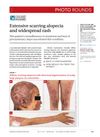 March 2022 in “The Journal of Family Practice”
 Following treatment plans is crucial to prevent worsening skin and hair conditions.
 4 citations
,
August 2010 in “Journal of the American Academy of Dermatology”
4 citations
,
August 2010 in “Journal of the American Academy of Dermatology” This case report involves a 56-year-old woman with idiopathic thrombocytopenic purpura and scarring alopecia, suggesting diagnoses including discoid lupus erythematosus and lichen planopilaris without presenting new clinical findings.
23 citations
,
June 1977 in “Clinical and experimental dermatology” This study described clinical findings in 71 patients with pityriasis amiantacea, noting that skin biopsies in 18 of these cases showed prominent eczematous changes.
April 2019 in “Journal of Investigative Dermatology” Researchers created a new mouse model for studying scleroderma.
September 2007 in “Hair transplant forum international” This commentary describes a case of a 22-year-old man who had a 550-graft hair transplant performed by a novice cosmetic surgeon but reports no new clinical results.
 February 2024 in “Frontiers in physiology”
 In this review, the authors explore strategies for inducing scarless skin regeneration by modulating dermal signaling or specific fibroblast subsets to promote the formation of new hair follicles in wounds, particularly focusing on mimicking neonatal skin's regenerative capabilities.
1 citations
,
March 2012 in “Actas dermo-sifiliográficas/Actas dermo-sifiliográficas” Dermoscopy helps diagnose frontal fibrosing alopecia by identifying specific scalp features.
 December 2021 in “Journal of clinical images and medical case reports”
 This descriptive study observed that a "moth-eaten" pattern of hair loss can occur in several skin diseases, with lichen planopilaris and discoid lupus erythematosus being among the most common conditions identified in patients from Baghdad, emphasizing its potential as a diagnostic tool for clinicians.
1 citations
,
January 2010 This article reviews various reconstruction techniques for scalp alopecia, highlighting the challenges of applying traditional flap methods and the limitations of hair grafting on unstable scars but offers no new study results.
 July 2026 in “Preprints.org”
 In this case study, a comprehensive reconstruction approach using autologous fat grafting, follicular unit excision hair transplantation, and scalp micropigmentation led to significant aesthetic and psychosocial improvements in a male patient with severe facial and scalp burn injuries.
1 citations
,
March 2023 in “Anais Brasileiros de Dermatologia” July 2022 in “Zenodo (CERN European Organization for Nuclear Research)” This promotional text advises against certain hair restoration methods near Coral Springs but provides no new clinical research findings.
 March 2026 in “Scholarly Horizons University of Minnesota Morris Undergraduate Journal”
 This study explores how cultural perceptions of hair used in art have evolved from the Victorian Era to now, analyzing theories of disgust and abjection, and highlighting hair art's historical ties to death and mourning.
 15 citations
,
February 1999 in “The anatomical record”
15 citations
,
February 1999 in “The anatomical record” This study found that defective cross-linking in hair cuticles is observable in a minority of mouse hair mutants, suggesting different proteins are involved in cross-linking across cell types.