January 2019 in “Figshare” This study found that redhaired individuals exhibit higher calcidiol levels compared to non-redhaired individuals, suggesting a possible evolutionary adaptation for vitamin D photosynthesis in low UV-B environments in Europe.
January 2025 in “Digital Repository (National Repository of Grey Literature)” In this study, analysis of questionnaire data from over 111,000 respondents revealed that red hair is significantly associated with a higher level of mental health problems in both men and women, while red-haired women also exhibited poorer overall physical health.
 December 2019 in “bioRxiv (Cold Spring Harbor Laboratory)”
 This study found that redhaired individuals consistently had higher calcidiol levels compared to non-redhaired subjects, suggesting a physiological adaptation for vitamin D synthesis in low UV-B conditions.
 5 citations
,
June 2020 in “Experimental dermatology”
5 citations
,
June 2020 in “Experimental dermatology” This study found that redheaded individuals had higher levels of vitamin D precursor 25(OH)D3 compared to non-redheaded individuals, suggesting a physiological adaptation to low UVB radiation in Europe.
This study suggests that the prevalence of red beards in individuals with dark hair may be explained by Thayer’s Theorem of countershading.
Fair skin, not red hair, affects health due to possible vitamin D deficiency.
5 citations
,
February 2012 in “Australasian Journal of Dermatology” This case report documents two instances of red-haired men with patch-type alopecia areata, where hair regrowth occurred in black rather than red, an unusual phenomenon potentially linked to pigmentation and receptor pathways.
1 citations
,
January 2012 in “Human health handbooks” This review discusses the factors influencing human hair color, including genetic components like the MC1R gene and enzyme activity, without presenting new experimental results.
This review discusses the factors influencing human hair color, including genetic components and enzymatic activity, and highlights the forensic significance of hair color analysis, but reports no new findings.
 January 2024 in “Australasian journal of dermatology (Print)”
 In this case study, researchers documented a Chinese boy with hair color changing to red and identified MC1R genetic mutations as the cause, rather than zinc deficiency, enhancing our understanding of hair heterochromia due to genetic factors.
June 2025 in “Albus Scientia” This review discusses the role of the MC1R gene in human pigmentation and its genetic variants, reporting no new results; the authors highlight its forensic applications for phenotypic prediction.
 1 citations
,
January 2013 in “International Journal of Trichology”
1 citations
,
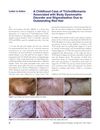
January 2013 in “International Journal of Trichology” A girl with red hair developed hair-pulling and body image disorders after being bullied for her hair color.
9 citations
,
November 2015 in “JAMA dermatology” This case study describes an elderly woman with distinctive black hair patches and scalp pigmentation, but it does not provide a diagnosis or new findings.
June 2025 in “Clinical and Experimental Dermatology” This report describes a rare case where a 76-year-old man's grey scalp hair unexpectedly regained its original orange to brown color after he underwent radiotherapy for squamous cell carcinoma, suggesting possible implications involving hair follicle melanocytes and radiation effects.
November 2011 in “Journal of Investigative Dermatology” TRH in hair follicles can influence hair color by increasing melanin.
18 citations
,
April 1989 in “Archives of Dermatology” This study found that segmented heterochromic scalp hair associated with iron-deficiency anemia in a teenage girl completely recovered following iron supplementation, suggesting a role for iron in hair pigment production.
June 2025 in “Clinical and Experimental Dermatology” In this case report, a 25-year-old woman with alopecia areata experienced hair regrowth after treatment with baricitinib, despite not responding to conventional treatments, with the new hair initially appearing dark brown.
8 citations
,
May 2003 in “Clinical and Experimental Dermatology” This case report suggests that nonsynchronized segmented heterochromia in black scalp hair in a 14-year-old girl may represent premature greying unrelated to deficiencies in iron, copper, zinc, or protein.
94 citations
,
April 2018 in “Nature Genetics” This study identified more than 100 genetic loci associated with hair color variation in Europeans, explaining a significant portion of the trait's heritability and advancing understanding of hair pigmentation.
2 citations
,
August 2002 in “PubMed” 16 citations
,
November 2003 in “Journal of the American Academy of Dermatology” Iron therapy cured the boy's hair color issue.
1 citations
,
September 2021 in “Biomedical & Pharmacology Journal” This study found that the reticulocyte hemoglobin content (CHr) most frequently indicated iron deficiency in female patients with diffuse non-scarring hair loss.
1 citations
,
May 2012 in “Clinical and Experimental Dermatology” This article discusses the presence of iron in segmented heterochromia of scalp hair and concludes that it occurs without iron-deficiency anemia, reporting no new clinical results.
May 2024 in “Cardiometry” This study documented that after hair transplantation, 34 patients with white or gray hair in the donor area experienced color repigmentation, with most regaining their original blackish color in the recipient area over a 1-year follow-up.
January 1996 in “Journal of Investigative Dermatology” 24 citations
,
January 2023 in “Cancer Research” This study suggests that activating AMPK to phosphorylate ZDHHC13 may enhance MC1R function and reduce melanoma risk in individuals with red hair.

This article discusses localized repigmentation of hair, suggesting it may be an indicator of underlying melanoma, and emphasizes the need for careful diagnostic evaluation.
15 citations
,
June 1993 in “Archives of Dermatology” This letter discusses the causes of gray hair, noting both genetic factors and potential associations with other conditions or certain medications, but reports no new findings.
March 2026 in “Journal of Investigative Dermatology”  July 2024 in “Dermatology and Therapy”
 This study found that individuals with black hair have a significantly higher risk of alopecia areata compared to those with dark brown hair, while lighter hair colors like red or blonde are associated with a lower risk.