1 citations
,
November 2025 in “Aging Cell” This review discusses the role of the ectodysplasin A2 receptor as a biomarker and driver of ageing related to inflammation, and its potential therapeutic implications, but reports no new clinical findings.
11 citations
,
October 2021 in “Orphanet journal of rare diseases” This study found that patients with RASopathies have lower serum IgA and CD8 levels compared to controls, indicating a potential risk for developing autoimmune disorders.
 1 citations
,
November 2025 in “Clinical Chemistry and Laboratory Medicine (CCLM)”
1 citations
,
November 2025 in “Clinical Chemistry and Laboratory Medicine (CCLM)” This study developed a new measurement procedure using isotope dilution-liquid chromatography-tandem mass spectrometry for accurate quantification of DHEAS in human serum or plasma, demonstrating high selectivity, sensitivity, and low measurement uncertainty, making it suitable for routine standardization and clinical evaluation.
 26 citations
,
June 2018 in “The journal of immunology/The Journal of immunology”
26 citations
,
June 2018 in “The journal of immunology/The Journal of immunology” This study demonstrated that AIRE-deficient rats exhibit key symptoms of APECED, making them a relevant model for exploring potential treatments.
9 citations
,
February 2020 in “Materials Express” In a study on female SD rats, the authors found that RADA16-1 short-peptide nano-fiber gel scaffolds improved burn wound healing, hair follicle growth, hair growth length, and expression of bFGF and EGF compared to a NaCl control.
July 2026 in “Journal of the American Academy of Dermatology” Ritlecitinib helps adolescents with severe alopecia areata regrow scalp hair and normalize body hair and nails.
 April 2023 in “The journal of investigative dermatology/Journal of investigative dermatology”
 This study found that treatment with ritlecitinib led to significant scalp hair regrowth in patients with alopecia areata at Weeks 24 and 48, with higher response rates observed in those receiving 50 mg compared to 30 mg doses.
50 citations
,
February 2004 in “Genomics” This study identified a missense mutation in the rat Desmoglein 4 gene, causing abnormal hair shaft development in lanceolate hair mutant rats by disrupting a critical calcium binding site.
This study concluded that the combination of all-trans-retinoic acid and tocopherol-α is not recommended for treating del(5q) myelodysplastic syndromes due to low efficacy and high incidence of adverse effects.
 June 2025 in “Journal of the Pakistan Medical Association”
 In this study, researchers explored the use of a 2-deoxy-D-ribose sodium alginate hydrogel on mice with androgenic alopecia and found it resulted in similar hair regrowth to minoxidil, highlighting increased hair follicle density and angiogenesis.
57 citations
,
August 1997 in “Pediatrics International” This abstract discusses two types of hereditary vitamin D metabolism defects, VDDR I and VDDR II, and reports on their distinct characteristics and treatment responses, without presenting new clinical data.
1 citations
,
November 2025 in “American Journal of Clinical Dermatology” This study reports that long-term treatment with ritlecitinib is generally well tolerated for up to approximately five years in patients aged 12 and older with alopecia areata, with the safety profile aligning with previous data from the ALLEGRO clinical trials.
 29 citations
,
July 2012 in “The Journal of Sexual Medicine”
29 citations
,
July 2012 in “The Journal of Sexual Medicine” In this study using a rat model, discontinuing dutasteride improved some relaxant responses but did not fully restore erectile function, indicating a potential time-dependent detriment of the drug.
1 citations
,
August 2023 in “Journal of Investigative Dermatology” Farudodstat may help treat alopecia areata by protecting hair follicles.
 3 citations
,
February 2019 in “Disease Markers”
3 citations
,
February 2019 in “Disease Markers” This study reports that a lower 2D:4D finger length ratio is significantly associated with higher disease activity and reduced spinal mobility in females with ankylosing spondylitis, but not in males.
2 citations
,
June 2025 in “Journal of Investigative Dermatology” CD8+ T cells re-expressing CD45RA may predict treatment resistance in severe alopecia areata.
13 citations
,
February 2025 in “Journal of the European Academy of Dermatology and Venereology” Ritlecitinib shows promise for treating alopecia areata, especially with early and extended treatment.
75 citations
,
January 2004 in “Molecular and Cellular Biology” In this study, EDA-A2 transgenic mice exhibited multifocal myodegeneration dependent on XEDAR, suggesting a potential role for XEDAR in skeletal muscle homeostasis.
 June 2026 in “Dermatology and Therapy”
 This study reported that ritlecitinib was prescribed to a diverse group of patients with severe alopecia areata in the first 10 months after FDA approval, indicating its potential role in AA management.
May 2026 in “Dermatology and Therapy” This study reports that among adults with severe alopecia areata taking ritlecitinib, 49% saw hair regrowth within 3 months, increasing to 82% after more than 6 months; treatment satisfaction also rose with longer duration, indicating sustained efficacy and improved quality of life over time.
3 citations
,
November 2023 in “Journal of Investigative Dermatology” Over 45% of patients with alopecia areata benefit from ritlecitinib, mostly within a year.
 May 2012 in “Journal of Clinical Oncology”
 This study found a significant association between male breast cancers and exposure to finasteride and dutasteride, with an estimated additional case per 564 men taking these drugs.
1 citations
,
November 2023 in “Journal of Investigative Dermatology” Farudodstat may effectively treat alopecia areata without harming hair follicles.
 January 2023 in “Surgical & Cosmetic Dermatology”
 This report describes a 17-year-old woman who experienced severe anagen effluvium after DRESS syndrome but achieved full recovery in two months with topical minoxidil.
May 2026 in “Journal of Medicinal Chemistry” In this study, the authors developed a novel PROTAC named dAR-6–1, which demonstrated superior hair regeneration in an AGA mouse model compared to minoxidil, highlighting its promise as a therapy due to potent AR degradation and excellent skin permeability.
 1 citations
,
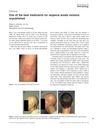
June 2018 in “International Journal of Dermatology”
1 citations
,
June 2018 in “International Journal of Dermatology” DNCB is highly effective for treating alopecia areata with minimal long-term side effects.
2 citations
,
July 2013 in “Journal of Life Sciences” In this case report, researchers described a two-year-old girl with Vitamin D dependent rickets Type II, noting elevated 1,25-dihydroxyvitamin D3 and alopecia, and observed limited treatment response likely due to poor compliance.
 3 citations
,
August 2023 in “Drug safety”
3 citations
,
August 2023 in “Drug safety” This source reports that trastuzumab deruxtecan improves outcomes in HER2-positive and HER2-low metastatic breast cancer, emphasizing the need for careful adverse event monitoring, particularly for interstitial lung disease, and managing emetic risk to maximize benefits.
48 citations
,
June 2000 in “Japanese Journal of Cancer Research” This study found that dimethylarsinic acid significantly accelerates skin tumor development in hair follicle-targeted K6/ODC transgenic mice.
157 citations
,
September 2012 in “Journal of the American Academy of Dermatology” In this retrospective cohort study, researchers reported that 11.5% of patients with DRESS developed significant long-term autoimmune or renal sequelae, with age influencing the type of sequelae observed.