37 citations
,
June 2000 in “Experimental dermatology” This study investigated a spontaneous mutation in mice resulting in hair abnormalities and elevated IgE levels, which resembles human Netherton's syndrome and monilethrix.
May 2024 in “International journal of medicine and psychology.” This study examined monoclonal antibodies LT-1, LT-2, and LT-7, finding they can effectively detect certain antigens on T and B cells involved in various lymphoproliferative diseases, aiding in the diagnosis of both acute and chronic lymphoid neoplasias.
September 2022 in “European Journal of Dermatology” This study identified a novel pathogenic splice-site variant of the LAMB3 gene in patients with junctional epidermolysis bullosa, highlighting the importance of gene sequencing for diagnosis.
 2 citations
,
January 2011 in “Dental Medicine Research”
2 citations
,
January 2011 in “Dental Medicine Research” This study suggests that Keratin 6hf may be a potential marker of oral squamous cell carcinoma and could play a role in its progression, though further research is needed to understand its function.
 April 2017 in “Journal of Investigative Dermatology”
 This study identified that dominant mutations in the KLHL24 gene cause epidermolysis bullosa through dysregulated autoubiquitination, leading to excessive degradation of keratin 14.
 June 2017 in “Journal of evolution of medical and dental sciences”
 This study observed that lupus erythematosus-specific skin lesions were more common than nonspecific ones and can serve as diagnostic clues, while nonspecific lesions were more often linked to systemic disease.
19 citations
,
February 2001 in “Journal of paediatrics and child health” This report documents a 14-year-old Chinese boy with mitochondrial encephalopathy, lactic acidosis, stroke-like episodes, and a de novo A3243G mitochondrial DNA mutation, highlighting the condition's multisystem involvement without ragged red fibers in muscle biopsy.
1 citations
,
January 2015 in “The Journal of Dermatology” This letter to the editor presents a case of non-Herlitz junctional epidermolysis bullosa associated with a COL17A1 mutation and reports no new clinical findings.
1 citations
,
July 2025 in “Journal of Investigative Dermatology” 1 citations
,
October 2019 in “PubMed” This study successfully created a mouse model with conditional knockout of the p75 neurotrophin receptor gene in epidermis cells, with no significant changes in skin histomorphology observed.
 10 citations
,
March 2015 in “American journal of primatology”
10 citations
,
March 2015 in “American journal of primatology” This study found that ringtailed lemurs consuming leucaena in Berenty absorb mimosine, which causes alopecia without affecting body condition or organ toxicity; this may increase infant mortality due to alopecic mothers.
 17 citations
,
October 2006 in “Molecular and Cellular Endocrinology”
17 citations
,
October 2006 in “Molecular and Cellular Endocrinology” This study found that the L457(3.43)R mutation in the human luteinizing hormone receptor increases phosphodiesterase activity, reducing hormonal response despite elevated basal cAMP levels.
 5 citations
,
February 1977 in “Archives of Dermatology”
5 citations
,
February 1977 in “Archives of Dermatology” This study reports that 14 of 19 patients with erythema nodosum leprosum had C3 deposits in vessel walls when examined using direct immunofluorescence.
Lupus is a complex disease that requires personalized treatment because it varies greatly between individuals.
 August 2025 in “Tropical Journal of Natural Product Research”
 In this study, LEON gel—an innovative nanoliposome-based delivery system for lavender essential oil—showed significant hair growth acceleration in male white rats without causing irritation, suggesting enhanced effectiveness compared to traditional essential oil use.
 January 1994 in “Nippon Ronen Igakkai Zasshi Japanese Journal of Geriatrics”
 In this study, both VEPA and ML-Y1 treatment regimens for older patients with non-Hodgkin's lymphoma showed similar response and survival rates, but neither was sufficient, indicating the need for a more effective approach.
June 2010 in “Chinese Journal of Dermatology” This study found a novel R430Q gene mutation in hHb6, which may be linked to the hereditary hair disorder monilethrix in the examined family.
18 citations
,
January 2018 in “BMC dermatology” This paper describes a case of epidermolysis bullosa simplex with muscular dystrophy associated with a novel PLEC mutation and diffuse alopecia, highlighting a potential genetic link that remains uncertain.
3 citations
,
September 2022 in “European Journal of Dermatology” This report identifies a novel splice-site variant in the LAMB3 gene linked to junctional epidermolysis bullosa, emphasizing the need for gene sequencing in diagnosing the disease.
 1 citations
,
February 1977 in “Archives of Dermatology”
1 citations
,
February 1977 in “Archives of Dermatology” This case report describes a 2-month-old infant with a severe seborrhea-like skin eruption and respiratory distress, similar to symptoms that led to a sibling's death from Gram-negative septicemia.
36 citations
,
July 1996 in “The journal of investigative dermatology/Journal of investigative dermatology” This research reports a new autosomal recessive mutation in mice, 'lanceolate hair', causing generalized alopecia and hair shaft abnormalities, which may serve as a model for Netherton's syndrome in humans.
October 2023 in “Lithuanian University of Health Sciences” This study investigated the TG5 gene polymorphism in Lithuanian beef cattle, finding that the CC genotype is associated with higher productivity traits, such as live weight and carcass weight, compared to other genotypes, and noted a statistically significant impact on these traits.
April 2026 in “Frontiers in Medicine” This study observed that 675-nm diode laser therapy may serve as a safe and possibly effective adjuvant treatment for telogen effluvium, showing improvements in hair pull test results, pruritus, and trichodynia among patients. However, controlled studies are needed to confirm its efficacy.
![The Synthesis of (−)-4-Methyl-8-Chloro-Trans-1,2,3,4,4a,5,6,10b-Octahydrobenzo-[f]-Quinolin-3-One-[3-14C] (LY300502-14C) via a Circuitous Route](/images/assets/73bab8dc-bdf0-45e3-8ef7-73d0d4b93cb1/small/21074.jpg) 3 citations
,
October 1994 in “Journal of Labelled Compounds and Radiopharmaceuticals”
3 citations
,
October 1994 in “Journal of Labelled Compounds and Radiopharmaceuticals” This synthesis report details the successful development of a C-14 labeled isotopomer of LY300502, a 5α-reductase inhibitor, through a multi-step radiochemical process.
 1 citations
,
March 2015 in “Journal of the European Academy of Dermatology and Venereology”
1 citations
,
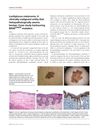
March 2015 in “Journal of the European Academy of Dermatology and Venereology” This letter to the editor shares a case study of lentiginous melanoma that appears clinically malignant but histopathologically benign, involving the BRAFV600R mutation.
December 2018 in “Bioscience Journal” This study reports the first known occurrence of Leporacarus gibbus infestation alongside Cheyletiella parasitovorax and Psoropotes cuniculi in a domestic rabbit in Espírito Santo, Brazil.
This study found that four bacterial isolates from a microbiology laboratory collection demonstrated resistance to selenate, with molecular analysis showing they closely resemble different strains of Bacillus megaterium.
 9 citations
,
December 2002 in “Novartis Foundation Symposium”
9 citations
,
December 2002 in “Novartis Foundation Symposium” In this research, LEF1 was identified as a crucial transcription factor for submucosal gland development in mouse and ferret tracheas, though it requires other factors to induce gland formation.
 November 2022 in “Piretc”
 This review discusses the historical development and market presence of financial leasing, emphasizing its advantages, but reports no new research findings.
10 citations
,
January 2003 in “Dermatology” This study describes a Japanese family with monilethrix and found no clear genotype/phenotype correlation in cases with the E413K mutation in hHb6.