42 citations
,
September 1985 in “British Journal of Dermatology” This study found that trichothiodystrophic hair shows reduced and disoriented protein deposition in follicles, with both the cuticle and cortex affected, providing localized structural insights into keratin abnormalities.
 34 citations
,
April 2016 in “International Journal of Dermatology”
34 citations
,
April 2016 in “International Journal of Dermatology” In this study, certain trichoscopic features were found to be sensitive and specific for diagnosing primary cicatricial alopecias and its subtypes using dermatoscopy.
 11 citations
,
September 2011 in “Biochemical journal”
11 citations
,
September 2011 in “Biochemical journal” This study found that neurotrophin-4 regulates Cav3.2 T-current expression in D-hair neurons via TrkB receptor activation, highlighting its role in mechanosensitive function.
10 citations
,
November 2018 in “The Italian Journal of Pediatrics/Italian journal of pediatrics” This case report identifies a mutation in the TRPS1 gene, leading to the diagnosis of trichorhinophalangeal syndrome type I in a young girl and her family, highlighting the importance of detailed clinical and family history for proper diagnosis.
1 citations
,
January 1980 in “Acta Dermato Venereologica” This study found that oral tetracycline hydrochloride significantly reduced the free fatty acid/triglyceride ratio in hair lipids of young men and women treating acne vulgaris, with or without additional ethyl lactate application.
 4 citations
,
May 2011 in “Movement Disorders”
4 citations
,
May 2011 in “Movement Disorders” A woman's unique dementia was misdiagnosed, a genetic mutation increases Parkinson's risk with age, and finasteride may help with Tourette syndrome.
October 2022 in “The Laryngoscope” The InCISE score is a promising tool for assessing wound healing in head and neck surgery but needs more research for broader use.
 1 citations
,
January 2017 in “International Journal of Dermoscopy”
1 citations
,
January 2017 in “International Journal of Dermoscopy” This study observed that dermoscopy is a valuable tool for hair transplant surgeons to evaluate and improve the aesthetic outcomes and address technical errors in transplant procedures.
April 2012 in “Informa Healthcare eBooks” Some drugs for inflammation may cause psoriasis-like hair loss.
37 citations
,
January 1986 in “Carcinogenesis” This study found that TPA treatment transiently induces high levels of ODC in mouse epidermal cells, particularly around hair follicles, with localization reduced by retinoic acid or cycloheximide pretreatment.
 1 citations
,
August 2024 in “Transgenic Research”
1 citations
,
August 2024 in “Transgenic Research” In this study, the researchers observed that inducing and then withdrawing β-catenin expression in a bigenic mouse model caused reversible changes in skin morphology, indicating dependence on β-catenin signaling.
March 2016 in “Cairn.info” This abstract discusses the potential link between unexplained infant crying and tourniquet syndrome, noting the importance of considering underlying causes such as abuse, but reports no new clinical findings.
1 citations
,
January 2024 in “Pharmaceuticals” The researchers reported that dPGS-PCL as a carrier improved the penetration of tofacitinib in an ex-vivo human skin model compared to free tofacitinib, but did not show significant differences in inhibiting IL-6 and IL-8 during short incubation.
8 citations
,
August 2014 in “Journal of Clinical Oncology” This article explores the historical development and evolution of stereotactic radiosurgery (SRS) and stereotactic body radiation therapy (SBRT), emphasizing advancements in safety and technology, and reports no new clinical results.
 4 citations
,
February 2014 in “Journal of the European Academy of Dermatology and Venereology”
4 citations
,
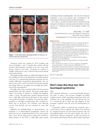
February 2014 in “Journal of the European Academy of Dermatology and Venereology” Early diagnosis of hair tourniquet syndrome saved a baby's toe from being lost.
11 citations
,
January 1957 in “Journal of Histochemistry & Cytochemistry” This study demonstrated radiocalcium uptake in skin, eye, cartilage, and mucous glands, with the highest concentration in the hair follicle's keratogenous zone.
 301 citations
,
May 1998 in “Genes & Development”
301 citations
,
May 1998 in “Genes & Development” Ets2 gene is crucial for placental development in mice.
 April 2026 in “Zenodo (CERN European Organization for Nuclear Research)”
 This study examines how conditions like PSSD, Long COVID, and ME/CFS form a "Post-Exposure Syndromes" family, initiated by transient exposures but persisting due to complex state-space dynamics, and suggests improving pharmacovigilance to better address and understand these persistent syndromes.
This case report highlights that Tjalma Syndrome may present as a main symptom of systemic lupus erythematosus and should be considered in patients with ascites, pleural effusions, and elevated CA-125 levels.
 2 citations
,
January 2023 in “Journal of Education, Health and Sport”
2 citations
,
January 2023 in “Journal of Education, Health and Sport” In this study, researchers reviewed current treatments for trichotillomania and found that psychotherapy, particularly cognitive-behavioral therapy like habit reversal training, is most effective, with some medications helping to alleviate symptoms, though further study is needed on their use.
 September 2022 in “XXXIX Congresso Brasileiro de Reumatologia”
 In this case report, a 42-year-old woman with cutaneous dermatomyositis showed significant improvement, including reduction of erythema, pruritus, and scaling, after starting JAK inhibitor tofacitinib, especially when conventional systemic treatments failed and intravenous immune globulin wasn't viable.
 15 citations
,
June 2019 in “Journal of Neuroendocrinology”
15 citations
,
June 2019 in “Journal of Neuroendocrinology” This study found that isoallopregnanolone reduced stress-induced tic-like behaviors and sensorimotor gating deficits in a mouse model of Tourette syndrome, suggesting potential therapeutic properties comparable to existing treatments like haloperidol and finasteride.
 December 2007 in “Röntgenpraxis”
 This review discusses various treatments for androgenic alopecia, highlighting FDA-approved options and other commonly used therapies, but reports no new clinical results.
January 2025 in “International Journal of Trichology” This case report documents a rare instance of body-focused repetitive behavior in a 37-year-old male physician who compulsively pulled hair from his thighs due to exam stress, highlighting the variability in presentation and demographics of such disorders and the potential for psychiatric comorbidity.
September 2016 in “Journal of Dermatological Science” Polarizing light microscopy can easily and reliably diagnose congenital keratinizing disorders like Netherton syndrome.
 May 2023 in “Frontiers in Endocrinology”
 This study found that tildacerfont treatment in males with congenital adrenal hyperplasia reduced androgen levels and improved markers of testicular function, suggesting potential benefits for male reproductive health.
 24 citations
,
September 2014 in “Journal of the European Academy of Dermatology and Venereology”
24 citations
,
September 2014 in “Journal of the European Academy of Dermatology and Venereology” This study suggests that trichoscopy with a handheld dermatoscope may help differentiate temporal triangular alopecia from other localized alopecia by identifying specific hair features.
 April 2026 in “Zenodo (CERN European Organization for Nuclear Research)”
 This presentation argues that post-exposure syndromes like PSSD and Long COVID form a coherent group of conditions driven by complex interactions in high-dimensional state spaces rather than singular molecular pathways.
13 citations
,
January 2018 in “Skin Appendage Disorders” This study found that dermoscopy improves clinical diagnosis accuracy for trichostasis spinulosa and proposes a new dermoscopic classification with implications for treatment outcomes.

The researchers reported a case where treatment with tofacitinib improved both hair loss and skin lesions in a patient with Graham-Little-Piccardi-Lassueur Syndrome and hidradenitis suppurativa over six months, with no recurrence or adverse events during two-year follow-up.