 2 citations
,
April 2018 in “Journal of Investigative Dermatology”
2 citations
,
April 2018 in “Journal of Investigative Dermatology” This study defines two types of RDEB wounds, chronic open and recurrent, and finds that patient self-reports on wound size correlate well with investigator measurements when complemented by serial photography.
13 citations
,
January 2001 in “Pediatric dermatology” This study reports pseudopili annulati in a dark-haired Chinese girl, identifying the unique appearance and structural characteristics of her hair without finding abnormalities in the cuticle and cortex.
 12 citations
,
April 1990 in “PubMed”
12 citations
,
April 1990 in “PubMed” This review discusses physiologic skin changes and various dermatoses associated with pregnancy but reports no new clinical findings, highlighting limited understanding of some conditions' etiologies.
5 citations
,
March 2010 in “International Journal of Dermatology” This article reports on a case of congenital localized basaloid follicular hamartoma and reviews existing literature without presenting new clinical findings.
13 citations
,
January 2010 in “PubMed” In this study, pilomatricoma, a benign skin tumor from hair follicle matrix cells, is highlighted as an important consideration when diagnosing painless, firm subcutaneous nodules, with accurate diagnosis relying on histopathological examination.
 June 2023 in “British Journal of Dermatology”
 This study reviews historical accounts suggesting several British monarchs suffered from various skin diseases, including leprosy, psoriasis, stasis dermatitis, systemic lupus erythematosus, and porphyria.
 12 citations
,
July 2016 in “Forensic science international”
12 citations
,
July 2016 in “Forensic science international” This study found that postmortem root banding in hair is likely due to the degradation of the intermacrofibrillar matrix in the cortex, with no damage to the cuticle observed.
1 citations
,
October 2015 in “Actas Dermo-Sifiliográficas” 35 citations
,
October 2019 in “Journal of pediatric health care” This article reviews the clinical presentations, pathophysiology, and treatment options for various skin conditions in children with skin of color and reports no new findings.
 35 citations
,
December 2014 in “Clinical Obstetrics and Gynecology”
35 citations
,
December 2014 in “Clinical Obstetrics and Gynecology” This article discusses skin changes during pregnancy and emphasizes the importance of recognizing these physiological manifestations to prevent unnecessary tests and stress for pregnant patients; it reports no new study findings.
22 citations
,
May 2007 in “Molecular Biotechnology”  December 2023 in “International Journal of Research in Dermatology”
 This case report describes Halo Scalp Ring, a rare type of non-scarring alopecia in newborns, emphasizing the importance of proper diagnosis to avoid unnecessary tests and timely referral for potential hair restoration if scarring alopecia develops.
 December 2022 in “The journal of pediatrics/The Journal of pediatrics”
 This case report describes a diagnosis of cutaneous pilus migrans in a 19-month-old girl, highlighting its rarity and distinction from larva migrans, and confirming it through microscopic examination.
10 citations
,
June 1999 in “Veterinary Dermatology” This report documents follicular dysplasia with pigmentary changes in two adult cows, contributing to the understanding of this rare condition in cattle.
 58 citations
,
June 2018 in “Scientific reports”
58 citations
,
June 2018 in “Scientific reports” This study identified novel genetic associations with skin phenotypes such as age-spots, freckles, and hair characteristics in Japanese women, providing insights into the genetic basis of these traits.
8 citations
,
December 2019 in “Molecular genetics and metabolism reports” This study found that early biochemical screening and molecular confirmation are crucial for distinguishing profound from partial biotinidase deficiency, which supports timely treatment and management in symptomatic children.
68 citations
,
December 1983 in “British Journal of Dermatology” This study found HLA and beta 2-microglobulin antigens in various skin structures, with specific localization patterns in keratinocytes and hair follicle components, but not in eccrine or apocrine glands.
 April 2018 in “Journal of Investigative Dermatology”
 This study found that BMP signaling is involved in regulating melanogenesis, pigment transfer, and melanocyte migration, contributing to our understanding of skin pigmentation mechanisms.
 58 citations
,
July 2007 in “Clinics in Dermatology”
58 citations
,
July 2007 in “Clinics in Dermatology” This article reviews the use of medical tattooing for cosmetic and therapeutic purposes across various fields, but reports no new clinical results.
March 2013 in “Pigment Cell & Melanoma Research” This study revealed that different coat patterns in cats and cheetahs are related to variations in the aminopeptidase Q gene and endothelin-3 expression, which affects pigment production.
8 citations
,
January 2017 in “Acta Dermato Venereologica” Thorough clinical examination is crucial for diagnosing unusual alopecia.
January 2023 in “Indian Dermatology Online Journal” This case report describes two instances of superficial dermatophytosis in neonates, highlighting the unusual occurrence and successful resolution with topical antifungal treatment.
17 citations
,
September 2009 in “British Journal of Dermatology” This study suggests that clinically apparent fragile hair in children is rarely linked to trichothiodystrophy, and the tiger-tail pattern is not wholly specific to this diagnosis.

This study suggests that holes found in mature hair fibers may be linked to daily hair care actions and the removal of extractable substances.
1 citations
,
August 2023 in “Clinical Cosmetic and Investigational Dermatology” This study found that exclamation mark hairs are the only trichoscopic feature that can differentiate clinically suspicious SA from AA.
 June 2023 in “British Journal of Dermatology”
 This pilot study found that night shift workers showed fewer signs of wrinkle formation compared to day workers, but there were no significant differences in DNA amplification or collagen percentage.
 1 citations
,
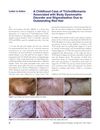
January 2013 in “International Journal of Trichology”
1 citations
,
January 2013 in “International Journal of Trichology” A girl with red hair developed hair-pulling and body image disorders after being bullied for her hair color.
36 citations
,
December 2004 in “British Journal of Dermatology” This case study reports a peculiar variant of an epidermal cyst in a patient, featuring unique characteristics like brownish, lumpy contents resembling bone marrow.
34 citations
,
January 1998 in “Archiv für Pathologische Anatomie und Physiologie und für Klinische Medicin” This report describes four trichoblastoma cases rich in Merkel cells, suggesting these tumors may mimic fetal skin development where Merkel cells are numerous.