 11 citations
,
June 2022 in “Frontiers in immunology”
11 citations
,
June 2022 in “Frontiers in immunology” This review discusses the challenges in identifying specific hair follicle antigens involved in initiating alopecia areata and highlights the need for further research to understand its etiopathogenesis, reporting no new results.
 5 citations
,
December 2015 in “Dermatologic Therapy”
5 citations
,
December 2015 in “Dermatologic Therapy” In this study, topical phenylephrine significantly reduced hair shedding and increased the force needed to pluck hair in women undergoing cosmetic procedures, suggesting its potential utility for traction alopecia.
 7 citations
,
January 2011 in “Veterinary Pathology”
7 citations
,
January 2011 in “Veterinary Pathology” In this case report, a 9-year-old horse was diagnosed with alopecia areata contributing to Malassezia dermatitis, involving lymphocyte infiltration and symptoms consistent with yeast presence.
 July 2018 in “Elsevier eBooks”
 This chapter reviews traction alopecia, discusses its clinical presentation and severity grading, and reports no new clinical results; the authors highlight controversies in its treatment and prevention strategies.
 May 2025 in “Journal of Developmental Biology”
 This study reports that KRTAP-like proteins, which resemble keratin-associated proteins found in mammals, are also present in the cornified teeth of various lamprey species, suggesting these proteins may serve similar functions in skin appendages across different vertebrates despite independent evolutionary origins.
69 citations
,
May 2002 in “Journal of Investigative Dermatology” This study suggests that congenital atrichia with papular lesions may be more common than previously thought and proposes diagnostic criteria including the observation of hypopigmented whitish streaks on the scalp.
May 2025 in “Indian Dermatology Online Journal” This case report highlighted two atypical childhood alopecia cases: congenital atrichia without papules and Bjornstad syndrome with alopecia areata; emphasizing diagnostic challenges, notably the absence of keratotic papules usually associated with congenital atrichia and the presence of alopecia areata in Bjornstad syndrome.
 November 2023 in “Laser therapy”
 In this case report, trichoscopy was highlighted as a vital diagnostic tool for pediatric alopecia areata, showing significant hair regrowth in a 4-year-old girl with toxoplasma-related alopecia after six weeks of therapy, emphasizing its role in tracking therapeutic progress.
 1 citations
,
February 2022 in “Clinical, Cosmetic and Investigational Dermatology”
1 citations
,
February 2022 in “Clinical, Cosmetic and Investigational Dermatology” In this study, researchers found that the thyroxine receptor agonist TDM10842 accelerated the onset of anagen, a hair growth phase, in C3H mice, potentially through activation of the Wnt/beta-catenin and Hedgehog pathways, with Pclaf playing a key role in this process.
 May 2025 in “Scientific and Technical Bulletin оf State Scientific Research Control Institute of Veterinary Medical Products and Fodder Additives аnd Institute of Animal Biology”
 In this study, researchers developed "Akaro Spectra," an antiparasitic tablet for dogs using cryodestruction of plant materials, which showed 100% efficacy against Otodectes cynotis ticks by the second day and 93.76% efficacy against Ixodes, Dermacentor, and Rhipicephalus ticks.
2 citations
,
September 2017 in “Journal of Zoo and Wildlife Medicine” This case report presents the first known instance of cutaneous lymphoma in a nondomestic bovid, documented in a 13-year-old addax.
32 citations
,
August 2016 in “Journal of the American Academy of Dermatology” This letter discusses congenital triangular alopecia (TTA), a non-scarring hair loss condition often seen in children, without reporting new clinical findings.
36 citations
,
July 1996 in “The journal of investigative dermatology/Journal of investigative dermatology” This research reports a new autosomal recessive mutation in mice, 'lanceolate hair', causing generalized alopecia and hair shaft abnormalities, which may serve as a model for Netherton's syndrome in humans.
 April 2016 in “Actas Dermo-Sifiliográficas”
 The document concludes that a unique target-like hair regrowth pattern in alopecia areata may be more common than thought and should be properly identified.
 19 citations
,
May 2006 in “Clinical and Experimental Dermatology”
19 citations
,
May 2006 in “Clinical and Experimental Dermatology” This study identified a novel insertion mutation in the hairless gene that may contribute to the development of congenital atrichia with papular lesions in a Pakistani family.
26 citations
,
October 2002 in “Journal of Investigative Dermatology” This study identifies a mutation in the hairless gene that may impact thyroid receptor interaction, contributing to alopecia universalis congenita in an Arab Israeli patient.
 31 citations
,
October 2010 in “Journal of the European Academy of Dermatology and Venereology”
31 citations
,
October 2010 in “Journal of the European Academy of Dermatology and Venereology” The authors concluded that some patients clinically diagnosed with telogen effluvium may actually have alopecia areata incognita, suggested by the presence of dystrophic hairs and development of alopecia patches.
 30 citations
,
January 2014 in “Dermatologic Clinics”
30 citations
,
January 2014 in “Dermatologic Clinics” This review discusses traction alopecia in individuals with Afro-textured hair and emphasizes the importance of education to prevent this condition, but it reports no new clinical results.
July 2026 in “Indian Journal of Dermatology Venereology and Leprology” 8 citations
,
January 2017 in “Journal of Biological Chemistry” This study found that astrotactin-2 undergoes unique intramembrane proteolysis during maturation, revealing specific transmembrane topologies and substrate sequence requirements for cleavage.
January 2002 in “Linchuang pifuke zazhi” This report describes an unusual case of proliferating trichilemmal cyst with trichoepitheliomatous change in a young woman, differing from its typical presentation in elderly women.
6 citations
,
December 2017 in “International Journal of Dermatology” Traction alopecia is hair loss from pulling on hair too much.
 60 citations
,
April 2018 in “Clinical, cosmetic and investigational dermatology”
60 citations
,
April 2018 in “Clinical, cosmetic and investigational dermatology” This review discusses the causes and diagnosis of traction alopecia, emphasizing education for high-risk populations as there is currently no cure, and presents no new clinical findings.
 1 citations
,
January 2018 in “Acta dermato-venereologica”
1 citations
,
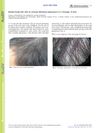
January 2018 in “Acta dermato-venereologica” A teenager's hair with alternating white and dark bands, known as Pili annulati, is a genetic condition that is usually harmless and often considered attractive.
2 citations
,
July 2019 in “Indian dermatology online journal” This report documents a rare case of familial eyelash trichomegaly and synophrys in three siblings, with one sister also having loose anagen hair syndrome, an unreported association.
 February 2013 in “Journal of the American Academy of Dermatology”
 This case report found that intense focused skin tightening ultrasound reduced excessive underarm sweating by nearly 80% in two patients and was associated with temporary side effects like tenderness and redness.
3 citations
,
January 2016 in “Journal of Clinical & Cellular Immunology” In this study, increased production of CXCL10 was associated with the infiltration of Th1 and Tc1 cells in acute alopecia areata, suggesting a possible new target for treatment.
 11 citations
,
October 2018 in “Pediatric dermatology”
11 citations
,
October 2018 in “Pediatric dermatology” In this case report, the authors describe a child with treatment-resistant alopecia areata who successfully responded to leflunomide and anthralin, proposing this combination as a potentially cost-effective alternative for managing recalcitrant cases by possibly inhibiting the JAK/STAT pathway.
April 2012 in “Neuropediatrics” This article reviews the genetic and phenotypic characteristics of Trichothiodystrophy and discusses the associated DNA repair defects, but does not report new clinical findings.
 December 2020 in “TURKDERM”
 This case report describes a 3-year-old boy diagnosed with temporal triangular alopecia, emphasizing the importance of clinical and dermoscopic examination for correct diagnosis due to the condition's rarity and risk of misdiagnosis.