December 2015 in “PLOS ONE” This content contains no study findings or new results, instead referring only to statistical methods and figure captions.
April 2023 in “Journal of Investigative Dermatology” 3D ultrasound can detect hair follicle changes and disease phases in alopecia areata.
 12 citations
,
August 2011 in “European Journal of Endocrinology”
12 citations
,
August 2011 in “European Journal of Endocrinology” This study found that anti-Müllerian hormone (AMH) is a valuable primary variable for classifying functional androgenization, especially in distinguishing ovarian-related groups, and supports the novel stratification system.
 16 citations
,
February 2010 in “Journal of the European Academy of Dermatology and Venereology”
16 citations
,
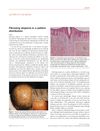
February 2010 in “Journal of the European Academy of Dermatology and Venereology” This article is a letter to the editor about fibrosing alopecia in a pattern distribution and reports no new research findings.
9 citations
,
March 2018 in “International journal of molecular sciences” This study suggests that the progesterone metabolite allopregnanolone and progesterone regulate distinct gene sets involved in glioblastoma cell proliferation, with some overlapping effects modified by finasteride.
 76 citations
,
April 2005 in “Cancer Epidemiology, Biomarkers & Prevention”
76 citations
,
April 2005 in “Cancer Epidemiology, Biomarkers & Prevention” This study found that the AR-E211 A allele is associated with a lower risk of both metastatic prostate cancer and androgenetic alopecia in an Australian population.
March 2026 in “JID Innovations” In a mouse model study, researchers found that mutations in Aire reduced alopecia areata frequency, while Notch4 mutations did not lead to the disease, likely due to proximity with a resistance gene.
 10 citations
,
January 1977 in “Archives of Dermatology”
10 citations
,
January 1977 in “Archives of Dermatology” This article discusses the term "androgenetic alopecia" proposed to replace "male pattern alopecia," noting its limited use in American dermatology literature.
4 citations
,
January 2020 in “Dermatology Online Journal” In this report, a 1-year-old boy with congenital atrichia with papular lesions was found to have a complete absence of scalp and body hair and keratin-filled cysts due to a mutation in the hairless gene.
 1 citations
,
March 2023 in “bioRxiv (Cold Spring Harbor Laboratory)”
1 citations
,
March 2023 in “bioRxiv (Cold Spring Harbor Laboratory)” This study found that Dermal Fibroblast Progenitors have repressed chromatin profiles which hinder their ability to reform skin in allograft assays despite their differentiation potential.
2 citations
,
January 2023 in “Skin Appendage Disorders” This study suggests a potential role for systematic scalp examinations in first-degree relatives of patients with pattern cicatricial alopecia.
July 2024 in “Journal of Investigative Dermatology” This study found that in mice with alopecia areata, CD8+ T cells showed clonal expansion and specific regulatory networks, which might help identify new therapeutic targets for patients not responding to JAK inhibitors.
25 citations
,
June 2002 in “Steroids” This study examined 4-azasteroids using 13C-NMR spectroscopy, detailing the NMR spectrum assignments and reporting a new molecular complex of finasteride with dioxane.
1 citations
,
September 2021 in “Journal of Cosmetic Dermatology” This study found that the ACE gene I/D polymorphism may serve as a genetic susceptibility indicator for androgenetic alopecia in an Egyptian patient group.
September 2023 in “Journal of the American Academy of Dermatology” This meta-analysis found a significant positive association between frontal fibrosing alopecia and both sunscreen and moisturizer use, with the moisturizer association significant only in males.
 4 citations
,
August 2017 in “Journal of Cosmetic Dermatology”
4 citations
,
August 2017 in “Journal of Cosmetic Dermatology” The study found that males with androgenetic alopecia had a significantly lower left-hand 2D:4D digit ratio compared to healthy controls, suggesting this ratio may help estimate future AGA risk.
29 citations
,
July 2004 in “The journal of investigative dermatology/Journal of investigative dermatology” This study observed that in mouse hair follicles, enzymes Aldh1a2 and Aldh1a3 have distinct expression patterns that suggest they are involved in different signaling pathways during the hair cycle.
 December 2023 in “Clinical Cosmetic and Investigational Dermatology”
 This case report describes an 8-year-old boy in Saudi Arabia diagnosed with IFAP syndrome, highlighting its distinct characteristics and distinguishing features from similar conditions, and notes successful genetic confirmation of the disorder.
May 2023 in “Reactions Weekly” January 2013 in “Reactions Weekly”  6 citations
,
January 2016 in “International Journal of Trichology”
6 citations
,
January 2016 in “International Journal of Trichology” This case study suggests that patients with acquired progressive kinking of the hair may benefit from finasteride treatment due to an increased risk of developing androgenetic alopecia.
56 citations
,
July 2004 in “Mechanisms of Development” Pax9 is crucial for proper tongue surface development and preventing skin-like changes.
 4 citations
,
January 2011 in “Annals of Dermatology”
4 citations
,
January 2011 in “Annals of Dermatology” This article discusses the role of HR gene mutations in differentiating atrichia with papular lesions from alopecia universalis, but presents no new experimental results.
 June 2025 in “International Journal of Applied Pharmaceutics”
 This study developed a testosterone-induced androgenetic alopecia model in BALB/c mice, finding that a 0.075 ml testosterone injection best replicated the dermal and hair follicle conditions of AGA patients, providing a promising tool for future drug testing and research into AGA therapies.
1 citations
,
November 2023 in “SKIN The Journal of Cutaneous Medicine”  August 2019 in “Journal of The American Academy of Dermatology”
 PFD patch helps laser tattoo removal, trichoscopy diagnoses AGA, and serum boosts SOD activity.
 13 citations
,
January 2012 in “International journal of trichology”
13 citations
,
January 2012 in “International journal of trichology” This case study describes a 14-year-old girl with pili annulati who had fragile hair, which may be due to cavities within the hair shafts as seen in electron microscopic examinations.
 January 2020 in “Research Portal Denmark”
 This study concludes that anti-androgenic chemicals causing short anogenital distance in male fetuses also induce a feminized transcriptional profile in the perineum, implicating Wnt and estrogen signaling in the process.
This study found that neonatal administration of Allopregnanolone may mitigate some behavioral effects of early maternal separation in adolescence, but also lead to similar adverse effects as the separation in adulthood.