Ketoconazole-P Aminobenzoic Cocrystal Exhibits a Potent Anti-Inflammatory Effect on the Skin of BALB/c Mice
April 2021
in “
Research Square (Research Square)
”
New to Ketoconazole? There is a guide in the encyclopedia. Read the guide → ketoconazole para-amino benzoic acid KET-PABA cocrystal bioavailability biocompatibility antimycotic efficiency skin sensitization anti-inflammatory effect proinflammatory cytokines IL1α IL1β IL6 TNFα NRF2 IL10 COX2 NFκB pathway cutaneous mycosis PABA KET-PABA cocrystal antifungal efficiency skin irritation skin fungal infection
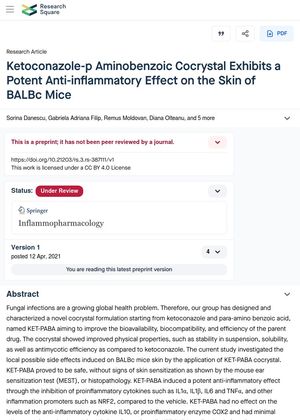
Studysummary This study found that the new cocrystal formulation KET-PABA improved the antimycotic efficiency of ketoconazole and induced an anti-inflammatory response without causing skin sensitization in mice. Our plain-language summary of this paper — not a Tressless recommendation.
The document discusses a novel cocrystal formulation, KET-PABA, created from ketoconazole and para-amino benzoic acid, designed to enhance the bioavailability, biocompatibility, and efficiency of the parent drug. The cocrystal demonstrated improved stability, solubility, and antimycotic efficiency compared to ketoconazole. The study investigated the potential side effects of KET-PABA on the skin of BALBc mice, finding it to be safe with no signs of skin sensitization. Furthermore, KET-PABA exhibited a potent anti-inflammatory effect by inhibiting proinflammatory cytokines such as IL1α, IL1β, IL6, and TNFα, and other inflammation promoters like NRF2. It had no effect on the levels of the anti-inflammatory cytokine IL10, or proinflammatory enzyme COX2 and had minimal effects on the activation of the NFκB pathway. Therefore, KET-PABA cocrystal could potentially be an effective drug in treating cutaneous mycosis due to its improved antimycotic effect and anti-inflammatory action.