Cutaneous Manifestations and Their Relationship with Serum Testosterone and DHEAS Levels in Women with Polycystic Ovary Syndrome: A Cross-Sectional Clinical Study
February 2026
in “
Zenodo (CERN European Organization for Nuclear Research)
”
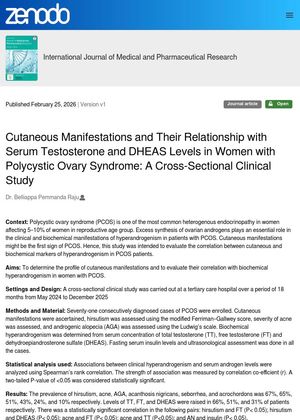
Studysummary In this cross-sectional study at a tertiary care hospital, researchers found a significant correlation between cutaneous manifestations like hirsutism and acne and biochemical hyperandrogenism levels in women with PCOS, suggesting these skin conditions can predict elevated androgen levels.
Our plain-language summary. Not medical advice or a treatment recommendation. Consult a qualified healthcare professional before changing treatment. Full disclaimer
This study investigated the relationship between cutaneous manifestations and biochemical markers of hyperandrogenism in 71 women with polycystic ovary syndrome (PCOS). The prevalence of hirsutism, acne, and androgenic alopecia (AGA) was 67%, 65%, and 51%, respectively. Elevated levels of total testosterone (TT), free testosterone (FT), and dehydroepiandrosterone sulfate (DHEAS) were found in 66%, 51%, and 31% of patients, respectively. Significant correlations were observed between hirsutism and FT/DHEAS, acne and FT/TT, and acanthosis nigricans (AN) and insulin. The study concludes that hirsutism and acne are reliable indicators of biochemical hyperandrogenism in women with PCOS, suggesting that early intervention could improve cutaneous symptoms and quality of life.