TLDR BMP2 and BMP7 have opposite roles in feather formation.
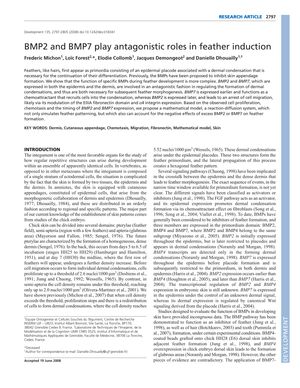
The study revealed that BMP2 and BMP7 played antagonistic roles in feather induction, with BMP7 acting as a chemoattractant to recruit cells into dermal condensations and BMP2 halting cell migration later in the process. Both BMPs were necessary for feather morphogenesis, with BMP7 expressed earlier and BMP2 later. The researchers proposed a reaction-diffusion model to simulate feather patterning and explain the negative effects of excess BMP2 or BMP7 on feather formation.
112 citations
,
January 2004 in “The International journal of developmental biology” Feather patterns form through genetic and epigenetic controls, with cells self-organizing into periodic patterns.
176 citations
,
January 2003 in “Journal of Investigative Dermatology” Bone Morphogenetic Proteins (BMPs) help control skin health, hair growth, and color, and could potentially be used to treat skin and hair disorders.
4 citations
,
June 2023 in “Journal of developmental biology” The skin systems of jawed vertebrates evolved diverse appendages like hair and scales from a common structure over 420 million years ago.
January 2022 in “Springer eBooks” Fibroblast growth factors are crucial for hair follicle development and regeneration.
47 citations
,
May 2012 in “Wiley Interdisciplinary Reviews-Developmental Biology” The conclusion is that understanding how feathers and hairs pattern can help in developing hair regeneration treatments.
133 citations
,
February 2019 in “PLoS Biology” Feather patterns in birds are shaped by signaling interactions and cell movements, with EDA/EDAR crucial for pattern formation.
103 citations
,
March 2011 in “PLoS Biology” Birds can lose neck feathers due to a genetic change that increases a gene's activity, helping them adapt to heat.