16 citations
,
September 2022 in “Cold Spring Harbor Perspectives in Biology” This article explores how adult mammals can regenerate hair follicles after wounding and suggests that manipulating cell signals during healing might enhance this process, but provides no new experimental results.
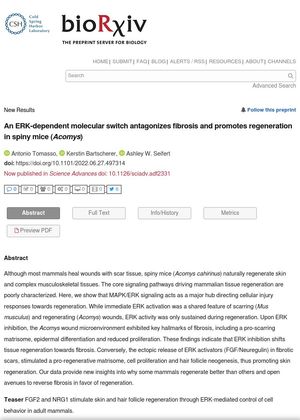
 June 2022 in “bioRxiv (Cold Spring Harbor Laboratory)”
 This study found that MAPK/ERK signaling plays a key role in driving tissue regeneration in spiny mice and suggests potential for reversing fibrosis to promote regeneration in mammals.
 3 citations
,
December 2020 in “bioRxiv (Cold Spring Harbor Laboratory)”
3 citations
,
December 2020 in “bioRxiv (Cold Spring Harbor Laboratory)” In this study, researchers found that inhibiting YAP signaling in skin wounds leads to regenerative repair with active Trps1 and Wnt signaling, contrasting the typical fibrotic scarring process.
 7 citations
,
November 2020 in “Experimental Dermatology”
7 citations
,
November 2020 in “Experimental Dermatology” This article reviews skin regeneration and fibrosis, identifying key cellular and molecular players, and emphasizing the potential to manipulate the postwound environment to promote regeneration over fibrosis.

This review discusses recent research on the cell sources and signaling pathways involved in wound-induced hair follicle neogenesis, noting its complexity and association with immune responses, but reports no new experimental findings.
123 citations
,
January 2020 in “International Journal of Molecular Sciences” This review discusses the role of fibroblast heterogeneity in determining skin scarring versus regeneration and reports no new results, highlighting opportunities for developing antiscarring therapies.
 28 citations
,
October 2019 in “Seminars in Cell & Developmental Biology”
28 citations
,
October 2019 in “Seminars in Cell & Developmental Biology” This article discusses the advances in understanding wound-induced hair follicle neogenesis (WIHN) and highlights the roles of specific signaling pathways and cellular plasticity, noting no clinical results but suggesting potential areas for further research.
 145 citations
,
November 2018 in “Nature Communications”
145 citations
,
November 2018 in “Nature Communications” This study found that activating the Sonic hedgehog pathway in scarring wounds can remodel the dermis to promote hair follicle regeneration, highlighting a potential new approach to enhance healing.
 36 citations
,
July 2014 in “Experimental Dermatology”
36 citations
,
July 2014 in “Experimental Dermatology” This narrative piece considers how epigenetic factors may influence the processes of skin wound healing, including hair follicle formation, but it presents no new experimental results.
 September 2013 in “Regenerative Medicine”
 This summary reports that γδ T cells play a role in regulating hair follicle formation during wound healing in adult skin.