 6 citations
,
October 2019 in “Case Reports in Dermatology”
6 citations
,
October 2019 in “Case Reports in Dermatology” This report describes a case of fibrosing alopecia in a pattern distribution in a postmenopausal woman, highlighting its distinction from other forms of lichen planopilaris and pattern hair loss.
 April 2012 in “Informa Healthcare eBooks”
 Fibrosing alopecia in a pattern distribution is a unique hair loss condition with inflammation and scarring, resembling but distinct from common balding.
May 2016 in “DOAJ (DOAJ: Directory of Open Access Journals)” This study found that vertex accentuation is the second most common pattern of female pattern hair loss in Asian women, following the diffuse type.
 7 citations
,
November 2011 in “Skin Research and Technology”
7 citations
,
November 2011 in “Skin Research and Technology” The authors observed that the patterned melanoderma on the hairless scalp of fair-skinned Caucasian men with androgenic alopecia resembled similar patterns seen on facial skin.
 December 2023 in “Clinical Cosmetic and Investigational Dermatology”
 This case report describes an 8-year-old boy in Saudi Arabia diagnosed with IFAP syndrome, highlighting its distinct characteristics and distinguishing features from similar conditions, and notes successful genetic confirmation of the disorder.
December 2025 in “ILDS-DEV” July 2019 in “Indian dermatology online journal” This case report highlights an unusual trichoscopic appearance in alopecia areata due to dithranol staining, which may obscure typical patterns and reveal atypical vascular features in the interfollicular spaces.
1 citations
,
October 2022 in “Current Opinion in Endocrinology, Diabetes and Obesity” This review discusses the diagnosis, management, and clinical challenges of female pattern hair loss in PCOS patients but reports no new clinical findings, highlighting the need for further research and multidisciplinary care.
 September 2023 in “Clinical, Cosmetic and Investigational Dermatology”
 The researchers reported that one-third of women with female pattern hair loss in their study had occipital region involvement, which is important for diagnosing and planning treatment, including hair restoration surgery, as the occipital region is often used as a normal reference.
 41 citations
,
January 2014 in “Annals of Dermatology”
41 citations
,
January 2014 in “Annals of Dermatology” This study found that dermoscopy showed distinctive patterns for different types of alopecia, supporting its clinical usefulness for diagnosing diseases with small round or oval hairless patches on the scalp.
 March 2012 in “Journal of The American Academy of Dermatology”
 In this study, white females with Ludwig I female pattern hair loss had higher hair density on the occipital scalp, while Asian females had thicker hair diameters in both frontal and occipital areas.
 7 citations
,
March 2003 in “PubMed”
7 citations
,
March 2003 in “PubMed” This study reported that in men with androgenic alopecia, a distinct subclinical hyperpigmentation pattern was observed in the scalp, associated with baldness severity and possibly linked to local melanin production by pilosebaceous units.
 1 citations
,
September 2015 in “Serbian Journal of Dermatology and Venereology/Serbian Journal of Dermatology and Venerology”
1 citations
,
September 2015 in “Serbian Journal of Dermatology and Venereology/Serbian Journal of Dermatology and Venerology” This paper presents a case of a young male with a family history, showing overlap between ulerythema ophryogenes and keratosis follicularis spinulosa decalvans, affecting both eyebrows and scalp with cicatricial patchy alopecia.
 40 citations
,
January 2013 in “International journal of trichology”
40 citations
,
January 2013 in “International journal of trichology” This study found that among women with frontal fibrosing alopecia, 100% showed dermoscopic elements suggestive of the condition, with perifollicular erythema often indicating disease activity.
This study found that onychomatricoma can fully mimic the nail unit and differentiate toward the nail bed and isthmus, distinguishing it from other pilar tumors.
July 2021 in “British Journal of Dermatology” In this study, the researchers reported that early diagnosis and treatment of fibrosing alopecia in a pattern distribution may arrest or potentially reverse disease progression, though some patients experienced continued hair loss.
January 2022 in “Clinical Cases in Dermatology” This report describes a case of a 4-year-old boy diagnosed with linear alopecia areata, characterized by patchy hair loss and associated with unique hyperpigmented skin lesions.
 2 citations
,
January 2017 in “Przegla̧d dermatologiczny”
2 citations
,
January 2017 in “Przegla̧d dermatologiczny” This study identified two distinct trichoscopic patterns in the mid-frontal scalp of patients with frontal fibrosing alopecia who also display clinical features of androgenetic alopecia.
 7 citations
,
August 2021 in “Journal of the European Academy of Dermatology and Venereology”
7 citations
,
August 2021 in “Journal of the European Academy of Dermatology and Venereology” This study suggests that early initiation of treatment in fibrosing alopecia in a pattern distribution may lead to a more favorable outcome, as evident in some patients experiencing arrested disease progression and hair regrowth.
2 citations
,
July 2024 in “Indian Journal of Dermatology” In this study, researchers found that adults with alopecia areata exhibited trichoscopic features of empty follicular openings and tulip hair, while children showed more honeycomb pigment patterns and pohlpinkus constriction on their scalp lesions.
 August 2023 in “Clinical, Cosmetic and Investigational Dermatology”
 In this study, the Hamilton-Norwood subtype of female pattern hair loss was associated with early onset and polycystic ovary syndrome, while the Ludwig pattern was more common overall.
 1 citations
,
February 2014 in “Hair therapy & transplantation”
1 citations
,
February 2014 in “Hair therapy & transplantation” This case report describes a one-year-old boy with combined occipito-linear and triangular fronto-temporo-parietal alopecia and discusses the possibility of these lesions being a variant of neonatal occipital alopecia.
1 citations
,
January 2016 in “Indian journal of clinical and experimental dermatology” This study found that female pattern hair loss is more common than previously thought among Indian women, with the most frequent pattern being diffuse hair loss over the vertex.
 February 2011 in “Journal of the American Academy of Dermatology”
 This study found that polycystic ovary syndrome was the most common cause of hirsutism among premenopausal women in Algeria.
September 2023 in “International Journal of Trichology” In this study, researchers reported three cases of alopecia areata patients experiencing a rare targetoid pattern of hair regrowth, a phenomenon originally described in 1988.
This study identified vertex accentuation as the second most common pattern of female pattern hair loss in Asian women.
 January 2023 in “Journal of Cutaneous Pathology”
 This study found that histopathologic features such as a catagen/telogen shift, melanin in fibrous tracts, and small dystrophic follicles can help differentiate alopecia areata from pattern hair loss in the absence of peribulbar infiltrates.
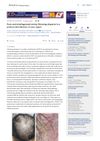 March 2023 in “Journal of Cosmetic Dermatology”
 This case report illustrates that fibrosing alopecia in a pattern distribution may be misdiagnosed as androgenetic alopecia due to similar hair loss patterns, but distinctive trichoscopic and histopathologic features help differentiate it.
February 2025 in “Archives of Dermatological Research” This study observed that fibrosing alopecia in a pattern distribution shows varied histological features and may resemble lichen planopilaris with initial diffuse distribution, potentially leading to scarring alopecia.
 30 citations
,
January 2020 in “Journal of The American Academy of Dermatology”
30 citations
,
January 2020 in “Journal of The American Academy of Dermatology” This review reports no new clinical results but discusses fibrosing alopecia in a pattern distribution as a distinct scarring alopecia with characteristics of both androgenetic alopecia and lichen planopilaris.