6 citations
,
November 2022 in “Journal of autoimmunity”
6 citations
,
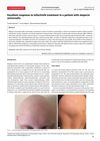
November 2022 in “Journal of autoimmunity” This case report discusses a successful treatment of Alopecia Areata with tofacitinib and includes a literature review on the condition's pathophysiology and the mechanism of JAK inhibitors, though it notes the high failure rate of available treatments and absence of FDA-approved options.
 1 citations
,
September 2022 in “International Journal of Trichology”
1 citations
,
September 2022 in “International Journal of Trichology” In this case report, a young adult male with resistant alopecia areata showed nearly 90% hair regrowth after 3 months of treatment with tofacitinib, alongside biotin supplementation, without any side effects observed.
 March 2022 in “International Journal of Trichology”
 In this case report, a young female Indian patient with alopecia areata saw hair regrowth within 2 months of treatment with oral tofacitinib, with continued improvements over a 5-month period and no reported side effects.
290 citations
,
August 2021 in “Clinical Reviews in Allergy & Immunology” JAK inhibitors show promise for treating alopecia areata, but more research is needed.
130 citations
,
February 2019 in “JEADV. Journal of the European Academy of Dermatology and Venereology/Journal of the European Academy of Dermatology and Venereology” This study found that JAK inhibitors for alopecia areata showed promising response rates, with 72.4% of 289 cases responding, and oral administration achieving better outcomes than topical treatment, but recurrence occurred when treatment stopped. Further large-scale studies are needed to confirm these findings.
 130 citations
,
February 2018 in “Journal of Investigative Dermatology”
130 citations
,
February 2018 in “Journal of Investigative Dermatology” This study found that tofacitinib led to ≥50% hair regrowth in eight out of twelve patients with moderate to severe alopecia areata, suggesting a potential benefit for using JAK inhibitors in treating this condition.
355 citations
,
January 2017 in “Journal of the American Academy of Dermatology” This review reports no new results and highlights existing research suggesting JAK inhibitors may be effective in treating inflammatory skin conditions like alopecia areata, atopic dermatitis, psoriasis, and vitiligo.
 139 citations
,
November 2016 in “Journal of the American Academy of Dermatology”
139 citations
,
November 2016 in “Journal of the American Academy of Dermatology” In this retrospective review, tofacitinib treatment was associated with clinically significant hair regrowth in most adolescent patients with alopecia areata, though limitations suggest further studies are needed to confirm these findings.
 238 citations
,
November 2016 in “Journal of The American Academy of Dermatology”
238 citations
,
November 2016 in “Journal of The American Academy of Dermatology” In this study, tofacitinib was reported to improve scalp hair regrowth in patients with severe alopecia areata, alopecia totalis, and alopecia universalis, showing a higher response in alopecia areata.
 222 citations
,
September 2016 in “JCI insight”
222 citations
,
September 2016 in “JCI insight” This research overview highlights that although JAK inhibitors show promise as potential treatments for alopecia areata based on recent insights into the disease mechanism, their efficacy has not yet been thoroughly evaluated in a systematic manner.
96 citations
,
December 2015 in “JAMA dermatology” This article discusses the potential of topical ruxolitinib as a treatment for alopecia universalis and acknowledges the need for alternatives to systemic JAK inhibitors due to the risk of serious side effects.