A Consensus Single-Cell Atlas of Hidradenitis Suppurativa Tunnels Defines a Fibro-Inflammatory Niche with Druggable Microenvironmental Endotypes
May 2026
in “
Zenodo (CERN European Organization for Nuclear Research)
”
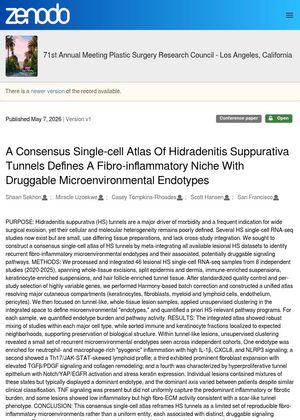
Studysummary This study constructed a consensus single-cell atlas of hidradenitis suppurativa tunnels, identifying distinct microenvironmental endotypes with different inflammatory and fibrotic profiles, suggesting that TNF blockade may not be sufficient for addressing all lesions.
Our plain-language summary. Not medical advice or a treatment recommendation. Consult a qualified healthcare professional before changing treatment. Full disclaimer
The study aimed to create a consensus single-cell atlas of hidradenitis suppurativa (HS) tunnels by integrating 46 lesional HS single-cell RNA-seq samples from 8 studies. The atlas identified distinct fibro-inflammatory microenvironmental endotypes within HS tunnels, each associated with specific signaling pathways. These include a neutrophil- and macrophage-rich "pyogenic" inflammation, a Th17/JAK-STAT-skewed lymphoid profile, fibroblast expansion with TGFβ/PDGF signaling, and hyperproliferative tunnel epithelium with Notch/YAP/EGFR activation. The findings suggest that HS tunnels are not uniform but consist of reproducible microenvironments, each potentially responsive to different therapeutic strategies. This atlas provides a framework for understanding varied responses to treatments and suggests that TNF blockade may not be sufficient for all lesions, highlighting the need for endotype-guided clinical trials and treatment approaches.