23 citations
,
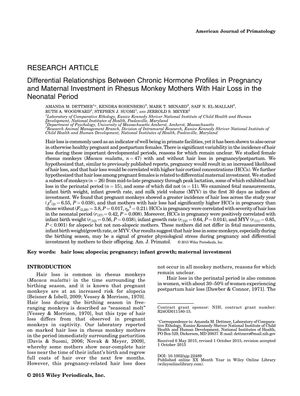
March 2016 in “American Journal of Primatology” This study found that female rhesus macaques who gained hair showed a significant reduction in hair cortisol concentrations, suggesting a connection between hair regrowth and stress levels.
189 citations
,
January 2014 in “Journal of Visualized Experiments” This study developed and validated a method for extracting cortisol from human and animal hair, suggesting its potential as a biomarker for assessing chronic stress exposure.
87 citations
,
February 2009 in “PubMed” This review discusses the potential causes and treatments for alopecia in nonhuman primates, emphasizing the need for comprehensive testing before attributing hair loss to stress.
34 citations
,
July 2006 in “Clinics in dermatology” This article reviews dermatological manifestations of endocrine diseases in dogs, such as hypothyroidism and hyperadrenocorticism, but reports no new clinical findings.
 36 citations
,
April 1990 in “Dermatologic Clinics”
36 citations
,
April 1990 in “Dermatologic Clinics” This review discusses skin changes and dermatoses during pregnancy and reports no clinical findings, emphasizing a need for better understanding of their causes.
 12 citations
,
April 1990 in “PubMed”
12 citations
,
April 1990 in “PubMed” This review discusses physiologic skin changes and various dermatoses associated with pregnancy but reports no new clinical findings, highlighting limited understanding of some conditions' etiologies.
 23 citations
,
October 1971 in “BMJ”
23 citations
,
October 1971 in “BMJ” This case report describes a woman who experienced diffuse hair loss both after stopping oral contraceptives and after childbirth, suggesting a similar pathogenesis in these situations.
 24 citations
,
May 1963 in “Archives of Dermatology”
24 citations
,
May 1963 in “Archives of Dermatology” In this study of postpartum alopecia, most patients experienced significant hair regrowth within four to six months, and heredity did not appear to be a significant factor in hair loss.