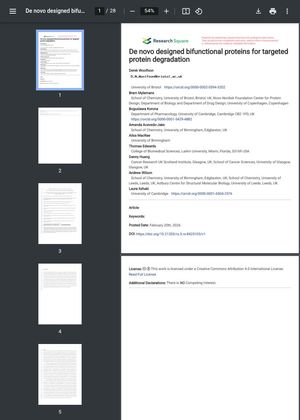
In this study, researchers developed de novo designed hetero-bifunctional proteins as an alternative approach for targeted protein degradation, successfully targeting BCL-xL for degradation in cells and inducing apoptosis, which may expand the range of addressable E3 ligases and disease targets.
40 citations
,
July 2023 in “Clinical Pharmacology & Therapeutics” This review discusses the progress and challenges of targeted protein degradation therapies, highlighting the increasing number of degraders in cancer clinical trials and the limited diversity in targeted proteins, primarily focusing on those employing CRL4CRBN as the E3 ligase.
March 2026 in “Bioconjugate Chemistry” This review highlights the potential of peptide-based PROTACs (pPROTACs) in expanding the target range of protein degraders beyond small-molecule limitations, particularly for undruggable proteins, by utilizing advances in design, conjugation, and bioPROTAC technology.
July 2026 in “Journal of Enzyme Inhibition and Medicinal Chemistry” This review discusses the evolution of Cereblon ligands in PROTAC technology, highlighting chemical innovations that may enhance drug-likeness and applicability in protein degradation, while noting challenges and future research directions.
15 citations
,
November 2024 in “Pharmaceutics” This review discusses how recent advancements in computational and lab-based methods have enhanced peptide drug discovery, noting the efficiency and cost benefits over traditional approaches and the potential for targeting difficult protein interactions, including protein degradation using proteolysis-targeting chimeras.