3 months with .5 dut and 5mg minox (both oral) 8/11/2026
A user shared progress pictures after using 0.5 mg dutasteride and 5 mg oral minoxidil for three months, showing improved temple hair. Others discussed their own experiences with similar treatments and dosage adjustments.
View this post in the Community →
Similar Community Posts Join
6 / 6 resultscommunity dutasteride 0.5 and oral minoxidil 2.5 progress pictures
The user experienced thicker and darker hair at the temples after 4 months of using oral minoxidil and dutasteride, with an intense shedding phase between 1 to 3 months. They report no side effects and positive regrowth, with others noting dutasteride's effectiveness over finasteride.
community Dutasteride 0.5mg 6 months +oral minoxidil 2.5mg
Dutasteride 0.5mg and oral minoxidil 2.5mg improved hair density but not receded temples. No side effects were reported, and the user switched from finasteride to dutasteride due to side effects.
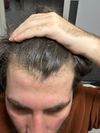
community Seeking Advice on Dutasteride and Oral Minoxidil Effectiveness After 1 Year, Considering Finasteride
The user is experiencing continued hair loss despite using dutasteride and oral minoxidil, and is considering adding finasteride or adjusting their current treatment. They are seeking advice on whether to change their approach due to lack of improvement, especially at the temples and crown.
community My report taking dutasteride 0.5 and oral minoxidil 2.5 for 70 days
The user reported initial shedding but noticed darkening and thickening of hair at the temples after 70 days of using dutasteride 0.5 mg and oral minoxidil 2.5 mg. Others shared similar experiences and advised patience, as early shedding is common and improvement may take 6 to 12 months.
community 43M — 5.5 months on dutasteride + oral minoxidil. How’s my progress?
A 43-year-old man has been using dutasteride, oral minoxidil, and ketoconazole shampoo for 5.5 months, seeing improvement in hair density and hairline but still struggling with temple regrowth. He is considering adding microneedling to his routine and is advised to use a depth of 0.5 to 0.75 mm every 10 to 14 days for better results.
community My temples after 2.5 months on oral fin/dut, ketoconazole shampoo, minoxidil, tretinoin and dermarolling
The user shared progress pictures showing improved hair growth at the temples after 2.5 months using oral finasteride/dutasteride, ketoconazole shampoo, minoxidil, tretinoin, and dermarolling. The user reported no side effects from the medications and noted inconsistent microneedling.
Related Research
6 / 6 resultsresearch Hair Restoration—Nonsurgical and Surgical Approaches
Hair restoration can be achieved through non-surgical treatments like minoxidil, antiandrogens, phototherapy, and PRP procedures, or through surgical methods like hair transplantation. Continued treatment is needed to maintain results, and full results are visible after 12-18 months.
research Androgenetic, Diffuse and Senescent Alopecia in Men: Practical Evaluation and Management
This review discusses the evaluation and management of male baldness and related conditions, but reports no new clinical results.
research The state‐of‐the‐art in the management of androgenetic alopecia: A review of new therapies and treatment algorithms
This abstract outlines a guide reviewing both FDA-approved and off-label therapies for androgenetic alopecia and proposes treatment algorithms based on scientific research, highlighting a gap in common treatments for this prevalent condition.
research Updates in Treatment for Androgenetic Alopecia
This review discusses current and emerging treatments for androgenetic alopecia, covering mechanisms, efficacy, and safety of both androgen-targeted and non-androgen-targeted approaches, but reports no new clinical results.
research Additive Effects of Platelet-Rich Plasma and Systemic Therapies in Androgenetic Alopecia: A Retrospective Study
This study found that combining platelet-rich plasma with systemic therapies for androgenetic alopecia may result in greater improvements in hair density and width than using PRP alone, though the differences were not statistically significant.
research Androgenetic Alopecia: a Review and Emerging Treatments
This review covers the pathogenesis, diagnosis, and potential new treatments for androgenetic alopecia but reports no new clinical findings, highlighting an ongoing need for effective therapies.