In this study, trichoscopy was diagnostically useful in 97.5% of alopecia cases at a rural Indian hospital, confirming initial diagnoses in most cases and reducing the need for invasive scalp biopsies.
8 citations
,
February 2021 in “Comprehensive psychiatry” This study found that adults with trichotillomania or skin picking disorder experienced significantly poorer sleep quality, which was linked to various factors including age, stress, distress tolerance, impulsivity, and comorbid mental disorders.
11 citations
,
August 2016 in “Journal of the European Academy of Dermatology and Venereology” This letter discusses the use of serial trichoscopy versus a modified hair pull test for monitoring localized alopecia areata but reports no new clinical results.
 2 citations
,
July 2005 in “Baylor University Medical Center Proceedings”
2 citations
,
July 2005 in “Baylor University Medical Center Proceedings” This case report diagnosed a 4-year-old girl with trichotillomania after observation of her twirling and pulling her hair at the affected site.
 1 citations
,
June 2022 in “Movement disorders clinical practice”
1 citations
,
June 2022 in “Movement disorders clinical practice” This study reports a unique case of trichotillomania as a presenting sign in a patient with neurological Wilson's disease, confirmed by genetic testing and copper abnormalities.
May 2025 in “International Journal of Trichology” The examined study explored how trichoscopic evaluations of female pattern hair loss might relate to disease severity and histological changes, but the authors highlighted methodological issues such as unclear sample size determination and insufficient control of confounding variables, which limit the results' generalizability and reproducibility.
27 citations
,
October 2002 in “International Journal of Dermatology” This study presents a microscopic analysis of the pruritic variant of trichostasis spinulosa in two patients and reviews existing literature, reporting no new clinical results.
November 2024 in “Actas Dermo-Sifiliográficas” This review outlines current treatment strategies for trichotillomania, noting that while cognitive-behavioral therapy is effective, N-acetylcysteine and memantine are also recommended due to their safety and efficacy, though evidence for other drugs like fluoxetine and naltrexone remains limited.
 1 citations
,
January 2013 in “International Journal of Trichology”
1 citations
,
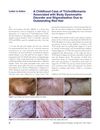
January 2013 in “International Journal of Trichology” A girl with red hair developed hair-pulling and body image disorders after being bullied for her hair color.
 5 citations
,
November 2009 in “Revista médica de Chile”
5 citations
,
November 2009 in “Revista médica de Chile” This study confirms that scalp hair follicles in Chilean subjects exhibit seasonal variations, with a higher percentage of follicles in the telogen (resting) phase during the summer compared to the winter.
 2 citations
,
June 2016 in “PubMed”
2 citations
,
June 2016 in “PubMed” This case study reports successful treatment of an 11-year-old girl's trichotillomania with cognitive behavioral therapy, mild topical treatments, and supportive parental involvement, without psychopharmacologic intervention.
2 citations
,
January 2023 in “Skin Appendage Disorders” In this study, chemotherapy-induced alopecia in cancer patients showed specific trichoscopic patterns and abnormal hair shaft morphology, suggesting intermittent follicle damage from chemotherapy, but larger studies are needed for confirmation.
15 citations
,
January 2012 in “International journal of trichology” This study found that the HairCheck® device, demonstrating high correlation between its Hair Mass Index and hair characteristics such as strand number and diameter, may be an effective tool for assessing hair mass changes in alopecia patients.
 December 2024 in “Texila international journal of public health”
 In this study conducted from September to November 2023, researchers used trichoscopy to accurately diagnose cicatricial alopecias by revealing unique patterns, reducing the need for biopsies, and proving to be a valuable non-invasive diagnostic method.
144 citations
,
May 1990 in “Journal of the American Academy of Dermatology” 21 citations
,
January 2010 in “International journal of trichology” This report on two Indian male siblings with monilethrix highlights trichoscopy's role in diagnosing this condition, which can be complicated by early-onset androgenetic alopecia.
 May 2022 in “European medical journal”
 This case report highlights a rare instance of gastric trichobezoar, or "Rapunzel syndrome," associated with trichotillomania, characterized by hair accumulation in the stomach of a patient.
2 citations
,
June 2001 in “Medical Electron Microscopy” This study observed that the keratinization pattern of trichilemmal cysts in two Japanese women may originate from the proliferation of the outer root sheath in the follicular isthmus of anagen hairs.
 February 2026 in “Dermatology Reports”
 In this case study, trichoscopy was found to be a valuable non-invasive tool for diagnosing dissecting cellulitis of the scalp, enabling early detection and intervention to prevent disease progression and reduce the need for invasive procedures.
2 citations
,
January 2018 in “International Journal of Trichology” This case report describes trichothiodystrophy in two sisters with only hair fragility, illustrating the condition's variable presentation and the importance of regular monitoring for potential associated impairments.
April 2011 in “www.virtualization.info” This report describes a case of trachyonychia with associated various types of lichen planus in a young male, highlighting the importance of accurate diagnosis for effective treatment.
 July 2022 in “Research Square (Research Square)”
 This case report highlights a small bowel obstruction from hair ingestion in an African American woman, emphasizing the need for cultural awareness of Black hairstyles in trichotillomania and trichophagia.
 47 citations
,
February 2015 in “European Journal of Clinical Investigation”
47 citations
,
February 2015 in “European Journal of Clinical Investigation” This review discusses Chrousos syndrome, a rare condition caused by NR 3C1 gene mutations leading to glucocorticoid resistance, and reports no new clinical results; early identification and genetic testing are recommended for diagnosis.
 September 2023 in “Skin appendage disorders”
 This pilot study detailed the use of Hair-to-Hair-matching technology™ in a clinical trial to assess botulinum toxin's efficacy in treating male androgenetic alopecia, providing a precise method for evaluating hair count and thickness changes over time.
2 citations
,
September 2023 in “Journal of the European Academy of Dermatology and Venereology” In this study, the authors compared trichoscopy findings for different forms of diffuse non-cicatricial alopecia in females and suggested that trichoscopy might often replace the need for histopathological confirmation, reserving biopsies for more uncertain cases.
188 citations
,
June 1998 in “Molecular cell” This study found that mimicking the XPD point mutation in mice resulted in trichothiodystrophy-like symptoms, supporting the role of basal transcription and DNA repair defects in the disease.
 April 2014 in “Jurnal Biomedik : JBM”
 This case report diagnosed an 8-year-old girl with trachyonychia and secondary onychomycosis, finding that spontaneous improvement is common, making specific therapy often unnecessary despite treatment challenges with associated fungal infections.
27 citations
,
August 2017 in “Anais Brasileiros de Dermatologia” In this case report, a patient with trichotillomania showed a significant positive response to treatment with N-acetylcysteine, suggesting its potential effectiveness for this disorder according to the authors’ observations.
 245 citations
,
March 2012 in “Journal of The American Academy of Dermatology”
245 citations
,
March 2012 in “Journal of The American Academy of Dermatology” This review discusses the dermoscopic features of common hair and scalp disorders and reports no new clinical results, aiming to assist dermatologists in diagnosing conditions like tinea capitis and alopecia areata.
 1 citations
,
October 2022 in “Asian journal of medical sciences”
1 citations
,
October 2022 in “Asian journal of medical sciences” This study found trichoscopy to be a highly sensitive, non-invasive method for diagnosing tinea capitis in children, which could be valuable in resource-limited settings lacking mycological culture facilities.