 1 citations
,
July 2020 in “Benha Journal of Applied Sciences”
1 citations
,
July 2020 in “Benha Journal of Applied Sciences” This study identified that trichoscopy can effectively diagnose frontal fibrosing alopecia by highlighting specific scalp abnormalities in postmenopausal women.
 January 2019 in “Elsevier eBooks”
 This review discusses the evaluation methods for patients with hair loss, emphasizing the importance of history, physical examination, and, when necessary, laboratory tests or biopsy, but it reports no new clinical results.
 April 2016 in “Journal of The American Academy of Dermatology”
 The study found that Temporal Triangular Alopecia often starts in early childhood, while Folliculitis Decalvans is characterized by tufted hairs and redness around hair follicles.
24 citations
,
January 2017 in “International Journal of Trichology” August 2016 in “The Journal of Korean Medicine Ophthalmology and Otolaryngology and Dermatology” This study found that the hair scalpdetox five-step program may enhance scalp and hair condition and promote hair growth based on subjective evaluations and visual observations.
2 citations
,
June 2001 in “Medical Electron Microscopy” This study observed that the keratinization pattern of trichilemmal cysts in two Japanese women may originate from the proliferation of the outer root sheath in the follicular isthmus of anagen hairs.
 3 citations
,
November 1999 in “Journal of Cutaneous Medicine and Surgery”
3 citations
,
November 1999 in “Journal of Cutaneous Medicine and Surgery” Examining scalp biopsies in different ways helps better diagnose hair loss types.
 21 citations
,
March 2006 in “Seminars in Cutaneous Medicine and Surgery”
21 citations
,
March 2006 in “Seminars in Cutaneous Medicine and Surgery” This review discusses a clinical approach to diagnosing alopecia through patient history and clinical findings, but it reports no new clinical results.
This article describes an improved trichophytic closure technique for hair restoration surgery, achieving nearly invisible donor scars in over 95% of patients, but emphasizes tailoring the method to individual patient characteristics.
 June 2026 in “Indian Journal of Dermatology Venereology and Leprology”
 In this study, researchers found significant associations between trichoscopic features and the severity of androgenetic alopecia in Korean participants, suggesting trichoscopy as a useful tool for early detection and monitoring by identifying indicators like vellus hairs and follicular unit changes.
6 citations
,
January 2011 in “European Journal of Dermatology” This article discusses monilethrix, a rare human hair dysplasia caused by mutations in hair keratins, but reports no new clinical findings.
 13 citations
,
August 2017 in “International Journal of Dermatology”
13 citations
,
August 2017 in “International Journal of Dermatology” This study reported that trichoscopy revealed distinctive patterns across different autoimmune bullous diseases, suggesting it can be a useful preliminary diagnostic tool for differentiating these conditions.
 December 2025 in “Brazilian Journal of Hair Health”
 This review highlights that natural DHT blockers like saw palmetto and pumpkin seed oil show promise in managing androgenetic alopecia, though clinical data varies, and further research is needed to confirm their efficacy and safety in comparison to conventional pharmaceuticals.
June 2026 in “Journal of Clinical Practice and Medical Case Report.” This case report described a 16-year-old girl with trichotillomania, highlighting the challenges in diagnosing the condition due to its similarity with alopecia areata and the sociocultural barriers preventing acceptance of psychiatric treatment.
 February 2022 in “Scientia Pharmaceutica”
 This study validated that six out of seven tested topical formulations for alopecia are compatible for 6-month use, suggesting they may be practical for compounding pharmacies.
 27 citations
,
January 1990 in “Child Psychiatry & Human Development”
27 citations
,
January 1990 in “Child Psychiatry & Human Development” This review discusses the demographic, dermatologic, clinical, and psychodynamic aspects of trichotillomania, exploring its potential link to anxiety but reports no new clinical findings.
This study reported that Asian patients have few racial differences in trichoscopy compared to Caucasian patients, except for certain features like greater mean hair diameter and masking effects by normal skin color.

In this case report, a 65-year-old man's neck lesion was initially misdiagnosed as benign but later identified as trichilemmal carcinoma, with the authors recommending Mohs Micrographic Surgery as the preferred treatment option for this rare condition.
1 citations
,
January 2022 in “Journal of The American Academy of Dermatology” This article discusses various limitations of direct-to-consumer teledermatology platforms, highlighting concerns regarding ethical issues, financial conflicts of interest, and challenges in providing comprehensive patient care compared to traditional in-person consultations.
 January 2007 in “Revista del Centro Dermatológico Pascua”
 This case report describes a 2-year-old boy diagnosed with trichothiodystrophy, characterized by fragile hair, intellectual damage, diminished fertility, and short stature.
January 2023 in “SKIN The Journal of Cutaneous Medicine”  1 citations
,
January 2023 in “Indian Journal of Dermatology/Indian journal of dermatology”
1 citations
,
January 2023 in “Indian Journal of Dermatology/Indian journal of dermatology” This case study reported that 5% minoxidil solution effectively promoted hair growth and resulted in generalized hypertrichosis in a 7-year-old with Trichorhinophalangeal syndrome type I.
144 citations
,
May 1990 in “Journal of the American Academy of Dermatology”  July 2018 in “Elsevier eBooks”
 This chapter details the causes and diagnostic process of pediatric alopecia, including trichoscopic findings, but reports no new clinical results.
 13 citations
,
March 2002 in “Pediatric Dermatology”
13 citations
,
March 2002 in “Pediatric Dermatology” This article discusses temporal triangular alopecia, emphasizing the need for increased awareness to prevent misdiagnosis and ineffective treatment, but reports no new clinical results.
 2 citations
,
May 2022 in “Clinical, Cosmetic and Investigational Dermatology”
2 citations
,
May 2022 in “Clinical, Cosmetic and Investigational Dermatology” This study reports that quantitative trichoscopy, while noninvasive and convenient, provides less accurate hair density data compared to invasive histopathologic examination, which was demonstrated in a sample of adult Chinese individuals without alopecia.
 5 citations
,
January 2014 in “Journal of Cutaneous and Aesthetic Surgery”
5 citations
,
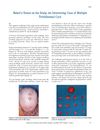
January 2014 in “Journal of Cutaneous and Aesthetic Surgery” A woman had 13 non-cancerous cysts on her scalp successfully removed in one surgery.
 32 citations
,
August 2015 in “Anais Brasileiros de Dermatologia”
32 citations
,
August 2015 in “Anais Brasileiros de Dermatologia” This review discusses the side effects and diseases related to hairstyles and hair treatments among black women, highlighting the need for thorough examination by dermatologists, but reports no new clinical results.
May 2022 in “International Journal of Trichology” January 2019 in “Revista Dermatológica Centro Uraga” This review discusses congenital temporal triangular alopecia, focusing on its clinical presentation and dermatoscopic diagnosis, and highlights the limited understanding of its etiology and treatment options; it reports no new clinical results.