 September 2017 in “Springer eBooks”
 FUE hair transplants have improved to give more natural results with less scarring and pain.
 May 2017 in “InTech eBooks”
 This chapter reviews types and causes of hair loss in children and suggests a diagnostic approach for identifying and treating this condition, but it reports no new clinical results.
 January 2017 in “Journal of clinical & experimental dermatology research”
 This study found that patients with telogen effluvium had significantly lower serum ferritin levels compared to healthy controls, suggesting a relationship between telogen effluvium and decreased iron stores.
 October 2016 in “Elsevier eBooks”
 This article reviews the most common skin diseases worldwide and reports no new clinical findings.
 January 2015 in “Hair therapy & transplantation”
 This review updates on various methods for hair and scalp examination, encompassing non-invasive, semi-invasive, and invasive techniques, and reports no new results.
 December 2014 in “Bangladesh Journal of Veterinary Medicine”
 In this study, mixed lice infestations and their associated skin changes were observed in the Egyptian lesser blind mole rat, marking the first report of such findings in this species.
 April 2014 in “Journal of Aesthetic Nursing”
 This article provides descriptive results indicating high client satisfaction and good tolerance associated with mesotherapy in treating hair loss, based on the author's personal experience with clients.
 January 2014 in “International Journal of Athletic Therapy and training”
 A female runner's hair loss was caused by stress from surgery and recovery, but her hair returned to normal in 5 months.

This research suggests that plucked hair follicles may serve as a reliable surrogate tissue for tumor biopsies in drug development, based on a mouse model linking hair and tumor pharmacodynamic responses.
 January 2012 in “Postgraduate obstetrics & gynecology”
 Up to 50% of women may experience significant hair loss by age 50, with various causes and treatments available.
 January 2012 in “Postgraduate obstetrics & gynecology”
 This descriptive abstract provides information about a continuing medical education activity for physicians, designating 1.5 credits for participation, but reports no new research findings.
 February 2010 in “ePrints Soton (University of Southampton)”
 This research found that androgen bioactivity plays a role in normal female sexual differentiation, suggesting females develop within a significant androgenic environment, with implications for understanding conditions like congenital adrenal hyperplasia.
 December 2008 in “Dermatologic Surgery”
 This study found that the novel powered FUE (P-FUE) technique reduced harvesting time and graft transection rates in hair restoration compared to manual FUE, with broader patient applicability.
 June 2006 in “The American Journal of Cosmetic Surgery”
 Advancements in cosmetic and reconstructive surgery improve techniques and patient satisfaction.
 January 2006 in “Journal of Rural Medicine”
 This review discusses recent Japanese research on trichotillomania and compares it with international studies, reporting no new clinical results.
 May 2003 in “Facial Plastic Surgery Clinics of North America”
 This review discusses the genetic and hormonal factors contributing to androgenetic alopecia in men and women, but reports no new clinical results; it highlights that the exact causes remain unknown.
 December 2002 in “International Journal of Cosmetic Surgery and Aesthetic Dermatology”
 This review covers preoperative considerations and surgical techniques for scalp reduction in hair restoration, noting its potential to provide natural, dense coverage for large vertex defects unachievable by traditional grafting.
 November 2002 in “Dermatologic Surgery”
 This review discusses the surgical methods of hair restoration, highlighting the density benefits of scalp reduction and rotation, but reports no new clinical findings.
 July 1998 in “Dermatologic Surgery”
 Various techniques and tools for hair restoration were presented in 1998, including a mathematical model for donor area, use of lasers in surgery, methods for controlling grafted hair direction, and ways to increase graft yield. Satisfaction rates were around 39%, and studies showed trauma and dehydration can damage hair follicles.
 October 1987 in “Clinics in Dermatology”
 This article reviews the principles of donor and recipient dominance in hair transplantation and reports no new experimental results.
 January 1982 in “Clin-Alert”
 Some medications caused temporary health issues that improved after stopping the drugs, but two patients died from liver problems linked to carbamazepine.

This review discusses the characteristics and management of adolescent androgenetic alopecia, noting a lack of FDA-approved treatments and reporting no new clinical results.
 August 2013 in “Facial Plastic Surgery Clinics of North America”
 Hair restoration techniques and new cell sources improve hair loss treatments.
 June 2018 in “Advances in Cosmetic Surgery”
 Hair loss caused by genetics and hormones; more research needed for treatments.
 January 2018 in “Sohag Medical Journal”
 Combining topical dutasteride with microneedling is more effective for hair growth than microneedling alone.

Detailed history and physical examination are crucial for diagnosing hair loss.
 August 2016 in “InTech eBooks”
 This source highlights the diverse scope of facial plastic and reconstructive surgery, noting the specialty's adaptability to changing trends and ethnic preferences for aesthetic outcomes, without reporting specific study results.
 December 2002 in “Operative Techniques in Otolaryngology-head and Neck Surgery”
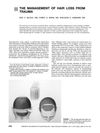
 This article reviews techniques for restoring appearance following scalp injuries and highlights the versatility of scalp expansion, advancement flaps, and follicular unit hair transplantation, but it provides no new clinical results.
 February 2002 in “Dermatologic Surgery”
 Best hair transplant results happen when tissues are least damaged.
 1265 citations
,
October 2013 in “The Journal of Clinical Endocrinology and Metabolism”
1265 citations
,
October 2013 in “The Journal of Clinical Endocrinology and Metabolism” This guideline from the Endocrine Society recommends using the Rotterdam criteria for diagnosing polycystic ovary syndrome and outlines first-line treatments, emphasizing hormonal contraceptives and lifestyle intervention.