July 2001 in “Pediatrics in review” This case describes a 14-year-old girl whose symptoms of hirsutism and virilization were attributed to an ovarian Sertoli-Leydig tumor, with improvement following surgical removal.
November 2024 in “SKIN The Journal of Cutaneous Medicine” In this observational study, researchers examined U.S. and Canadian patients with alopecia areata and found that while comorbid anxiety/depression correlated with increased patient-reported disease severity, other comorbidities like atopic dermatitis and vitiligo showed no statistically significant differences in clinician-reported AA severity or hair involvement.
 October 2010 in “Reproductive Biomedicine Online”
 Women with pituitary adenomas often have reproductive issues, like irregular periods and trouble getting pregnant, but not always breast milk production without pregnancy.
January 2013 in “International Journal of Trichology” This case report describes a young girl with trichothiodystrophy and suggests the need for early diagnosis and multidisciplinary interventions for her educational challenges.
May 2011 in “Journal of pediatric nursing” This case report of a 17-year-old with salt-wasting congenital adrenal hyperplasia due to 21-hydroxylase deficiency found that increasing the mineralocorticoid dose relieved daily headaches and reduced salt cravings.
15 citations
,
August 2022 in “The Application of Clinical Genetics” This review describes the clinical presentation, diagnosis, and management of adrenomyeloneuropathy, including rehabilitative therapies and spasticity management, and reports no new clinical results.
1 citations
,
January 2018 in “Indian dermatology online journal” This case report describes a girl diagnosed with ADULT syndrome, highlighting its rarity, varied presentation, and the importance of early diagnosis to prevent unnecessary stress and medical expenses.
April 2026 in “Therapeutic Advances in Drug Safety” This study developed a new clustering model to improve detection of drug-induced cognitive disorder risk signals, finding that it identified drugs with moderate risk signals, like Carbidopa/Levodopa, missed by traditional methods, enhancing clinical assessment comprehensiveness.
April 2025 in “International Journal of Clinical & Medical Case Studies” This source explains that unlike genetic hormonal alopecia, alopecia areata is associated with inflammatory factors and may also involve psychological and genetic contributions.
 151 citations
,
December 2004 in “Annals of the New York Academy of Sciences”
151 citations
,
December 2004 in “Annals of the New York Academy of Sciences” This review discusses nonclassical 21-hydroxylase deficiency as the most common autosomal recessive disorder in humans and highlights the effectiveness of glucocorticoid treatment in reversing related symptoms.
 1 citations
,
January 2013 in “International Journal of Trichology”
1 citations
,
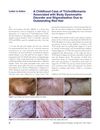
January 2013 in “International Journal of Trichology” A girl with red hair developed hair-pulling and body image disorders after being bullied for her hair color.
 April 2025 in “BMC Urology”
 This case report highlighted a rare occurrence of both adrenocortical carcinoma and uric acid kidney stones in a 5-year-old boy, with hormonal levels and clinical symptoms returning to normal after treatment and no recurrence over four years, emphasizing comprehensive endocrine evaluations in pediatric ACC management.
November 2015 in “Bulletin of University of Agricultural Sciences and Veterinary Medicine Cluj-Napoca Veterinary Medicine” This article discusses the complexities of diagnosing pituitary dependent hyperadrenocorticism in dogs and reports no new clinical findings, highlighting issues with varied symptoms and episodic hormone secretion complicating diagnosis.
June 2025 in “Journal of Kufa for Chemical Sciences” This study found that in males with alopecia areata, adult patients had significantly higher levels of adrenaline and prolactin compared to healthy controls, suggesting these hormones may play roles in the condition's development.
 10 citations
,
October 2017 in “Pediatric neurology”
10 citations
,
October 2017 in “Pediatric neurology” This case report suggests that poor hair and nail growth in children with autism spectrum disorder and developmental delay may indicate a biotin-responsive condition, as biotin and acetazolamide therapy improved symptoms and school performance in the reported patient.
6 citations
,
June 2024 in “Skin Appendage Disorders” This study identified associations between alopecia areata and posttraumatic stress disorder, obesity, and alcohol use, reinforcing the need for psychiatric and alcohol use screening in these patients.
 13 citations
,
October 2004 in “Anais Brasileiros De Dermatologia”
13 citations
,
October 2004 in “Anais Brasileiros De Dermatologia” This article reviews various self-aggressive hair disorders such as trichotillomania and emphasizes the psychiatric aspects of these conditions, but reports no new clinical findings.
 July 2017 in “Contemporary Endocrinology”
 This article discusses the ongoing care needs for individuals with 21-hydroxylase deficiency due to mutations in the CYP21A2 gene but does not present new clinical findings.
3 citations
,
May 2018 in “Psychiatry and Clinical Psychopharmacology” In this report, an 18-year-old female with trichotillomania was successfully treated using the glutamate modulator n-acetylcysteine.
5 citations
,
May 2015 in “JRSM open” If a child is losing a lot of eyelashes and it keeps happening, doctors should look carefully at their health history because it might be a sign of a different health problem.
 January 2023 in “Archives of Disease in Childhood Education & Practice”
 This article describes the causes of hirsutism, introduces a novel assessment tool, and suggests strategies for investigation and management, but provides no new experimental results.
4 citations
,
November 2020 in “Journal of the American Academy of Dermatology” This cohort study observed a bidirectional association between alopecia areata and migraine in Taiwanese patients, indicating that individuals with one condition have a higher risk of developing the other.
March 2025 in “International Journal of Trichology” This study describes a 62-year-old male with trichodaganomania, an urge to bite his mustache hair, who was treated with counseling and placebo medication, highlighting the need for a comprehensive treatment approach including potential psychological and psychiatric interventions if symptoms recur.
 16 citations
,
May 2003 in “International Journal of Dermatology”
16 citations
,
May 2003 in “International Journal of Dermatology” Trichotillomania, a disorder where people compulsively pull out their own hair, often starts around age 12, is more common in adult females, and can be treated with behavior therapy and medication.
December 2024 in “Ukrains kyi Visnyk Psykhonevrolohii” This study found that women with mixed alopecia experienced significant cognitive impairments, particularly those with adaptation disorders, with symptoms like rapid fatigue and impaired concentration being most prevalent. The cognitive patterns are complex and require further investigation to inform tailored rehabilitation strategies.
April 2014 in “Acta Medica Colombiana” This study presents a 63-year-old man with uncontrolled hypertension and facial hair who was diagnosed with adrenocortical adenoma, and whose blood pressure improved post-surgery.
17 citations
,
January 1998 in “Neurourology and Urodynamics” This report describes a case of adrenomyeloneuropathy where neurogenic bladder dysfunction developed, attributed to demyelinating lesions in the patient's peripheral nerves, spinal cord, and cerebral white matter.
 21 citations
,
April 2015 in “Psychology Research and Behavior Management”
21 citations
,
April 2015 in “Psychology Research and Behavior Management” This review evaluates various cognitive-behavioral interventions for trichotillomania but does not report new clinical findings, highlighting the need for further research on their efficacy.

This case study reports that a 14-year-old female with loose anagen hair syndrome and trichotillomania initially improved with topical minoxidil and counseling, but relapsed after a year, highlighting treatment challenges.
28 citations
,
November 2018 in “American Journal of Medical Genetics Part A” This report describes a neurometabolic disorder linked to gain-of-function variants in the ODC1 gene, characterized by developmental delay, ectodermal abnormalities, and notable facial and neuroimaging features.