Enriching Proteolysis Targeting Chimeras with a Second Modality: When Two Are Better Than One
July 2022
in “
Journal of Medicinal Chemistry
”
Studysummary This article discusses the potential for combining PROTACs with other therapeutic modalities in drug discovery and reports no clinical results.
Our plain-language summary. Not medical advice or a treatment recommendation. Consult a qualified healthcare professional before changing treatment. Full disclaimer
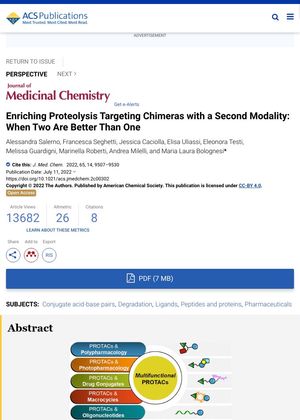
The document discusses the use and development of Proteolysis Targeting Chimeras (PROTACs), small molecules that induce protein removal in cells, in drug discovery. PROTACs are currently under clinical trials for prostate and breast cancers, with leading candidates ARV110 and ARV471 showing good safety profiles, tolerability, and anti-tumor activity. The document explores the enhancement of PROTACs by incorporating a second modality such as polypharmacology, photopharmacology, drug conjugates, macrocycles, and oligonucleotides. It also discusses the development of light-controllable PROTACs, and the potential of combining PROTACs with antibodies or small molecules for targeted cancer treatment. Despite the potential of PROTACs, challenges such as maintaining target interaction, managing increases in molecular weight and hydrophobicity, and issues like aggregation, immunogenicity, and instability are acknowledged. The paper emphasizes the need for more research and systematic development approaches.

