 March 2026 in “Medeniyet Medical Journal”
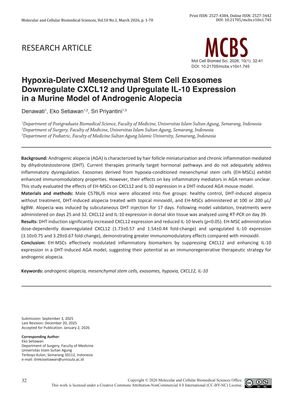
 This study found that hypoxia-conditioned mesenchymal stem cell exosomes increased GM-CSF and decreased IL-1 expression in a dose-dependent manner in a murine model, suggesting potential for treating androgenetic alopecia.
April 2026 in “Journal of Biomedicine and Translational Research” In this study, exosomes from hypoxia-conditioned mesenchymal stem cells significantly improved SOCS3 and STAT3 expression in a mouse model of androgenetic alopecia, suggesting they may offer a more effective therapeutic approach than minoxidil by restoring follicular homeostasis.
January 2026 in “DOAJ (DOAJ: Directory of Open Access Journals)” In this study, Exosome Hypoxia Mesenchymal Stem Cells significantly reduced inflammation and promoted hair follicle regeneration by normalizing IL-1Beta and IGF-1 levels in fluconazole-induced alopecia-like Wistar rats.
April 2026 in “Biosaintifika Journal of Biology & Biology Education” This study found that in a fluconazole-induced alopecia-like rat model, a 14-day treatment with hypoxia-induced mesenchymal stem cell exosomes significantly increased TGF-β and PDGF levels, which may improve hair growth and suggests a potential therapeutic strategy for alopecia and other inflammation-related skin disorders.
 November 2025 in “Molecular and Cellular Biomedical Sciences”
 This study evaluated the effects of exosome therapy from hypoxia-treated mesenchymal stem cells on a fluconazole-induced alopecia model in rats and found that it significantly reduced TNF-α and increased VEGF levels, suggesting potential as a novel regenerative treatment for alopecia.