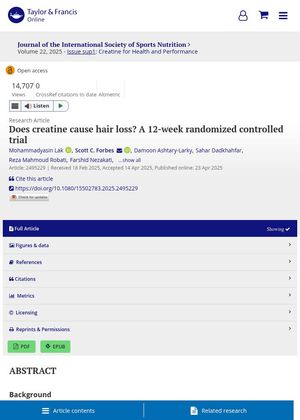
December 2024 in “Journal of the International Society of Sports Nutrition”
 In this narrative review, researchers examined common misconceptions and questions about creatine monohydrate, addressing issues such as its potential effects on muscle benefits without exercise, interactions with caffeine, inflammatory properties, safety during pregnancy, and effects on adolescents, among others.
140 citations
,
January 2021 in “Journal of the International Society of Sports Nutrition” This source reports that while creatine supplementation is popular for improving muscle mass and performance, questions about its efficacy and safety persist. An expert team is reviewing literature to address concerns like water retention, renal effects, and its benefits across different populations and uses.
 19 citations
,
April 2020 in “Dermatologic Therapy”
19 citations
,
April 2020 in “Dermatologic Therapy” This review found that dutasteride is more potent than finasteride as a dual receptor dihydrotestosterone blocker for treating androgenetic alopecia and shares a similar safety profile in terms of fertility, teratogenicity, neurotoxicity, and hepatotoxicity.
 153 citations
,
March 2017 in “Endocrine”
153 citations
,
March 2017 in “Endocrine” This review examines recent advances in understanding the pathophysiology and molecular mechanisms of androgenetic alopecia, highlighting two major genetic risk loci, but does not report new clinical findings.
35 citations
,
October 2011 in “Medicine and science in sports and exercise” This review discusses the role of skeletal muscle in synthesizing bioactive androgens, highlighting that intramuscular androgens may influence muscle via intracrine action, but their precise function remains unclear.
 49 citations
,
January 2004 in “Dermatology”
49 citations
,
January 2004 in “Dermatology” This study found that men with a paternal history of hair loss were significantly more likely to experience hair loss themselves.