 1 citations
,
October 2022 in “PubMed”
1 citations
,
October 2022 in “PubMed” This abstract describes androgenetic alopecia, a common dermatological condition, and does not provide new clinical findings.
 3 citations
,
January 2018
3 citations
,
January 2018 This study reports a case of pustular allergic contact dermatitis following the use of 5% minoxidil solution in a female patient, highlighting an uncommon reaction to a frequently used dermatological treatment.
 14 citations
,
January 2015 in “Skin appendage disorders”
14 citations
,
January 2015 in “Skin appendage disorders” This case report details two women with female pattern hair loss who experienced severe scalp allergic contact dermatitis from minoxidil, one due to the active ingredient and the other due to the vehicle.
 58 citations
,
October 1993 in “International Journal of Dermatology”
58 citations
,
October 1993 in “International Journal of Dermatology” This study found that 2% topical minoxidil solution was significantly more effective than placebo in promoting new hair growth in women with androgenetic alopecia.
 43 citations
,
November 1992 in “International Journal of Dermatology”
43 citations
,
November 1992 in “International Journal of Dermatology” This study found that minoxidil 2% increased nonvellus hair counts in women with female androgenetic alopecia without causing serious side effects, compared to a placebo.
17 citations
,
July 1988 in “International Journal of Dermatology” In this study, 2% minoxidil solution was found to be a safe and more effective treatment for early male pattern baldness compared to placebo.
 11 citations
,
July 1988 in “International Journal of Dermatology”
11 citations
,
July 1988 in “International Journal of Dermatology” In this study, topically applied 2% minoxidil solution was found to be more effective than placebo for promoting hair regrowth in men with early male pattern baldness over 24 weeks.
 44 citations
,
March 1987 in “Journal of The American Academy of Dermatology”
44 citations
,
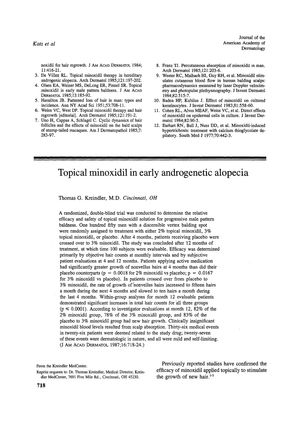
March 1987 in “Journal of The American Academy of Dermatology” This study found that both 2% and 3% topical minoxidil were more effective than placebo in promoting hair growth for men with male pattern baldness over 12 months.