 1 citations
,
January 2013 in “International Journal of Trichology”
1 citations
,
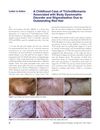
January 2013 in “International Journal of Trichology” A girl with red hair developed hair-pulling and body image disorders after being bullied for her hair color.
 2 citations
,
September 2022 in “Dermatologic therapy”
2 citations
,
September 2022 in “Dermatologic therapy” This case series reports promising initial data on using microneedling with a dermaroller in trichotillomania patients, indicating potential efficacy in reducing compulsive hair-pulling behaviors and promoting hair regrowth.

In this study, trichoscopy was found to be a valuable non-invasive tool for diagnosing scalp lesions, enhancing diagnostic accuracy and reducing the need for scalp biopsies by identifying specific trichoscopic features associated with conditions like psoriasis, seborrheic dermatitis, and alopecia areata.
December 2021 in “IP Indian journal of clinical and experimental dermatology” In this study, trichoscopy was identified as a useful non-invasive tool to aid in the diagnosis of female pattern hair loss, with peri pilar sign and hair diameter variability being common findings.
 2 citations
,
January 2008 in “Journal of The American Academy of Dermatology”
2 citations
,
January 2008 in “Journal of The American Academy of Dermatology” Trichoscopy is a helpful and quick method to diagnose hair loss without shaving.

This study found that both trichoscopy and folliscopy are highly accurate for diagnosing telogen effluvium, though trichoscopy is simpler and faster to perform.
 December 2024 in “IntechOpen eBooks”
 In this study, trichoscopy was identified as a valuable diagnostic tool for alopecia areata, revealing that specific hair features like yellow dots and short vellus hairs help assess disease activity and phase, with diagnosis relying on multiple combined signs rather than a single indicator.
 May 2022 in “European medical journal”
 This case report highlights a rare instance of gastric trichobezoar, or "Rapunzel syndrome," associated with trichotillomania, characterized by hair accumulation in the stomach of a patient.
 1 citations
,
January 2016 in “Journal of cosmetology & trichology”
1 citations
,
January 2016 in “Journal of cosmetology & trichology” Trichoscopy helped diagnose and treat a child's fungal scalp infection by spotting specific hair shapes.
April 2023 in “Al-Azhar International Medical Journal /Al-Azhar International Medical Journal” This study found that both trichoscopy and folliscopy are highly accurate for diagnosing telogen effluvium, but trichoscopy is easier and quicker to perform.
 91 citations
,
January 2009 in “International Journal of Trichology”
91 citations
,
January 2009 in “International Journal of Trichology” This review discusses the advantages and limitations of various hair loss evaluation methods but reports no new results; it emphasizes the importance of cautious interpretation for these diagnostic tools.
 2 citations
,
May 2022 in “Clinical, Cosmetic and Investigational Dermatology”
2 citations
,
May 2022 in “Clinical, Cosmetic and Investigational Dermatology” This study reports that quantitative trichoscopy, while noninvasive and convenient, provides less accurate hair density data compared to invasive histopathologic examination, which was demonstrated in a sample of adult Chinese individuals without alopecia.
4 citations
,
January 2018 in “Indian dermatology online journal” This case report found that dermoscopy, showing characteristic "comma" and "corkscrew" hairs, effectively identified tinea capitis in a 7-year-old girl, allowing for early treatment before confirmation with fungal culture.
 8 citations
,
January 2020 in “International Journal of Trichology”
8 citations
,
January 2020 in “International Journal of Trichology” The authors concluded that trichoscopy is a valuable noninvasive tool for diagnosing and monitoring nonscarring alopecia, aiding in the identification of new hair signs in difficult cases.
26 citations
,
November 2005 in “Journal of Investigative Dermatology Symposium Proceedings” TrichoScan effectively measures hair growth improvements in people using minoxidil.
In this study, trichoscopy was diagnostically useful in 97.5% of alopecia cases at a rural Indian hospital, confirming initial diagnoses in most cases and reducing the need for invasive scalp biopsies.
 April 2026 in “International Journal of Drug Delivery Technology”
 This study found trichoscopy to be a reliable non-invasive method for diagnosing various forms of alopecia, aiding in clinical management and reducing the need for biopsies in a hospital-based setting with 90 patients, including those with uncertain diagnoses.
1 citations
,
September 2025 in “Pediatric Dermatology” This systematic review reported that habit reversal training showed the most consistent benefit for treating pediatric trichotillomania, while evidence for pharmacological treatments and alternative therapies like N-acetylcysteine remains insufficient, highlighting the need for early behavioral intervention and further research into standardized treatment protocols.
 1 citations
,
May 2003 in “Archives of Pathology & Laboratory Medicine”
1 citations
,
May 2003 in “Archives of Pathology & Laboratory Medicine” This report discusses a case of pediatric trichotillomania, detailing its clinical presentation and distinguishing histopathological characteristics, ultimately diagnosing the condition in a 7-year-old boy with nonscarring alopecia.
January 2026 in “Surgical & Cosmetic Dermatology”  70 citations
,
June 2003 in “Journal of Investigative Dermatology Symposium Proceedings”
70 citations
,
June 2003 in “Journal of Investigative Dermatology Symposium Proceedings” This study reports that the TrichoScan method effectively measures hair growth parameters and detected significant improvements in hair counts and thickness in men with androgenetic alopecia after finasteride treatment.
 7 citations
,
January 2013 in “Dermatology Research and Practice”
7 citations
,
January 2013 in “Dermatology Research and Practice” This review discusses the usefulness of trichoscopy in diagnosing and managing scalp and hair disorders, reporting it as a valuable tool for linking clinical and histological findings.
July 2026 in “Journal of Cutaneous and Aesthetic Surgery” This study found that trichoscopic quantitative parameters reliably indicate the severity of female pattern hair loss and complement the Sinclair scale by offering a more objective and reproducible grading system.
 5 citations
,
January 2015 in “Current problems in dermatology”
5 citations
,
January 2015 in “Current problems in dermatology” This article reviews the diagnostic process for hair problems, emphasizing the importance of thorough patient evaluation and communication but reports no new clinical results.
2 citations
,
October 2015 in “The Journal of Dermatology” This article is a letter to the editor discussing a case of extensive cicatricial alopecia in a patient with long-term trichotillomania and reports no new research findings.
 8 citations
,
March 2011 in “Archives of Dermatology”
8 citations
,
March 2011 in “Archives of Dermatology” This study suggests that corkscrew hair could serve as a new diagnostic marker for tinea capitis and that dermoscopy might help diagnose atypical cases swiftly.
 5 citations
,
March 2017 in “Laser Physics Letters”
5 citations
,
March 2017 in “Laser Physics Letters” This review discusses the role of scalp imaging techniques in trichology for researching drug delivery and toxicology, without presenting new clinical results.
June 2025 in “British Journal of Dermatology” This systematic review reports that trichoscopy is highly accurate for diagnosing scalp disorders, suggesting it as a valuable alternative to biopsies and supporting recommendations for its integration into routine dermatology practice.
 43 citations
,
August 2013 in “Pediatric Dermatology”
43 citations
,
August 2013 in “Pediatric Dermatology” This review discusses the use of trichoscopy in diagnosing and managing pediatric hair and scalp disorders and reports no new experimental findings.
7 citations
,
November 2022 in “Actas Dermo-Sifiliográficas” This study reviewed the usefulness of trichoscopy in diagnosing and monitoring alopecia areata, noting that the technique identifies specific hair features like yellow and black dots, which are linked to the disease's chronic nature and treatment response.