 August 2023 in “Journal of The American Academy of Dermatology”
 In this commentary, the authors highlighted that valproic acid, unlike lamotrigine, is notably associated with alopecia in various studies, with an incidence rate up to 12% and mechanisms involving telogen effluvium and hyperandrogenism contributing to hair loss in patients.
June 2019 in “bioRxiv (Cold Spring Harbor Laboratory)” This study found that atopic dermatitis patients had a 30% lower prevalence of benign paroxysmal positional vertigo, with socioeconomic factors influencing these patterns.
 March 2026 in “Indian Dermatology Online Journal”
 This report details a case study where a 40-year-old woman experienced allergic contact dermatitis and angioedema-like symptoms after using PPD-containing hair dye. Patch testing confirmed a positive reaction to PPD, highlighting the substance's potential to cause both T-cell and IgE-mediated hypersensitivity reactions.
May 2020 in “Journal of the Dermatology Nurses’ Association” This study concluded that using a multimedia patient education tool may improve patient comprehension of platelet-rich plasma treatment for androgenetic alopecia in a dermatology practice.
December 2024 in “Annals of Medicine and Surgery” Early diagnosis of pseudopelade of Brocq in men is crucial to prevent permanent hair loss.
January 1990 in “대한피부과학회지” This study found that peanut agglutinin binding patterns after neuraminidase pretreatment can help differentiate malignant melanoma from nevocellular nevus in skin specimens.
 8 citations
,
January 2023 in “Surgical Neurology International”
8 citations
,
January 2023 in “Surgical Neurology International” This case report describes the successful use of percutaneous and endovascular embolization with PHIL embolic agent to treat a rare scalp arteriovenous fistula following a hair transplant.
 20 citations
,
September 2019 in “Journal of Cosmetic Dermatology”
20 citations
,
September 2019 in “Journal of Cosmetic Dermatology” This study found that combining stromal vascular fraction with PRP injections significantly improved hair density and reduced hair loss more effectively than PRP alone in patients with androgenetic alopecia.
June 2023 in “Scholars journal of medical case reports” This case report describes a 45-year-old Malian woman with Vogt-Koyanagi-Harada disease, highlighting its uncommon occurrence among individuals of African descent and detailing her treatment with prednisone and other adjunct therapies.
February 2022 in “Authorea (Authorea)” This report presents a case of a seven-year-old girl with porokeratotic adnexal ostial nevus manifesting as hyperkeratotic verrucous papules on her left foot.
January 2023 in “Repositorio Institucional Universidad El Bosque” In this case report, a rare traumatic arteriovenous fistula following hair transplant was successfully treated using percutaneous and endovascular embolization with PHIL, a liquid embolic agent.
 June 2023 in “International Journal of Pharmaceuticals Nutraceuticals and Cosmetic Science”
 This review compiles recent findings on the pharmacokinetics, pharmacodynamics, and pharmacogenomics of Valproate, highlighting potential new uses, benefits, and risks, but reports no new clinical results.
17 citations
,
October 2011 in “International Journal of Immunopathology and Pharmacology” This study found that after 24 weeks of DPCP treatment for alopecia areata, there was a significant increase in new capillaries and hair regrowth detectable by videocapillaroscopy.
 April 2017 in “The Journal of Urology”
 This study found that patients with BPH who received finasteride before TURP experienced reduced intraoperative blood loss and improved quality of life one month after surgery compared to those who did not.
This study presents a case where a young male with cryptogenic stroke and patent foramen ovale, using finasteride, experienced symptomatic improvement after PFO closure and discontinuing finasteride, suggesting cardiovascular risks associated with the drug.
 48 citations
,
June 2013 in “Journal of Dermatological Science”
48 citations
,
June 2013 in “Journal of Dermatological Science” This study found that valproic acid promoted human hair growth by increasing β-catenin levels, suggesting it may be a potential therapeutic option for alopecia.
 47 citations
,
March 2019 in “Journal of immunology research”
47 citations
,
March 2019 in “Journal of immunology research” This review discusses the effects of valproic acid on immune cell activation and gene expression, potentially influencing infection outcomes and suggesting its promise for autoimmune and hypersensitivity condition management.
9 citations
,
October 2015 in “Cutaneous and ocular toxicology” This case report observed vemurafenib-induced pityriasis amiantacea, a scalp scaling reaction, in a patient with metastatic melanoma, which was managed symptomatically without altering vemurafenib treatment.
 September 2009 in “European journal of paediatric neurology”
 Biotin supplements did not significantly reduce hair loss in rats on valproic acid.
January 2009 in “Journal watch” This study enrolled nine patients to investigate the effects of oral psoralen and ultraviolet A therapy plus oral prednisolone for treating alopecia areata.
January 2020 in “International Journal of Trichology” This study reported that platelet-rich plasma injections led to only temporary improvement in vellus hair characteristics in temporal triangular alopecia, suggesting it may not be an effective long-term treatment.
19 citations
,
March 2011 in “The Journal of Dermatology” This case report in a child suggests that lichen planus pemphigoides may represent a heterogeneous group of disorders, potentially triggered by conditions like varicella.
 1 citations
,
October 2025 in “Frontiers in Immunology”
1 citations
,
October 2025 in “Frontiers in Immunology” In this study, researchers analyzed adverse events linked to avacopan using FDA data, finding no high-priority safety concerns but identifying five potential new adverse events, including alopecia, primarily among American patients, and noting a higher risk of liver dysfunction in Japanese patients.
2 citations
,
April 2021 in “JAAD International” This article discusses the potential safety of platelet-rich plasma therapy for cicatricial alopecia but highlights that its effectiveness is still uncertain; no new empirical results are provided.
1 citations
,
May 2021 in “Clinical Nuclear Medicine” In this study, 18F-FDG PET/CT revealed increased FDG uptake in the scalp of a woman after platelet-rich plasma therapy, indicating potential inflammatory changes.
1 citations
,
October 2023 in “European Journal of Dermatology” This study found that combining hair transplantation with platelet-rich plasma treatment significantly improved hair regeneration, reduced hair loss, and minimized skin lesion areas in patients with androgenic alopecia compared to hair transplantation alone, suggesting enhanced treatment efficacy.
 1 citations
,
January 2018 in “Acta dermato-venereologica”
1 citations
,
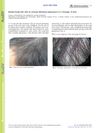
January 2018 in “Acta dermato-venereologica” A teenager's hair with alternating white and dark bands, known as Pili annulati, is a genetic condition that is usually harmless and often considered attractive.
 January 1994 in “Nippon Ronen Igakkai Zasshi Japanese Journal of Geriatrics”
 In this study, both VEPA and ML-Y1 treatment regimens for older patients with non-Hodgkin's lymphoma showed similar response and survival rates, but neither was sufficient, indicating the need for a more effective approach.
14 citations
,
January 2019 in “Annals of plastic surgery” This case report details a face and scalp transplant in a patient with granulomatosis with polyangiitis and trauma, showing an encouraging 3-year outcome without disease relapse or severe complications.
 November 2024 in “Journal of Cosmetic Dermatology”
 This study found that valproic acid-loaded microemulsion formulations enhanced skin penetration pathways in guinea pigs compared to an aqueous solution, with composition elements like oil content and surfactant ratios significantly affecting drug delivery performance.