 February 2025 in “Physician s Journal of Medicine”
 In this review, researchers highlighted that COVID-19 can cause various skin manifestations like maculopapular rashes and "COVID toes," which often precede or appear without respiratory symptoms, suggesting their potential for early detection and prognostic evaluation, especially in severe cases.
 January 2025 in “Advances in Dermatology and Allergology”
 This study suggests that foods and drugs containing sulfhydryl groups may induce or worsen pemphigus vulgaris.
 September 2024 in “World Journal of Advanced Research and Reviews”
 This review highlights that COVID-19, beyond affecting the respiratory system, leads to various complications across multiple organ systems like cardiovascular, neurological, and immune, emphasizing the importance of understanding these to enhance patient care and guide future research.
 May 2024 in “International Journal of Advanced Multidisciplinary Research and Studies”
 In this cross-sectional study of COVID-19 positive patients in Bangladesh, researchers found that maculo-papular eruptions were the most common dermatological manifestation, with other prevalent conditions including chilblain-like eruptions, urticarial lesions, and petechiae/purpura.
 April 2024 in “Cell death and disease”
 This review discusses the long-term complications of COVID-19, known as long COVID or PASC, and emphasizes the need to improve awareness and management strategies but reports no new clinical findings.
 February 2024 in “PloS one”
 This review concluded that oral tofacitinib and adalimumab are promising treatments for cicatricial alopecia, showing effectiveness in improving signs and symptoms but requiring regular monitoring for adverse effects. The authors emphasize the need for further extensive studies to solidify these findings.
 January 2024 in “Pediatria Polska”
 This study found that long-COVID symptoms in children with multisystem inflammatory syndrome did not differ significantly across SARS-CoV-2 variants, with factors like age being more impactful.
 July 2023 in “Media Dermato Venereologica Indonesiana”
 This research discusses Stevens-Johnson syndrome and toxic epidermal necrolysis, life-threatening conditions often induced by immune-mediated drug reactions. Optimal management involves early diagnosis, drug withdrawal, and supportive therapy, though evidence for systemic treatments like corticosteroids and cyclosporin remains variable and lacks randomized controlled trial confirmation.
 May 2023 in “Frontiers in veterinary science”
 This study describes the successful treatment of erythema multiforme in a young Central American tapir with a combination of wound care, silver sulfadiazine cream, and oral prednisolone, emphasizing the importance of diagnostic testing for vesicular dermatitis syndromes in tapirs.
 January 2023 in “Acta dermatovenerologica Alpina, Pannonica et Adriatica (Tiskana izd.)”
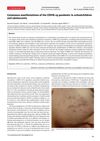
 This review details skin conditions in children and adolescents related to the SARS-CoV-2 pandemic, emphasizing mask-related acne and various cutaneous manifestations linked to infection and vaccination, with most being mild or nonspecific.
 January 2022 in “Dermatology Review”
 This study found that patients with chronic kidney disease-associated pruritus had elevated serum levels of interleukin 31, suggesting a possible role of this cytokine in the condition.
 December 2021 in “The Sri Lanka Journal of Dermatology”
 This study found that the prevalence of dermatological manifestations in COVID-19 patients was 1.7% in Sri Lanka, with various types of skin lesions reported.
 November 2019 in “Harper's Textbook of Pediatric Dermatology”
 This review discusses potential causes of alopecia and hair overgrowth in pediatric patients, detailing diagnostic techniques and treatments, but presents no new research findings.
 November 2019 in “Harper's Textbook of Pediatric Dermatology”
 This index of Harper's Textbook of Pediatric Dermatology, Fourth Edition, provides no clinical results or new findings.

This book reviews evidence-based medicine practices in obstetrics and gynecology but reports no new clinical findings.
 July 2018 in “Elsevier eBooks”
 This article reviews the clinical presentation, diagnosis, and treatment options for discoid lupus erythematosus and reports no new clinical results.
 January 2017 in “Springer eBooks”
 The document explains various skin conditions and their treatments.
 April 2016 in “Journal of the American Academy of Dermatology”
 This study found that in a tertiary academic institution, nearly 1 in 5 dermatology consults were for drug-related skin reactions, with antibiotics frequently identified as the culprits.
 January 2016 in “Springer eBooks”
 This review discusses medications used in dermatology, detailing their side effects and interactions, and reports no new clinical results.
 February 2012 in “Journal of The American Academy of Dermatology”
  January 2012 in “Springer eBooks”
 Lupus can cause different skin problems, and treatments like quitting smoking and using certain creams or medicines can help.
 August 2010 in “The Journal of Dermatology”
 The document concludes that low-dose acne treatment is most suitable for moderate acne, with high patient satisfaction and low relapse rates.
 February 2010 in “Journal of the American Academy of Dermatology”
 This case report describes a 4-month-old boy with anhidrotic ectodermal dysplasia and immunodeficiency who showed minimal improvement with initial treatments but significant improvement after an umbilical cord blood transplantation.
 February 2010 in “Journal of the American Academy of Dermatology”
 Lactic acid cream can help improve skin bumps known as eruptive vellus hair cysts.
 July 2003 in “Journal of Cutaneous Medicine and Surgery”
 Certain drugs can cause lupus, stopping these drugs is the main treatment. NB-UVB phototherapy clears psoriasis faster when applied three times a week. Monoclonal antibodies and oral pimecrolimus are effective in treating psoriasis. Smoking and drinking are linked to psoriasis in men. No direct link between low iron and hair loss was found. Vaccines are effective against genital herpes and human papillomavirus type 16.
 July 2003 in “Journal of Cutaneous Medicine and Surgery”
 Blood pressure drugs can cause skin lupus, early treatment is key for baby herpes and diabetic foot ulcers, a certain vaccine works against genital herpes and HPV in women, more frequent light therapy helps psoriasis, smoking and drinking can worsen psoriasis, a cream clears up a type of skin cancer, and low iron levels don't cause chronic hair loss.
 July 2003 in “Journal of Cutaneous Medicine and Surgery”
 Various skin conditions can be treated effectively with different methods, such as discontinuing certain drugs, using specific vaccines, applying creams, and changing lifestyle habits like smoking and drinking.
 July 2003 in “Journal of Cutaneous Medicine and Surgery”
 The document concludes that various treatments for skin conditions are effective, but some require further research, and certain factors like gender and lifestyle can influence disease outcomes.
 July 2003 in “Journal of Cutaneous Medicine and Surgery”
 Stopping certain drugs can improve skin conditions, arsenicosis affects over half of a Bangladeshi village, males are more vulnerable, and certain treatments are effective for warts, acne, and psoriasis. Smoking and drinking are linked to psoriasis in men, a cream helps with a type of skin cancer, and low iron levels don't directly cause chronic hair loss in women.
 July 2003 in “Journal of Cutaneous Medicine and Surgery”
 High blood pressure drugs often cause skin lupus, stopping the drug usually helps. A vaccine helps prevent genital herpes and HPV-16. More frequent light therapy clears psoriasis faster. No link was found between low iron and chronic hair loss.