
This article reviews the characteristics and risks associated with polycystic ovary syndrome, such as insulin resistance and obesity, highlighting a need for further understanding of its pathogenesis; it reports no new findings.
 February 2010 in “Journal of The American Academy of Dermatology”
 This study found that among Chinese patients with alopecia areata, those with alopecia totalis or universalis had an earlier onset, longer disease duration, and more severe quality of life impact than those with patchy alopecia.
 March 2009 in “Prenatal Diagnosis”
 This paper discusses the management of pregnancy in a carrier of the Donohue mutation and reports no new clinical findings.
January 2003 in “Jiefangjun yixue zazhi” In this study, the researchers observed that the expression of certain growth factors and their receptors increases with gestational age, implying a role in skin development, structure maintenance, and wound healing.
 208 citations
,
July 2001 in “Journal of The American Academy of Dermatology”
208 citations
,
July 2001 in “Journal of The American Academy of Dermatology” This review discusses the classification and diagnosis of pregnancy-related skin conditions and reports no new clinical findings.
 88 citations
,
January 2011 in “Annals of Dermatology”
88 citations
,
January 2011 in “Annals of Dermatology” This review discusses the reclassification of pregnancy-related skin diseases and provides a management algorithm but reports no new clinical findings.
 41 citations
,
February 1970 in “Archives of Dermatology”
41 citations
,
February 1970 in “Archives of Dermatology” This review discusses various cutaneous side effects potentially linked to oral contraceptive use but provides no new clinical results, emphasizing the need for more evidence in certain associations.
 36 citations
,
April 1990 in “Dermatologic Clinics”
36 citations
,
April 1990 in “Dermatologic Clinics” This review discusses skin changes and dermatoses during pregnancy and reports no clinical findings, emphasizing a need for better understanding of their causes.
 34 citations
,
June 2014 in “The BMJ”
34 citations
,
June 2014 in “The BMJ” This study found that children with intracranial injuries had significantly lower odds of achieving satisfactory early academic performance compared to those without head injuries.
 33 citations
,
August 2006 in “Journal der Deutschen Dermatologischen Gesellschaft”
33 citations
,
August 2006 in “Journal der Deutschen Dermatologischen Gesellschaft” Pregnancy can cause specific skin conditions that need correct diagnosis and treatment to protect both mother and baby.
 26 citations
,
June 2012 in “The Journal of Obstetrics and Gynecology of India”
26 citations
,
June 2012 in “The Journal of Obstetrics and Gynecology of India” This review discusses various skin changes during pregnancy, noting that while most are benign and resolve after childbirth, some may require careful medical management for the safety of the mother and fetus; it reports no new results.
 24 citations
,
March 2015 in “Best Practice & Research in Clinical Obstetrics & Gynaecology”
24 citations
,
March 2015 in “Best Practice & Research in Clinical Obstetrics & Gynaecology” This review discusses physiological skin changes and specific dermatoses in pregnancy but reports no new clinical results, emphasizing careful diagnosis and management due to potential fetal risks in rare cases.
 24 citations
,
June 2011 in “International Journal of Dermatology”
24 citations
,
June 2011 in “International Journal of Dermatology” This review summarizes physiologic skin changes during pregnancy and specific pregnancy-related dermatoses but reports no new clinical results.
 13 citations
,
January 2013 in “Our Dermatology Online”
13 citations
,
January 2013 in “Our Dermatology Online” This study found that polymorphic eruption was the most common pregnancy-related dermatosis, occurring mostly in the third trimester.
 13 citations
,
June 1984 in “Postgraduate Medicine”
13 citations
,
June 1984 in “Postgraduate Medicine” This article discusses various pruritic dermatoses that can occur during pregnancy, emphasizing the importance of physician skill in diagnosing and treating these conditions; it reports no new findings.
 9 citations
,
July 2002 in “Journal of the European Academy of Dermatology and Venereology”
9 citations
,
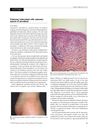
July 2002 in “Journal of the European Academy of Dermatology and Venereology” This article discusses multiple minute digitate hyperkeratosis in a dermatological context and reports no new clinical findings; the authors focus on a descriptive review.
 6 citations
,
September 2013 in “The Obstetrician & Gynaecologist”
6 citations
,
September 2013 in “The Obstetrician & Gynaecologist” This article reviews the physiological skin changes and unique dermatoses in pregnancy, discussing their causes and management, but reports no new clinical findings.
 6 citations
,
September 1990 in “International Journal of Gynecology & Obstetrics”
6 citations
,
September 1990 in “International Journal of Gynecology & Obstetrics” This case report describes a rare instance of pruritic urticarial papules and plaques of pregnancy in a 25-year-old caucasian primigravida during the third trimester, discussing management recommendations.
 3 citations
,
January 2018 in “Journal of South Asian Federation of Obstetrics and Gynaecology”
3 citations
,
January 2018 in “Journal of South Asian Federation of Obstetrics and Gynaecology” This study compared letrozole and clomiphene citrate for ovulation induction in women with polycystic ovary syndrome and found that while clomiphene led to more follicles, monofollicular development and endometrial thickness were higher with letrozole, and pregnancy rates did not significantly differ between the two treatments.
January 2026 in “Clinical Journal for Nurse Practitioners in Women s Health” In this article, it is explored how pregnancy-related physiologic changes can predispose women to dermatologic conditions affecting well-being, and it highlights the critical role of women’s health nurse practitioners in managing these conditions with attention to safety and efficacy in pregnant patients.
 February 2025 in “Quality in Sport”
 This review reports that pregnancy-specific dermatoses, including AEP, PEP, ICP, and PG, present overlapping clinical features and can significantly impact fetal outcomes, particularly ICP and PG, which are linked to preterm birth and stillbirth.
 February 2023 in “Pakistan Journal of Medical and Health Sciences”
 This study found a variety of dermatological conditions in pregnant women, with Striae Gravidarum being the most prevalent at 48.1%, followed by Linea Nigra at 45.9%.

This review discusses the variety of skin changes and diseases that can occur during pregnancy, categorizing them into physiological changes, non-specific alterations, and pregnancy-specific dermatoses, and reports no clinical results.
 August 2009 in “Expert Review of Dermatology”
 This review examines physiological changes and dermatoses during pregnancy and reports no clinical results, highlighting the importance of recognizing these conditions for appropriate management.
 January 2009 in “Springer eBooks”
 The document concludes that managing skin conditions during pregnancy is important and requires specialized care.
 December 2004 in “Medicine”
 This review examines different skin conditions during pregnancy, including physiological changes and pregnancy-exclusive dermatoses, and reports no new clinical findings.
This study reviewed various dermatological conditions associated with oral contraceptive use, highlighting increased pigmentation, decreased sebum production, and changes in hair growth, among other effects.
October 2022 in “Amplla Editora eBooks” Gestational diabetes increases risks for mothers and babies, needing early diagnosis and care.
 June 2008 in “British Journal of Dermatology”
 Herpes gestationis is linked to certain antigens, atopic eczema affects T cell populations and may be eased by breastfeeding, higher doses of anti-androgen treatment can improve androgenic alopecia, topical minoxidil increases hair thickness, long-term methotrexate therapy can cause liver fibrosis in psoriasis patients, and Lichen Sclerosus et Atrophicus patients aren't at higher risk for autoimmune disorders.
May 2026 in “Reviews in Endocrine and Metabolic Disorders” This review explores weight loss interventions during gestation, emphasizing incretin-based therapies' potential to enhance reproductive health and address metabolic changes for better maternal and fetal outcomes.