 47 citations
,
December 2020 in “Journal of the European Academy of Dermatology and Venereology”
47 citations
,
December 2020 in “Journal of the European Academy of Dermatology and Venereology” This article reviews the classification, diagnosis, and management of hair disorders, emphasizing the role of trichoscopy and early diagnosis for effective treatment but reports no new clinical findings.
 2 citations
,
August 2020 in “Dermatologic Therapy”
2 citations
,
August 2020 in “Dermatologic Therapy” This analysis from Egyptian researchers identified common risk factors associated with chronic telogen effluvium in children, but it reports no new clinical results.
 12 citations
,
July 2020 in “Dermatologic Therapy”
12 citations
,
July 2020 in “Dermatologic Therapy” This review discusses the use of topical and oral minoxidil for pediatric hair disorders, pointing out the lack of guidelines and the potential risks associated with systemic absorption, but reports no clinical results.
5 citations
,
October 2019 in “Giornale italiano di dermatologia e venereologia” This review highlights the potential benefits of biotin in treating skin disorders related to biotin deficiency but reports no new clinical results.
 23 citations
,
September 2019 in “Dermatology practical & conceptual”
23 citations
,
September 2019 in “Dermatology practical & conceptual” This study analyzed the features of alopecia areata incognita and diffuse alopecia areata, finding distinct patterns in hair loss regions and trichoscopic signs, and noted a benign course responsive to topical steroid therapy.
 13 citations
,
March 2018 in “Pediatric Dermatology”
13 citations
,
March 2018 in “Pediatric Dermatology” This review describes the clinical characteristics and confirms the diagnosis of short anagen syndrome in the largest reported series to date, comparing it to loose anagen syndrome.
 4 citations
,
May 2017 in “Pediatric Dermatology”
4 citations
,
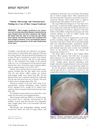
May 2017 in “Pediatric Dermatology” This case report details a 3-year-old girl with short anagen syndrome, characterized by short, sparse hair, where X-ray microanalysis showed her hair's main bioelements were normal.
 78 citations
,
January 2017 in “Skin appendage disorders”
78 citations
,
January 2017 in “Skin appendage disorders” This review discusses the use of biotin for hair and nail growth, noting clinical improvement in cases with existing pathologies, but concludes there is insufficient evidence supporting its benefits for healthy individuals.
 18 citations
,
March 2015 in “Journal of Dermatological Case Reports”
18 citations
,
March 2015 in “Journal of Dermatological Case Reports” This study identified distinctive trichoscopic features that may aid in diagnosing loose anagen hair syndrome, such as rectangular black granular structures, solitary yellow dots, and a predominance of follicular units with single hairs.
5 citations
,
November 2012 in “Journal of the American Academy of Dermatology” This case report describes a 3-year-old girl with short hair since birth, showing normal hair density with many vellus and intermediate hairs, and no hair shaft abnormalities.
 2 citations
,
January 2012 in “International Journal of Trichology”
2 citations
,
January 2012 in “International Journal of Trichology” This case report describes the first Indian patient diagnosed with short anagen syndrome, detailing the clinical and pathological characteristics of a 30-year-old woman with the condition.
28 citations
,
June 2010 in “Pediatric dermatology” This review discusses short anagen syndrome, highlighting its symptom of abnormally short scalp hair without associated systemic diseases, and notes that hair length often improves spontaneously after puberty without treatment.
 10 citations
,
May 2010 in “Journal of The American Academy of Dermatology”
10 citations
,
May 2010 in “Journal of The American Academy of Dermatology” This report presents a rare case of short anagen syndrome in a 38-year-old African American woman, expanding the documented demographic beyond previously reported Caucasian individuals with fine blond hair.
 46 citations
,
October 2009 in “Archives of Dermatology”
46 citations
,
October 2009 in “Archives of Dermatology” This study found that loose anagen hair syndrome is a common form of alopecia in young girls, typically presenting with thin, sparse hair and usually confirmed by a hair-pull test.
49 citations
,
April 2007 in “Pediatric Dermatology” This study describes a family with uncombable hair syndrome, suggesting autosomal dominant inheritance, and reports that oral biotin improved hair appearance in two young patients.
 37 citations
,
July 2005 in “Journal of The American Academy of Dermatology”
37 citations
,
July 2005 in “Journal of The American Academy of Dermatology” This article reviews the clinicopathologic features of short anagen syndrome in a child and suggests diagnostic methods like clinical examination and scalp hair growth rate measurement, without reporting new clinical results.
 42 citations
,
September 2000 in “British Journal of Dermatology”
42 citations
,
September 2000 in “British Journal of Dermatology” This report describes two children with congenital hypotrichosis and found their short hair is due to a shortened anagen phase, with the condition resolving spontaneously during puberty.