When’s a good time for a diffuse thinner to incorporate minoxidil into their regimen? Minoxidil 3/28/2024
A 31-year-old has been on finasteride for 8 years and is experiencing less dense hair and itchiness, and is considering adding minoxidil or RU58841 to their regimen. They are also inquiring about the benefits of oral versus topical finasteride.
View this post in the Community →
Similar Community Posts Join
6 / 6 resultscommunity Finasteride and Topical Minoxidil to Dutasteride and Oral Minoxidil. Is RU58841 still helping?
The user switched from finasteride and topical minoxidil to dutasteride and oral minoxidil, questioning the effectiveness and safety of continuing RU58841. They experienced hair loss improvement initially but are now considering stopping RU58841 due to cost and safety concerns.
community ~5 months topical minoxidil + oral finasteride results (swipe images). Slacked with minoxidil this past month, trying to wean off anyways. My last update because I’m hopping off fin and switching to RU in a few weeks (nothing to do with fin efficacy, just experimenting).
The user experienced significant hair thickening after using topical minoxidil and oral finasteride for about 5 months and is considering switching from finasteride to RU58841. Other users encourage the original poster to continue the current treatment due to the positive results.
community September - december with fin + oral & topical min + ru58841.
The user experienced hair regrowth using finasteride, oral and topical minoxidil, and RU58841, despite initial shedding. They also transitioned from finasteride to dutasteride and addressed scalp issues with a folliculitis shampoo.
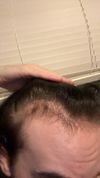
community 21M Considering Topical Fin or RU After Oral Minoxidil and Fin Reactions
A 21-year-old male experienced negative side effects from oral finasteride and is considering switching to topical finasteride or RU58841 after using oral minoxidil. He seeks advice on a standard hair loss routine, mentioning peptides, RU58841, and dermarolling.
community Adding Topical Dutasteride on top of Oral Finasteride & Oral Minoxidil (19m)
The user experienced gradual hair thinning since 2021 and tried various treatments including topical minoxidil, rosemary oil, oral finasteride, oral minoxidil, RU58841, and oral dutasteride. They are considering switching to daily finasteride and adding topical dutasteride, tretinoin, and microneedling due to side effects from oral dutasteride.
community 5 year progress on fin/dut and topical/oral minoxidil
The user shared their 5-year hair regrowth journey using oral finasteride, oral dutasteride, topical and oral minoxidil, and a hair transplant. They experienced significant hair improvement without major side effects, although RU58841 was not effective for them.
Related Research
6 / 6 results
research CLINICAL UPDATES IN HAIR
This chapter reviews various antiandrogens and androgen inhibitors, detailing their mechanisms, uses, and side effects, with a focus on spironolactone, finasteride, dutasteride, and oral contraceptives.

research Minoxidil: effectiveness and prospects for use in the treatment of androgenetic alopecia
Minoxidil is an effective and safe treatment for common hair loss when applied to the skin, but more research is needed for optimal use.

research Системная терапия больных андрогенетической алопецией
Some treatments like minoxidil, finasteride, and dutasteride are effective for hair loss, but there's no agreed best treatment.
research Treatments for Androgenetic Alopecia and Alopecia Areata
This review discusses current and emerging drug therapies for treating androgenetic alopecia and alopecia areata, and reports no clinical results; it highlights a need for improved and novel treatments.

research Compounding as a Current Therapeutic Option in Dermatology
This review discusses the current role and challenges of compounding in dermatology without presenting new research results; the authors suggest its resurgence in practice despite pharmaceutical alternatives.

research Investigational medications in the treatment of alopecia
This review discusses investigational treatments for androgenetic and chemotherapy-induced alopecia and reports no new clinical results, highlighting the need for further research.