 33 citations
,
September 2012 in “Australasian Journal of Dermatology”
33 citations
,
September 2012 in “Australasian Journal of Dermatology” This article reviews trichoscopic signs of chemotherapy-induced alopecia, including exclamation marks, but reports no new clinical results.
 32 citations
,
January 2014 in “Dermatology Research and Practice”
32 citations
,
January 2014 in “Dermatology Research and Practice” This study found that trichoscopy can rapidly and noninvasively diagnose tinea capitis and alopecia areata in pediatric patients by identifying specific hair patterns associated with each condition.
 30 citations
,
March 2015 in “Journal of Dermatology”
30 citations
,
March 2015 in “Journal of Dermatology” This study found that certain trichoscopic features like white peripilar sign, yellow dots, and scalp pigmentation are positively correlated with the severity of androgenetic alopecia in Chinese patients.
29 citations
,
February 2019 in “Pediatric dermatology” This abstract suggests that specific trichoscopic features like black dots, coiled hair, and trichoptilosis may help differentiate trichotillomania from patchy alopecia areata.
 26 citations
,
September 2016 in “International Journal of Dermatology”
26 citations
,
September 2016 in “International Journal of Dermatology” This study aimed to identify trichoscopic features that help differentiate between tinea capitis and alopecia areata in children, enhancing diagnosis and treatment decisions visually and non-invasively.
 25 citations
,
December 2008 in “Journal of Dermatological Case Reports”
25 citations
,
December 2008 in “Journal of Dermatological Case Reports” This case report describes alopecia areata dermoscopy in an African-American patient, revealing novel patterns such as a diffuse honeycomb-like pigmented network and white dots, suggesting skin color may affect dermoscopic findings.
 24 citations
,
September 2014 in “Journal of the European Academy of Dermatology and Venereology”
24 citations
,
September 2014 in “Journal of the European Academy of Dermatology and Venereology” This study suggests that trichoscopy with a handheld dermatoscope may help differentiate temporal triangular alopecia from other localized alopecia by identifying specific hair features.
 23 citations
,
September 2019 in “Dermatology practical & conceptual”
23 citations
,
September 2019 in “Dermatology practical & conceptual” This study analyzed the features of alopecia areata incognita and diffuse alopecia areata, finding distinct patterns in hair loss regions and trichoscopic signs, and noted a benign course responsive to topical steroid therapy.
 23 citations
,
November 2014 in “Anais Brasileiros de Dermatologia”
23 citations
,
November 2014 in “Anais Brasileiros de Dermatologia” This study suggests that trichoscopy may assist in diagnosing pemphigus, particularly for scalp-specific lesions, by identifying certain characteristic features.
21 citations
,
September 2022 in “Actas Dermo-Sifiliográficas” This study reviews the use of trichoscopy in diagnosing and monitoring alopecia areata, highlighting that certain trichoscopic findings like yellow and black dots, exclamation mark hairs, and others, provide valuable insights into disease status and treatment response.
 21 citations
,
January 2014 in “International Journal of Trichology”
21 citations
,
January 2014 in “International Journal of Trichology” This study observed that while dermoscopic features in alopecia areata for dark-skinned individuals align with existing literature, yellow dots appear more frequently and could help in grading disease severity.
 19 citations
,
January 2011 in “Clinics”
19 citations
,
January 2011 in “Clinics” This article reviews alopecia areata incognita, a rare condition mostly seen in young women, and discusses its similarities and differences with telogen effluvium; however, it reports no new clinical findings.
 19 citations
,
December 2008 in “Journal of The American Academy of Dermatology”
19 citations
,
December 2008 in “Journal of The American Academy of Dermatology” This study suggests that yellow dots observed in scalp videodermoscopy are not highly specific to alopecia areata, as they appear in various types of alopecia.
17 citations
,
October 2011 in “International Journal of Immunopathology and Pharmacology” This study found that after 24 weeks of DPCP treatment for alopecia areata, there was a significant increase in new capillaries and hair regrowth detectable by videocapillaroscopy.
 16 citations
,
May 2017 in “American Journal of Clinical Dermatology”
16 citations
,
May 2017 in “American Journal of Clinical Dermatology” This review discusses the clinical features, diagnosis, and treatment options for alopecia areata of the beard and reports no new clinical results.
 16 citations
,
January 2015 in “Annals of Dermatology”
16 citations
,
January 2015 in “Annals of Dermatology” In this study, trichoscopic features aiding differential diagnosis of alopecia in Korean patients were found to be similar to those in Caucasians, but pigment pattern frequencies differed due to racial characteristics.
14 citations
,
April 2017 in “Dermatology practical & conceptual” This study reports that yellow dots in a higher number per field of vision were the most consistent dermoscopic finding in severe cases of alopecia areata.
 13 citations
,
January 2014 in “Dermatology”
13 citations
,
January 2014 in “Dermatology” This study reported that alopecic lesions after radiation exposure during angioembolization share dermoscopic features with alopecia areata, highlighting the importance of accurate patient history to avoid misdiagnosis.
 12 citations
,
January 2014 in “Menoufia Medical Journal”
12 citations
,
January 2014 in “Menoufia Medical Journal” This review discusses the role of dermoscopy in diagnosing hair and scalp disorders, noting its ability to aid in differential diagnosis without the need for biopsies; it reports no new clinical results.
 12 citations
,
October 2012 in “Anais Brasileiros De Dermatologia”
12 citations
,
October 2012 in “Anais Brasileiros De Dermatologia” This study found that dermoscopy is an effective tool for diagnosing and monitoring androgenetic alopecia in women, as it helped identify common signs such as hair miniaturization and peripilar brown halo.
11 citations
,
July 2019 in “Pediatric dermatology” In this study, empty follicular openings and pigtail hairs were more frequently observed in children with alopecia areata compared to adults, while yellow dots were less common in children.
 10 citations
,
January 2015 in “Skin appendage disorders”
10 citations
,
January 2015 in “Skin appendage disorders” This study suggests that while low-cost videomicroscopes can correctly identify hair shaft alterations, they may be unreliable for detailed follicular and perifollicular trichoscopic examination compared to standard videodermatoscopes.
 10 citations
,
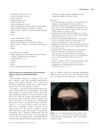
March 2014 in “International Journal of Dermatology”
10 citations
,
March 2014 in “International Journal of Dermatology” This report describes a case of postoperative pressure-induced alopecia in a 5-year-old girl following liver transplantation, suggesting that scalp dermatoscopy may help differentiate this condition from alopecia areata.
 9 citations
,
January 2017 in “Journal of the Egyptian Women's Dermatologic Society (Print)”
9 citations
,
January 2017 in “Journal of the Egyptian Women's Dermatologic Society (Print)” This article discusses the use of dermoscopy for diagnosing hair and scalp disorders in children and reports no new clinical results.
 9 citations
,
August 2013 in “Facial Plastic Surgery Clinics of North America”
9 citations
,
August 2013 in “Facial Plastic Surgery Clinics of North America” This article reviews nonscarring and scarring hair loss conditions that may mimic androgenetic alopecia, reporting no new clinical results and highlighting the need for accurate diagnosis in hair restoration surgery.
8 citations
,
February 2022 in “Dermatologic Therapy” This study found that both fractional CO2 laser and cryotherapy were effective and safe treatments for alopecia areata, with the CO2 laser showing somewhat better results.
 8 citations
,
November 2021 in “The Journal of Dermatology”
8 citations
,
November 2021 in “The Journal of Dermatology” This review addresses the complexities in trichoscopy terminology and proposes an updated diagnostic flowchart for hair diseases, but it reports no new clinical findings.
 8 citations
,
January 2020 in “International Journal of Trichology”
8 citations
,
January 2020 in “International Journal of Trichology” The authors concluded that trichoscopy is a valuable noninvasive tool for diagnosing and monitoring nonscarring alopecia, aiding in the identification of new hair signs in difficult cases.
8 citations
,
October 2014 in “The Journal of Dermatology” This paper reviews Satoyoshi syndrome and suggests diagnostic criteria to differentiate its subtypes, emphasizing the importance of testing alopecia areata patients for antinuclear antibodies, muscle spasms, and diarrhea.
7 citations
,
November 2022 in “Actas Dermo-Sifiliográficas” This study reviewed the usefulness of trichoscopy in diagnosing and monitoring alopecia areata, noting that the technique identifies specific hair features like yellow and black dots, which are linked to the disease's chronic nature and treatment response.